




Article
·
time
-min
read
·
May 14, 2020
The Dos and Don'ts of Client Reporting for High-Net-Worth Families
Shares practical dos and don’ts for producing effective high-net-worth client reports, from customization and automation to portal adoption and data clarity.

Chelsea Francis
·
Head of Strategy
Topics
Reporting
Categories
Family Office Reporting
Financial Reporting
How Family Offices and Financial Institutions Can Create Effective Financial Reporting for High-Net-Worth Families
As a financial caretaker for high-net-worth families and individuals, you face a lot of pressure to not only manage and preserve your clients’ wealth but also communicate and deliver on it at any given time.
With an abundance of tools and solutions available to help your team manage the workload, it’s easy to get pulled down the path of delivering too much of the wrong information that ultimately fails to engage your end-client. Avoiding this mistake is crucial.
After all, the purpose of client reporting is to translate complex investment data into clear, concise reporting that meets your clients at their level.
There’s a lot to consider to make client reporting effective, but a few of the most important questions to answer include:
- Who will be reading the reports? What level of reporting detail are they comfortable with?
- Is the reporting easy to consume? Does it meet their expectations?
- Are you including the right types of reporting? For instance, is the client interested in a monthly review of cash inflows and outflows or would they prefer to look at investment performance and exposure?
- Are you able to access all of the data you need to completely represent the client’s financial holdings? Are you able to easily slice and dice the data in a way that makes sense to the reader?
- Does the report layout help the reader visually move through the data? Do ancillary charts and graphs add value or are they a distraction?
- How will you get reporting to your end-client? Digitally? In person?
Below we’ve compiled a list of tips for reporting on high-net-worth wealth – a set of client reporting dos and don’ts – to help your family office or financial institution produce effective personal financial reporting.
The Dos and Don'ts of Client Reporting
DO: Ask family office staff and family members what financial reports they wish they had
In a world where financial reporting options are endless, how do you know what reports the client wants if you don’t ask? Invite them to share their opinion, learn their preferences and listen to their questions – at the end of the day, personal financial reports should represent the client’s complete net worth in a way that makes sense to them.
To start, meet with individual family members or households to get a better understanding of their financial knowledge and reporting expectations.
Questions you could consider asking your clients:
- How do you measure financial success?
- How do you want to categorize your holdings?
- How do you want to view investment performance? In a table or a graph?
- What level of detail do you like to see on your personal financial reports? Do you prefer to see a summary of your holdings or the underlying position detail?
- Are you interested in traditional financial statements like balance sheets, income statements and cash flow reports?
Similarly, be sure to meet with internal family office staff and advisors to define what operational reports can be produced to improve financial insight and decision-making.
DON’T: Implement a “one size fits all” reporting style
This suggestion is simple, but often overlooked – if your family office or financial institution is looking to stay competitive in a growing and evolving industry, forgo the cookie-cutter style reporting and focus on delivering reports that speak to each individual client’s needs, goals and preferences.
DO: Offer report flexibility and customization
Report customization is the obvious next step once you understand your end-clients’ reporting preferences.
That said, starting with a blank canvas can prove to be challenging. We recommend taking a controlled customization approach. For example, family office software can provide a library of accounting and investment reports, each with their own unique set of parameters. Using the parameters as guide posts, family office staff can run a single report in a variety of different ways to help them align reporting with each of their end-client’s unique expectations.
DON’T: Feel like you need to write your own reports
Although report writers allow you to create wholly unique reports, they can be cumbersome to use and often require a certain degree of technical skill. In lieu of a standalone report writer, look for a family office fintech solution that offers built-in reporting capabilities with plenty of room for customization.
By using a software solution with an integrated reporting engine, you can eliminate the need for in-house technical support and reduce the amount of time spent maintaining the reports.
DO: Seek ways to improve your family office reporting speed, efficiency and efficacy
“How can I speed up my family office reporting process?” is a question we hear regularly from family offices evaluating the reporting tools within the Archway PlatformSM.
One of the ways our family office clients accomplish this is by leveraging the automated report preparation and delivery tools within the Archway Platform. These built-in features eliminate manual data collection, report creation and delivery processes. Using these tools, family offices create a consistent, repeatable reporting process and provide a predictable reporting experience for their end-clients.
DON’T: Stick with your current family office reporting process for fear of change
We understand it can be difficult to shift away from your existing reporting processes – after all, they’re comfortable and familiar. But they can also be frustrating and, more consequently, time-consuming. If your family office has an aversion to change, consider a few “what if” scenarios.
What if I could aggregate data more efficiently and quickly? What if I could set up and schedule recurring report runs? What if I could save my report settings instead of recreating them every time I have to run a report?
Innovative technology for family offices is at your doorstep, it’s just a matter of embracing it.
DO: Implement a family office client portal
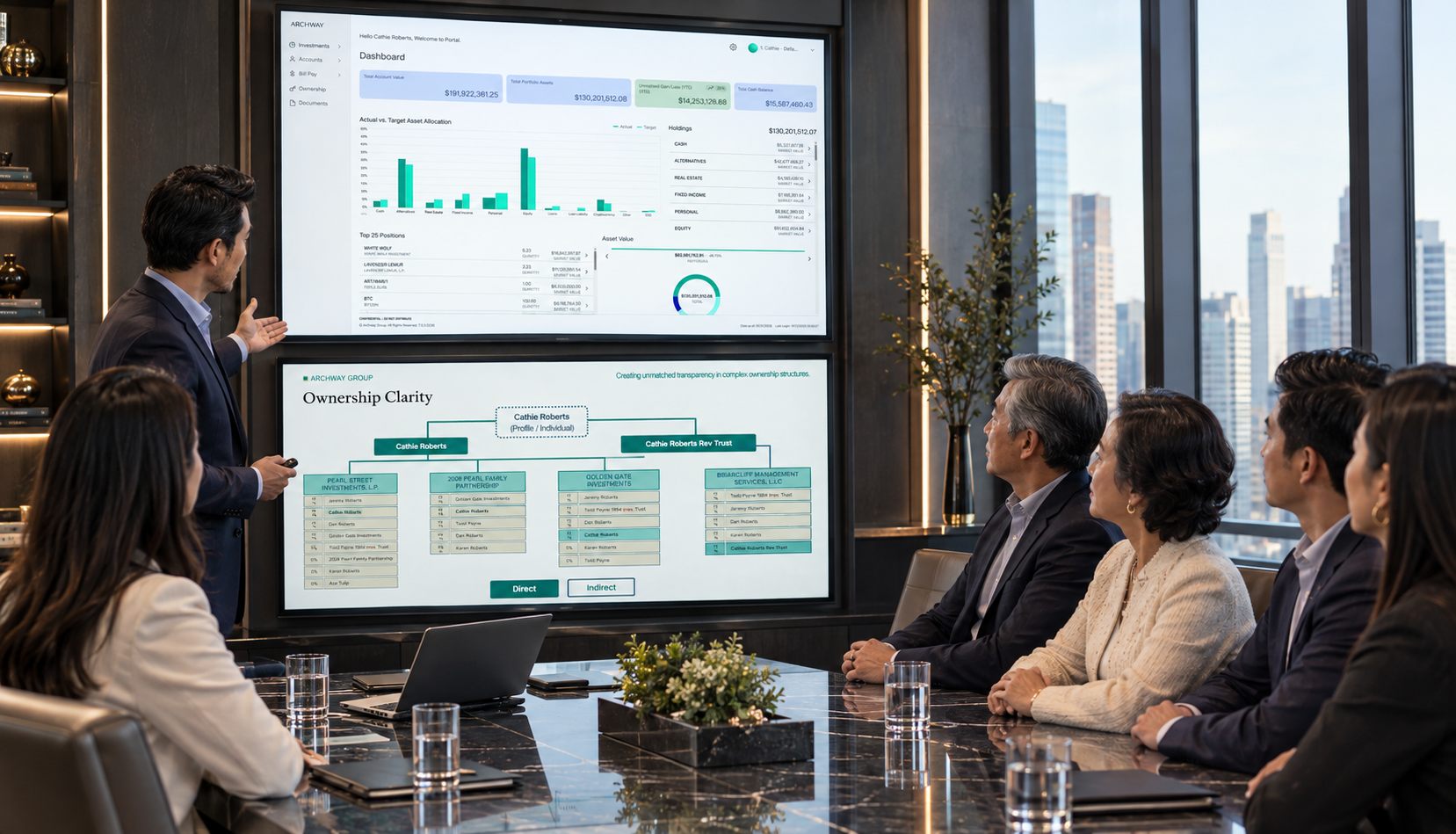
One of the biggest trends we’re seeing in family office fintech – and a key differentiator for private wealth firms – is the use of client portals. With benefits like on-demand access to personal financial reporting and availability from any location, it’s no surprise that client portals are at the top of the wish list for family offices and financial institutions.
By implementing a family office client portal, your end-clients have self-service access to their financial data via interactive dashboards and intuitive charts, graphs and tables. With clients viewing their aggregated financial information on their own schedule, you can reduce the amount of time you spend fielding questions and delivering reports.
DON’T: Assume that every family member will use modern reporting technology immediately
It’s likely that you’re producing reports for family members across several generations, each with their own level of comfort when it comes to technology. Knowing your audience – and respecting their technology preferences – is key to engaging your clients.
If you’re working with a tech-savvy family member, they’re likely already demanding digital access to their personal financial reporting. But if you’re working with a family member who is less interested in digital reporting, take your time warming them up to the technology by introducing it slowly and purposefully. It’s important to be patient and thorough in your training to help mitigate the risk of overwhelming your clients and potentially disenchanting them with the client portal altogether.
DO: Leverage automated reporting software and outsourced financial reporting services for help
In an age where everything and everyone moves at rapid speed, it’s essential that your family office moves at a similar pace.
Designed to adapt to your clients’ evolving interests and needs, family office reporting software offers purpose-built features and functionality like advanced data aggregation and reconciliation tools, user-defined classifications and groupings, integrated performance reporting and extensive report libraries.
Likewise, many firms employ teams of accounting and finance professionals that can operate the software on your behalf to ultimately deliver consolidated financial reporting to you and your end-clients.
Whether you’re looking to produce financial reporting in-house or leverage an outsourced service provider, a fintech solution designed specifically for family offices will help you deliver internal and end-client reporting with greater accuracy, speed and clarity.
DON’T: Rely on manual, time-consuming reporting processes
If your family office is still sifting through clunky spreadsheets and stacks of paper statements or manually maintaining classifications for grouping data, you could be saving time and closing the gap on human error.
Although familiar and easy to use, generic reporting solutions – including spreadsheets – are prone to error and aren’t intended to be a reporting tool for complex family offices. Adopting family office-specific reporting software can eliminate these antiquated means of reporting and provide system-wide functionality that is built for the management of complex wealth.
Ready to find out how you can take your personal financial reporting operations to the next level?
Learn how the Archway Platform can help your family office or financial institution handle complex reporting requirements and produce insightful, relevant reporting for your high-net-worth clients.
Related reading