

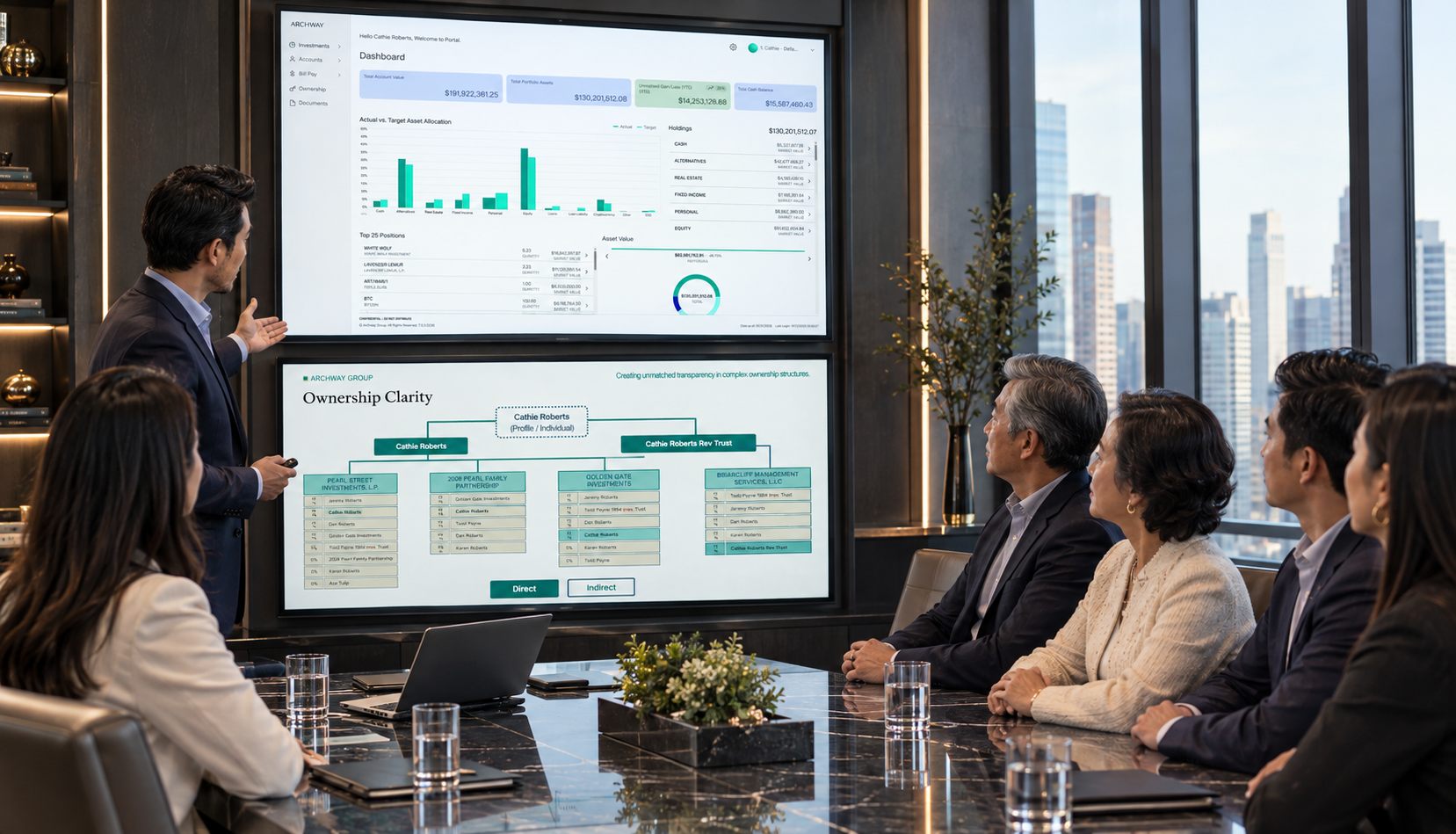



Consolidated Investment Reporting
Reporting that comes from accounting. Not reporting layered on top of it.
Most reporting platforms aggregate data, apply a reporting layer and deliver a polished view. The presentation is excellent. The reconciliation back to the source is a different question.
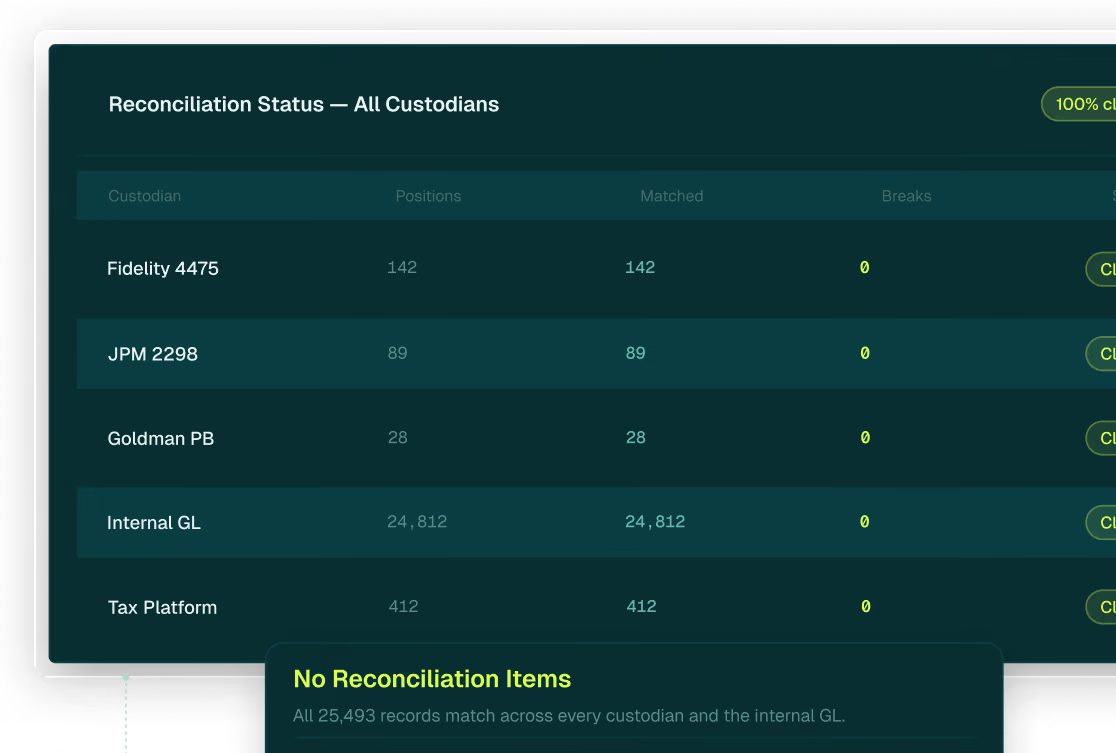
Archway's consolidated investment reporting comes from the same general ledger that closes the books. The investment book of record and the accounting book of record are the same ledger so every figure on every report traces to a specific journal entry. Performance, attribution, asset allocation, look-through entity reporting are all drawn from the same source. No reconciliation gap between the consolidated investment reporting and the accounting. No separate layer to maintain, break, or explain.

The problem we're solving
The reporting challenge isn't presentation. It's what happens when someone traces a number.
Most firms run two sets of reporting. The investment book tracks positions, performance, and attribution. The accounting book closes the financials and holds the audit trail. Both are necessary. The problem is they come from different systems never built to agree with each other perfectly.


The reconciliation runs every quarter. Sometimes it closes cleanly. Sometimes it doesn't, and when the principal questions a figure or the auditor traces a number back to source, the seam between the two books is where confidence breaks down.
Archway eliminates the problem at the architectural level. Not by improving the reconciliation process, by removing the need for one. The two books don't need to agree, because there is only one.
How it works
The investment reporting stack, without the reconciliation problem.
01・
Aggregation
Every position, every asset class, every source — posted to the general ledger.
Direct data feeds from major banks, prime brokers, clearing firms, and the sources your clients use. Managed assets, held-away positions, private investments and alternatives — every position posted as a journal entry to the same ledger. No intermediate data warehouse. No second source to reconcile against.
02・
Reconciliation
Reconciled into the book of record at source — not at the reporting layer.
Every position from every source reconciled directly into the general ledger. No separate reconciliation workflow between investment data and accounting records. The reconciliation step that runs every quarter on most platforms doesn't run here, because there's nothing to reconcile.
03・
Reporting
Every report drawn from the same ledger that closed the books.
Configurable report packages at the entity, household, family, principal or custom grouping level. Performance reporting across public and private markets. Look-through entity reporting without a separate consolidation step. Every figure on every report traceable to the journal entry that produced it.
04・
Independence
An independent view — not filtered by custody or management.
Archway sits outside the custody and management relationship. The consolidated view is independent by structure — not filtered by what a custodian wants to show or what a manager wants emphasized. Every report is the principal's complete picture, drawn from a source that has no incentive to present it any particular way.




Three ways to run reporting
The model changes who runs the reporting function. The general ledger doesn't change.
Every firm runs on the same platform, the same general ledger, the same book of record — regardless of how they choose to deploy. The three models reflect different operational arrangements, not different tiers of access. Every report is drawn from the same source in every model.
Technology
Your team runs reporting on the platform.
Your reporting team manages aggregation, reconciliation and report production through the Archway Platform — with full access to the general ledger and every capability the platform carries. Archway provides implementation, ongoing platform support and a dedicated client team. The work stays in-house. The infrastructure is ours.
Outsourced
Archway's team runs the reporting function. Your team retains full visibility.
Archway's reporting team runs aggregation, reconciliation, report production and distribution on the same platform your team logs into. You see everything in real time. The book of record is yours. The operational burden isn't.
Hybrid
Your team runs what makes sense to run in-house. Archway handles the rest.
Your reporting team runs the straightforward positions in-house — public markets, managed accounts, held positions with direct data feeds. Archway handles reconciliation of alternatives, held-away assets, complex private investment structures. Because both teams work on the same general ledger, the split doesn't create a reconciliation step between what your team produces and what Archway produces.
Who runs consolidated reporting on Archway
One general ledger. The integrity of the report doesn't change regardless of who's running it.
Single family offices, multi-family offices, private banks, and private fund managers all run consolidated investment reporting on the same platform — same general ledger, same book of record, same architecture underneath. How each segment delivers the report is specific to them.
Single Family Offices
Multi-Family Offices
Private Banks
Private Funds
For the household that needs the complete picture — every entity, every account, every position in one consolidated view.
Look-through reporting across trusts, LLCs, and family partnerships. Direct feeds from every custodian, bank and account the household uses. The principal sees the complete picture. The auditor sees the journal entries that produced every figure.

For the operating firm — every client family with their own report, all under your brand.
Operationally isolated client families on a single platform foundation. Reporting branded to your firm. Each family receives their complete consolidated view; your operations team runs it from one place.

For the institution — consolidated reporting beneath the wealth division's brand.
UHNW clients with assets across custodians, private investments, and held-away positions that sit outside the bank's own platform. Archway consolidates the complete picture — including what the bank doesn't manage — and delivers it under the institution's brand. The advisor sees everything the client holds. The client sees their complete wealth picture. The bank stays the relationship of record.

For the fund that needs every figure to trace back to the entry behind it.
Capital account statements, distribution notices, quarterly letters and portfolio reporting — every figure drawn from the general ledger that closed the books. The GP sees the complete picture. The investor sees their statement. The auditor sees the journal entries that produced every figure.


Clients stay for the team
"I can count on Archway for timely and accurate record keeping and reporting, enabling me to spend more of my time stewarding investment assets."
Private Investment Firm
·
Founding and Managing Member


FAQ's
The questions we hear most. Answered directly.
How does Archway's investment reporting differ from platforms that layer reporting on top of a third-party accounting product?
Archway’s consolidated investment reporting is supported by the same general ledger that closes the books. The investment book of record and accounting book of record are not maintained as separate systems. They are the same ledger viewed from different reporting and accounting perspectives. That gives teams a clear connection between what appears on the report and what is recorded in the books.
What asset classes and position types does the reporting cover?
Archway supports reporting across public equities, fixed income, cash via direct feeds, private equity, private credit, real (personal) assets, loans, liabilities, real estate, and co-investments via direct upload or manual entry. Alternatives are processed inside the platform, not in a separate module or external system.
How does look-through entity reporting work?
Look-through reporting starts with the entity structure. Ownership relationships between trusts, LLCs, partnerships, and other vehicles are mapped directly into the general ledger. Because the ownership hierarchy lives in the system rather than a separate model, the platform can trace economic exposure through direct and indirect holdings across the structure.
The result is a consolidated view at the entity, household, principal, or customized grouping level that reflects economic ownership, not just what is held at the top.
How does the platform handle alternative and private investment reporting?
Capital account statements, quarterly letters, K-1s, and partnership reports can be ingested directly into the Archway Platform rather than maintained in a separate system. These positions live in the same book as public markets positions, supporting a more complete consolidated view across traditional and alternative investments.
Who is responsible for reconciling the data from the various custodians, banks, and alternative fund managers?
Responsibility depends on the chosen operating model. When outsourced services are in scope, Archway’s team processes data feeds, reviews exceptions, and supports the reconciliation workflows required for periodic reporting. In technology or hybrid models, responsibilities are defined during scoping based on how your team wants to operate.
Can our team run the reporting function, or does Archway run it?
You have options. Your team can run the reporting function directly, Archway’s team can manage it through outsourced services, or the engagement can be structured as a hybrid model. All three models run on the same platform, general ledger, and book of record. The model changes who does the work. The data does not change.
How is pricing structured?
Archway's consolidated investment reporting fees are based on scope, including entities, portfolios, position count, report types, and service model. Pricing is not based on assets under management. Specific pricing is provided after an initial conversation and scoping process.
How is Archway different from reporting-only platforms?
Archway is differentiated by its ledger-based approach to investment reporting and accounting. Rather than treating investment reporting as a separate layer disconnected from the accounting record, Archway draws reporting from the same general ledger. For firms managing complex entities, private investments, held-away assets, and multi-level ownership structures, this creates a clearer connection between reporting, accounting, and operational oversight.
Start the conversation
Every reported number has a source. Let's talk about yours.
A short call with someone who has run the books at the level your operation runs at. If Archway is the right fit, we'll show you how. If we aren't, we'll say so.
Loading contact form…


Article
·
Single Family Offices
time
-min
read
A New Way to Synthesize, Visualize, and Analyze Family Office Data
With reporting at the center of nearly every family office software buying decision, the Archway Platform has offered a robust suite of reporting tools since its earliest days.
Launching with a raw database export capability, a handful of in-app performance visualizations, and roughly two dozen statement-style reports, the Archway Platform’s reporting foundation was set out of the gates.
Within the first five years of being on the market, the solution’s feature set quickly grew to include over 40 distinct reporting options.
By 2009, the Archway Platform featured more than 90 reports within its standard report library and users were first introduced to the concept of dynamic dashboards for quick, on-screen consumption of data. In 2012, the platform’s first standalone client portal application, dubbed FOIL, was released.
Over the course of the next decade, the standard report library ballooned to more than 200 parameter-driven reports, thousands of queries were built, dozens of dashboard inserts were rolled out, data grid customization was implemented throughout the application, and the Archway Client Portal was further enhanced to be an on-demand, mobile reporting tool for end-clients and family members.
Together, the Archway Platform’s standard report library, data queries, dashboards, custom data grids, and client portal served as a powerful, multi-faceted reporting engine.
But with an eye towards innovation, it was always clear that reporting is a function of our solution that can constantly be built upon: More metrics, more insights, more flexibility.
And so, in 2023, we introduced the Archway Platform’s report composer tool.
A unique, interactive reporting experience, the report composer functionality allows family offices to comprehensively analyze their enterprise data in a user-driven, self-service manner. Both elegant and powerful, the latest tool in the Archway Platform’s reporting suite grants nontechnical users the ability to create bespoke data views that deliver better insights and better reporting outputs for their needs.
Pulling from the Archway Platform’s vast database, family offices can assemble custom reports using raw data related to accounts payable, general ledger detail, investor activity, transactions, open positions, alternative assets, and other financial information.
But perhaps most important: The tool is inherently designed with versatility in mind. Featuring a drag-and-drop interface that enables users to build and edit custom reports in real-time, the report composer allows users to add, remove, and reorder data points—all without coding or custom development. And since the tool is embedded directly within the Archway Platform, users can dynamically group, sort, and filter their data based on their existing user-defined data classifications.
Using visualizations and charting tools like pie, bar, and line charts, users can further transform their data into meaningful analytics that help tell a story of trends, comparisons, and measurements.
Although a sophisticated reporting tool by nature, the Archway Platform’s report composer capability offers family offices yet another reporting mechanism built on the principle of simplexity: A simple interface that allows users to access and synthesize complex financial data on demand.
The report composer tool serves an important role in how family offices and advisors to high-net-worth families compile, communicate, and analyze their clients’ financial information, and seamlessly complements the existing suite of Archway Platform reporting capabilities.
Interested in seeing the report composer in action? Request a call with a member of the Archway Family Office Services team to schedule your live tour of the Archway Platform.

Article
·
Single Family Offices
time
-min
read
How Family Offices Use the Archway Platform℠ to Create Bespoke Client Reports
Every family office professional understands the necessity of balance sheets and income statements: They serve a fundamental purpose in understanding an individual’s financial position. And, fortunately, there are many family office software and service providers that can produce them.
But conventional financial statements rarely provide the level of insight needed to fully satisfy bespoke client requests.
As you’ve likely encountered, assembling non-traditional reports often requires unique attributes or classifications, custom data groupings, and client-specific data points. Moreover, if the request involves uncommon assets or personalized investment frameworks, compiling the data can require a heavy lift.
In our 20+ years working with family offices and advisors to high-net-worth families, we’ve received plenty of unique reporting requests, and we know how important it is to present complex—sometimes irregular—investment data in a simple, yet meaningful report.
Combining the robustness of the Archway Platform’s reporting engine with the flexibility of its user-defined data attributes and classifications, we’ve had the opportunity to help our clients harness the power of the platform to craft creative, tailored reporting outputs for their end-clients.
Whether you’re interested in building a report that compares household expenses across multiple properties, analyzes clean energy investments, or summarizes artwork valuations, the Archway Platform’s 200+ standard reports and multi-pronged reporting capabilities can help you quickly produce an easy-to-consume report.
Here are five unique reports, built using the Archway Platform, that break the boundaries of traditional family office reporting and deliver creative, tailored financial insights.
Inspiration #1. Paintings by historical era.
While it’s well known that artwork is a commonly held asset amongst family offices, the asset type tends to lack influence and inclusion in the development of family office technology and reporting standards. But given its prominence in high-net-worth investment portfolios, artwork—like any other asset—deserves specialized reporting.
Using the Archway Platform’s flexible, parameter-driven reporting templates, users can customize the view to see purchase price, change in market value, and unrealized gains / losses across the owner’s fine art collection. Perhaps more importantly, they can create custom attributes such as artist, historical era, region of origin, or art consultant—ultimately, allowing family offices to create a wholly unique way to consume artwork-related financial insights.
Inspiration #2. Profit comparison by horse.
Perhaps not as widely held as fine art, thoroughbred racing talent still requires an impressive amount of asset management. Leveraging the Archway Platform’s ability to create a fully customized general ledger, family offices can categorize and group expenses, measure their costs against equestrian-generated income, and compare profits across horses with simplicity and ease.
Inspiration #3. Primary residence expenses.
When you operate multiple households or properties, it can be difficult to compile the various expenses associated with each location. Spanning across utility and tax bills to insurance, property upkeep, and household staff payroll costs, it’s critical to know how much money is being spent on each property.
Using custom general ledger accounts and flexible reporting templates, family offices can succinctly compare property ownership costs across multi-level, user-defined expense categories.
Inspiration #4. Rental property income.
Like personal properties, many family offices hold a variety of rental properties. As a result, from time to time, you may be asked how much rental income is being generated—and which property is earning the most.
Using a combination of customized general ledger accounts and property-based portfolios, the Archway Platform’s reporting suite allows users to quickly produce a consolidated net income report that displays revenue and general operating expenses by individual rental property.
Inspiration #5. Impact report.
New investment frameworks—whether generally accepted or internally developed—are routinely popping up in the family office arena. Having the flexibility to infinitely tag assets with unique attributes gives family office professionals the opportunity to slice-and-dice data in line with the overarching investment strategy.
Using the Archway Platform’s multi-level grouping mechanisms, you can take multiple frameworks, such as foreign investment allocation laid over the United Nations’ Sustainable Development Goals, to present a unique view of investment impact across regions, areas of development, and environmental, social, and governance initiatives.
To learn more about how the Archway Platform’s powerful reporting engine can help your family office deliver tailored financial insights, check out a demo or schedule a call with a member of the Archway Family Office Services team.

Article
·
Single Family Offices
time
-min
read
What to Look for When Selecting Client Portal Technology for Your Family Office
Client portals have taken many shapes throughout the years. With nearly every modern financial institution offering clients some form of digital access to their financial information, online portal technology is a far cry from its infancy.
The same can be said for family office client portals.
To paint the picture, let's take a look at the evolution of the Archway PlatformSM and its portal technology.
Originally introduced in the early 2000s, our initial portal concept was referred to simply as Investor Login. Limited to a handful of configuration options, the Archway Platform's Investor Login served as an online access point for individual users to view performance returns, capital activity, fees, and a select number of reports.
Since those early days, we have rolled out several iterations of the portal using a combination of client requests, internal feedback, and a healthy dose of innovative thinking.
Which brings us to today, where the Archway Client Portal gives end-clients on-demand access to an interactive, mobile financial reporting tool.
Based on our experience developing and enhancing our own family office software and client portal, here are several key financial insights you should consider looking for when selecting client portal technology for your family office or financial institution.
1. Consolidated net worth
This seemingly simple request can actually be one of the most difficult to questions to answer, especially when it comes to high-net-worth (HNW) individuals.
Your family office’s client portal should be able to—at a minimum—tell your end-client exactly how much they are worth, inclusive of cash, investments, property, and indirect exposure to additional holdings, at the click of a button.
We recommend looking for family office portal technology that can:
- Consolidate net worth across entities, portfolios, and assets
- Compute net worth based on direct and indirect holdings
- Show net worth changes over time based on investment performance, purchases, sales, contributions, withdrawals, accruals, and other types of activity
2. Aggregated holdings
Having the means to answer the question “How much am I worth?” is powerful, but being able to show the assets that make up your client’s net worth can have an even greater appeal.
A standard family office client portal should allow your end-clients to view individual holdings. An elite family office client portal should allow your end-clients to consolidate, group, filter, and categorize their holdings in ways that are meaningful to their understanding.
We recommend looking for family office portal technology that can:
- Aggregate holdings data across all types of assets such as equities, bonds, cash, real estate, personal assets, and alternative investments like private equity, hedge funds, and cryptocurrency
- Assess changes in market values over time
- Maintain user-defined asset categories or groupings
3. Investment performance
Being able to analyze investment performance falls into family office reporting 101—and serves as a key capability of any financial reporting tool. But to really hit the mark, a family office client portal should feature the ability to attribute performance to factors like asset type, portfolio manager, strategy, or region.
We recommend looking for family office portal technology that can:
- Render performance data in both graphic and tabular formats
- Compare performance against benchmarks
- Measure performance over time, across multiple periods
- Use multiple performance calculations such as time-weighted and money-weighted returns
4. Cash balances
Understanding how much cash is available at any point in time is vital to a client’s financial health, particularly amongst individuals that have high transaction volumes or large purchase amounts.
Even for clients whose bills are paid by family office staff or an outsourced bill payment service, it’s always helpful to know how much money is available for day-to-day expenses.
We recommend looking for family office portal technology that can:
- Pull in daily cash activity from banks, custodians, and brokerage firms
- Provide on-demand cash balances as of a point in time
- Display cash flows and changes in cash balances over time
5. Expense and spending detail
Speaking of expenses, it can be easy for a family office or HNW advisor to focus their client portal search on tools that primarily show investment-related detail. But there can be tremendous value in being able to share accounting and investment data within a single portal.
By selecting a tool that can summarize expenses, identify spending habits, and even compare outflow detail against budgets and cash inflows, end-clients are able to be more in control of their recurring cash flow.
We recommend looking for family office portal technology that can:
- Categorize expenses based on user-defined expense categories
- Display summary-level expense data as well as underlying detail such as vendors, payment terms, and invoices
Beyond financial analytics and insights, we recommend assessing for other features as well, including things like bill payment approval functionality, document management, and customizable reporting dashboards.
To find tips, tricks, and best practices for adopting a client portal in your family office, check out Best Practices to Transition Your Family Office into the Age of Digital Reporting.
A family office client portal featuring valuable financial insights can introduce a new approach to traditional family office reporting.
Better yet, when offered as an interactive, user-controlled reporting experience, family offices can engage end-clients in ways that far surpass anything paper reports provide to create contemporary, meaningful connections with current and future wealth owners.
But if you’re still debating the merits of a client portal for your family office, start by checking out the Archway Client Portal’s flexible reporting dashboards, comprehensive financial insights, and easy-to-use tools. Operating as a seamless extension of the Archway Platform, our client portal can serve as the link you need between your family office staff and the family members they serve.

Article
·
Multi-Family Offices
time
-min
read
How Operational Survival Tactics Will Translate In Newly Redefined Work Environments
In the first quarter of 2020, the world saw seismic shifts in the way businesses operated. Employees left their offices, receding into their private residences where the only means of connection was via email, video, phone or online chat.
Without a centralized office, there weren’t any drop-ins or quick sign-offs. Swivel chair processes as we knew them ceased to exist. And, in the thick of it—across geographies, industries and markets—we saw entire operations upended and antiquated workflows grind to a halt.
Much like the rest of the world, many family offices and financial institutions serving wealthy families scrambled to create continuity in the absence of the in-person processes they relied on to serve their clients.
And then we saw something extraordinary.
Wealth management firms became scrappy. Determined to make it to the other side, they mended broken processes with new technology and they invested in teams of people that provided scalability and extensibility in a totally digital world.
Now, as businesses begin to reopen, doors are unlocked and lights begin to flicker back on, the question has become: what will remain? What pieces of remote work will stick as employees find themselves back inside of the physical family office?
Based on our experience working with hundreds of wealth management organizations, here are four pandemic-fueled trends we believe will continue to be front and center for family offices and financial institutions as they balance managing a decentralized staff with providing meaningful client interactions across in-person, remote and hybrid work environments.
Technology Investment
According to Family Office Exchange’s 2021 State of the Ultra-Wealth Business report, an overwhelming percentage of family offices invested in new technology during the pandemic.
Ranging from integrated family office software solutions like the Archway Platform℠ to best of breed and purpose-built solutions like Canoe’s AI-based data extraction technology for alternative assets, family offices are ditching spreadsheets and industry-agnostic data management tools in pursuit of technology designed specifically for private wealth management firms.
Why It Sticks:
We are in the throes of a technological revolution. And while COVID-19 may have throttled the adoption of technology forward amongst wealth managers, we have seen new technology entering into our personal and work peripherals for several years now. Disrupting the status quo and ushering the wealth management industry into a new era of digital engagement, technology is—and has been—changing the way we manage, interact with and exchange wealth information.
As the next generation of wealth owners takes asset control, there will be a greater demand for modernization of all kinds. From tools that facilitate digital touchpoints with wealth managers to technology that offers a better way to track and report on future-facing asset classes like cryptocurrencies, NFTs, SPACs and other types of alternative assets, wealth managers should be prepared for rapid changes in technology expectations amongst younger clients.
At Archway Family Office Services, we believe that family offices and wealth management firms that choose to embrace the abundance of technology at their disposal in pursuit of innovative client experiences will be better able to attract, engage and retain clients moving forward.
Digitization of Routine Processes
It goes without saying that the global COVID-19 pandemic—and the transition from office parks to home offices—exposed critical holes in the operational processes of many family offices and other wealth management firms. Traditionally beset with manual touchpoints and face-to-face interactions, processes like bill payment and client reporting were at risk of failure when social distancing became the norm.
But over the course of roughly 16 months, these organizations were pushed to review their operating procedures. As they identified areas of inefficiency, they were able to utilize new and existing technology solutions to help them remotely complete these historically manual tasks.
Why It Sticks:
Between Q1 2020 and Q2 2021, Archway Family Office Services saw a drastic increase in the number of report packages automatically generated using the Archway Platform’s reporting tools. In June 2021, numbers continued to surge, with over 14,000 unique report sets created in a single month.
Using the platform's tools, clients can virtually collaborate on client reporting by sharing report packages across groups of approved users. The added efficiency of pre-configured, pre-scheduled reporting coupled with the ability to work together regardless of physical location has our clients well positioned to run a largely automated reporting process.
As some employees head back to the office and others continue to work from home, a digitized reporting process helps wealth management organizations effortlessly deliver timely, accurate client reporting.
And reporting isn’t the only process worth automating. Family offices are actively implementing automation when it comes to workflow processes, bill payment approvals, cash movements and financial data collection.
Digital Client Reporting Enablement
Twenty years ago, reporting was a one-dimensional output. Family offices would create basic financial reports using spreadsheets and PowerPoint presentations based on hand-consolidated data from accounting files, custodial statements and bank account summaries.
As time went on, technology companies found ways to pipe data between fintech systems, banks, custodians and asset managers. But reporting remained largely unaffected. PDF and Excel-based reports continued to be the predominant reporting mechanism despite the advancement in technology.
Then, COVID-19 hit. For 12+ months, we were asked to stay home. To avoid close contact with our family, friends and neighbors—and our clients. As in-person meetings fell off of calendars, family offices and financial institutions sought out other means of distributing client reports.
So, rather than sitting down at a desk to discuss quarterly or annual report findings, family offices took to digital tools to share financial insights with their clients.
Why It Sticks:
Tools like the Archway Client Portal became high in demand in as wealth management professionals sought out new ways to connect with their clients. While some family offices opted to only leverage the technology’s document sharing capabilities as a short-term holdover until in-person meetings could resume, others elected to share the technology with their clients in full.
With a bit of configuration and a touch of client service wizardry, family members gained on-demand, secure access to a brand new selection of interactive charts, graphs and tables. They were able to customize their portfolio views using self-defined sorting and grouping options.
And directly from their phones and tablets, they were able to dive deeper into their financial insights—from aggregated holdings, expense summaries, cash balances and net worth calculations to performance, risk and model-to-actual reporting.
Much like Pandora’s Box, once a client portal—and all of its bells and whistles—is open, there’s no dialing it back.
Family Office Outsourcing
Over-extended networks. Natural disasters. Power outages. Illness. Turnover.
Financial services firms across the globe have felt the fallout of the COVID-19 pandemic. Lessons have been learned—and continue to be learned—as we navigate our way back to the office. But amidst it all, one recurring theme has emerged: everyone needs a contingency plan.
In the family office world, that plan has been a resounding need for expanded service relationships, specifically through outsourcing. Necessitated by emergency situations, loss of employees pursuing new opportunities and a desire for continuity, family offices and financial institutions are eager to partner with versatile, client-centric firms.
Why It Sticks:
Life happens. And while we all collectively hope to put COVID-19 behind us, there will most certainly be another scenario that will have us dusting off our business continuity plans. Whether it’s the retirement of your family office controller, the departure of an investment reporting analyst or just a jammed MICR printer that puts you on your heels, it’s imperative to have a solution at the ready.
With more than 50 years of experience partnering with wealth management firms, Archway has had the unique opportunity to curate a powerful combination of technology, process and, most importantly, people—all of which is designed to be tailored to your firm’s specific needs so that you can operate under the most stringent circumstances and continue delivering a seamless, dependable client experience.
If you are interested in discussing how our award-winning technology and outsourced services can help you enhance and fortify your family office operations, schedule a call with a member of the Archway Family Office Services team.
Together, we can identify ways that we can help you:
- Upgrade your family office technology stack and enhance the speed and efficiency of your wealth management operations
- Centralize and automate your core accounting, investment data aggregation and reporting processes
- Introduce an engaging client experience using enriched financial insights and tech-forward digital reporting tools
- Reduce the key-man risk by partnering with a trusted team of accounting and operations professionals to perform certain tasks or functions in conjunction with—or on behalf of—your own family office team

Article
·
Single Family Offices
time
-min
read
A Short Checklist to Help Family Offices Identify Alternative Investment Reporting Inefficiencies
Over the past decade, alternative assets have become a mainstay in the portfolios of high-net-worth (HNW) families. According to the 2020 UBS Global Family Office Report, alternative assets—which include private equity, hedge funds and real estate—make up 35% of family office portfolios.
While these investments represent a significant portion of HNW assets, they’re seldom easy to track and report on as a component of the family’s larger wealth picture. Unlike traditional investments like equities and fixed income, alternatives lack concrete public reporting requirements. As a result, investors are dependent on third-party managers to receive timely, accurate data regarding their investments.
Over time, it seems that this dependency has morphed into complacency, where delayed access to alternative asset data is an expectation and manual transcription of hard-copy documents into digital formats is a given. The reality is that the process of tracking and reporting on alternative investments has remained steadily challenging.
But as new solutions emerge and the integration between family office software platforms grows stronger, the boundaries of efficiency are being redrawn.
Still, it can be difficult to pinpoint inefficiencies within a process that has remained largely unaffected for the past decade—and not for lack of want, but for lack of available solutions.
To help family offices identify inefficient processes and manual tasks ripe for automation, Archway Family Office Services partnered with Canoe Intelligence to put together an evaluation checklist featuring questions focused on five key areas of the alternative investment reporting process.
Five Core Family Office Reporting Operations for Alternative Assets:
- Document collection
- Data access
- Data transfer and delivery
- Report creation
- Report analysis
Post-evaluation, if you’ve found that your family office—like many others—is expending too much time and too many resources manually collecting, normalizing, consolidating and reporting on its alternative assets, it may be time to consider a purpose-built technology solution.
This is where Archway Family Office Services and our friends at Canoe can help.
Using modern, automated tools like Canoe Intelligence and the Archway Platform, family offices can relieve bottlenecks and bridge gaps commonly associated with aggregating and reporting on alternative assets.
Designed to be tightly integrated, Canoe’s automated approach to digitizing printed copies of alternative investment documents helps family office professionals streamline extraction, validation and delivery of alternative asset data into the Archway Platform.
By leveraging the two systems together, users can eliminate manual data entry and automatically incorporate alternative asset data into the Archway Platform’s specialized suite of family office reporting.
Interested in diving into the benefits of Archway’s strategic partnership with Canoe?
Schedule a call with a member of the Archway Family Office Services team to learn more about how the integration between the Archway Platform and Canoe can help your family office streamline its alternative investment reporting process.

Article
·
Single Family Offices
time
-min
read
A List of Five Client Portal Benefits for Family Offices
From a fintech perspective, a client portal is a digital tool used to present an individual’s total net worth and overall financial position.
More often than not, client portals are accessible as a standalone website or mobile app that provides an on-demand snapshot of an individual’s holdings. Most client portals use a combination of reporting elements like tables, graphs and supplemental documents to present the information in an easy-to-consume fashion.
Depending on the power of the underlying family office software and the completeness of the data, client portals can include simple data points like total account value, asset allocation and account value history, as well as more complex analytics like performance, risk and nested – or multi-layered – ownership values.
Although client portals tend to be more widely embraced by family offices working with Gen X and Millennials given their always-on, at-your-fingertips nature, they can also be beneficial for family offices serving older generations.
This has become increasingly evident given the widespread adoption of remote work environments in 2020, particularly as family offices are seeking to digitize specific processes like bill payment approvals and recurring report delivery.
In this new paradigm where physical distance is being supplemented by digital technologies, client portals are becoming an invaluable asset in the client service toolkit.
So what are the core benefits of using a client portal in your family office? Here’s our shortlist:
1. Customized Client Experience
A well-designed client portal will offer family offices the ability to deliver a personalized client experience for each family member using configurable dashboards, custom data groupings and optional functionality.
2. Frictionless Client Engagement
Allow family members to seamlessly participate in family office operations like bill payment approvals using an intuitive, elegant solution designed specifically with the end-client in mind.
3. Secure Data Sharing
Client portals use encrypted data and multi-level security protocols to reduce the risk associated with sharing highly-sensitive financial information between family office staff and end-clients.
4. Self-Service Access
Clients can access financial reporting and investment insights on-demand without requiring a phone call or email exchange with your family office team.
5. Digital Document Storage
In addition to on-screen reporting, many client portals feature document repositories where you can easily share monthly or quarterly reporting as well as other third-party documents.
In short, client portals help alleviate manual touchpoints and simplify how family offices communicate financial information to their end-clients.
Ready to explore a client portal for your family office? Check out the Archway Client Portal to discover how the Archway Platform and its digital reporting tools can help your family office modernize its financial reporting operations and deliver an engaging, interactive reporting experience to your end-clients.
Article
·
Private Banks
time
-min
read
Tools That Can Help You Create Consolidated Financial Reports for Your High-Net-Worth Clients
Wealth management professionals are hungry for a more efficient way to run financial reports.
A way that helps them control the narrative of their client’s financial story using reports that are unique, but intertwined. A way that lets them co-mingle accounting and investment detail, without pulling data from multiple systems. A way that minimizes the reliance on a single individual to prepare spreadsheet-based reporting, and opens the door to collaboration. A way that reduces manual touchpoints, which ultimately reduces errors.
That said, there’s a lot of information out there when it comes to client reporting for high-net-worth families and individuals. What types of reports to provide, client reporting best practices, even client reporting examples.
But the real question is how. How do you create recurring client reports in a way that doesn’t involve spreadsheets, institutional knowledge and dependency on manual processes?
Having spent time on the Archway Family Office Services Client Relations team and, more recently, as a Relationship Manager and de facto client training guru, I’ve done my fair share of reporting consultations and implementations for our family office clients. With those experiences top of mind, here’s a list of tools that exist within the Archway Platform that can help you automate your client reporting process.
Tools to Help You Automate Your Family Office Reporting
- Report Library
- Report Packaging and Branding Tool
- Report Scheduling Tool
- Report Delivery Tool
1. Report Library
If you work for or advise a wealthy family, chances are you know the pain of stitching together reports from multiple systems. A balance sheet from the accounting system, a performance report or two from the portfolio management tool, a private equity overview that you built in Excel and a collection of statements downloaded from various custodians and investment managers.
There’s no flow. Each report is formatted different than the next. The naming conventions and asset categories vary from source to source. And you’re tasked with compiling all of it together into some semblance of a cohesive report package every quarter.
Here’s the catch: your job doesn’t have to be this hard.
Archway’s family office software solution is built to provide a seamless reporting experience for your end-clients and internal stakeholders.
But to do that, we have to start with the database. Enter the Archway Platform’s core general ledger.
It’s important because this means that as the platform is receiving nightly financial data – think investment buy/sell activity, account balances and dividend/interest payments – from external data sources, the system is normalizing the data and automatically booking the journal entries to the general ledger.
Now extrapolate that out to the other wealth operations your firm performs: bill payment, invoicing, cash management, transferring and gifting of assets, trust accounting and other business functions. As each of these tasks is being performed, the system is filing away the accounting records for reporting purposes.
So, when it comes time to configure a report package, whether it be for an individual, a household or an internal employee, you’re able to leverage that complete set of accounting and investment data. This gives you the opportunity to build custom report packages that can span from traditional financials like balance sheets and income statements to allocation and exposure reports, performance analyses, alternative investment summaries, holdings snapshots and other financial reports.
And while the Archway Platform’s report library offers hundreds of reporting options, we also give you the ability to include third-party documents like market research, commentary and disclosure statements – all of which can be cleanly packaged together alongside system-generated reports.
2. Report Packaging and Branding Tool
To really automate the report preparation process, you need a report packaging tool, which is to say a tool that lets you pre-configure a collection of reports, divide them into user-defined sections, put them into a specific order, apply your own branding and then save all of these selections to use on a recurring basis.
In the Archway Platform, you can set up as many report packages as needed.
As an example, you could create a unique set of financial reports for each generation:
- Gen 1 – A report package for the family office principal that provides a holistic view of the family’s finances and delivers insights into investment strategies, manager performance and net worth
- Gen 2 – A report package that is distributed to his children representing their pro-rata share of the family’s assets alongside their personal household expenses and portfolio performance
- Gen 3 – A report package that is distributed to his grandchildren representing their trusts and personal assets
As an extension of these packages, we oftentimes see clients create a “client-facing version” and an “internal QA version.” This allows family offices to create a polished, professional report package for the end-client and a detailed, line-by-line report package for their internal reporting analysts. In turn, the family office can make sure that the visual, client-friendly reports are an accurate representation of the underlying detail.
Plus, by housing your report operations inside of a centralized tool, you minimize the impact of employee turnover and loss of institutional knowledge. If someone takes a leave of absence or departs entirely, you can still access the report packages within the Archway Platform, which means your quarterly reporting can continue to roll out uninterrupted.
3. Report Scheduling Tool
If you have access to an extensive library of reports and you’ve gone through the process of creating pre-defined report packages, you certainly don’t want to have to manually kick off each report package when quarter-end rolls around.
The Archway Platform’s report scheduling tool eliminates those extra clicks, thus creating more efficiency for you and your team. Specifically, the tool can be used to create recurring report schedules based on dates and rolling calendar periods.
As a result, you can produce multiple report packages at a frequency of your choosing through a one-time setup.
4. Report Delivery Tool
The obvious benefit of a report delivery tool is that it electronically sends the reports for you.
The less obvious benefit is that report delivery tools aren’t limited to the physical distribution of reports. In fact, report delivery can be broadened to include digital reporting tools and online document portals.
The Archway Client Portal can be used for all of the above. Whether you’re simply seeking a secure way to share reporting documents or an interactive reporting experience, the Archway Client Portal can be tailored to meet the needs of your firm and your clients.
Additionally, the Archway Platform’s report delivery tool can help automate the report review process.
Using integrated workflow capabilities, the Archway Platform can be configured such that once reporting has been run and passed through a preliminary review, a notification can be sent via text or email to a designated user for final approval. Once approved, reports can be made available to clients in the client portal or sent electronically.
It’s also worth noting that the same report delivery tool can be used to deliver operational reports directly to an internal server so that extended teams within your organization can access system-generated files and reports.
For example, if your family office oversees multiple households, each with their own executive assistant that is responsible for managing their respective household’s budget, you could set up a budgeting report to populate out into a shared folder.
In making the report available via an internal server, you don’t necessarily need to give ancillary employees access to the Archway Platform, but you can still enable them to leverage the data, make changes and resubmit to an authorized system user for upload back into the system.
The benefits of report automation aren’t limited to client reporting.
Using the same tools that automate the client reporting process, you can also automate internal management reporting on a daily, weekly or monthly schedule. Here are a few examples of what that might look like:
- Daily Reporting: This can be as simple as cash balance and cash activity queries delivered into your team’s inboxes each morning that depict the prior day’s inflows and outflows.
- Weekly Reporting: This frequency of reporting tends to include more traditional management-style reports, like reconciliation audit reports that help you confirm reconciliation tasks have been completed or AP/AR reports that help you quickly identify what bills or invoices are outstanding.
- Monthly Reporting: On a monthly basis, many clients leverage the Archway Platform’s automated reporting tools to proactively identify latent prices and performance outliers to isolate and address any errors prior to the end of the quarter.
If you’re interested in learning more about the Archway Platform’s reporting automation tools, schedule a call with a member of our team or take a tour of the Archway Platform.
Article
·
Single Family Offices
time
-min
read
How 3 Family Offices Used the Archway Platform’s Parameter-Driven Reporting Suite to Create Custom Client Report Packages
As we head into the New Year, many of us are deep into 2021 planning. And as we plan for our future, it’s traditional to reflect on which processes have worked well throughout the past year and which ones could use some refining.
Throughout our long history working with family offices and financial institutions, we often see our clients use the start of a new year as a time to reevaluate their accounting and investment reporting functions, including how they can leverage the Archway PlatformSM to better perform these functions in the coming year. We’ve found that our clients tend to focus on details like:
- Reporting Content: Are we providing each family member with financial reports that are meaningful and relevant? Are there new reports that we could introduce to the family? Is there a report that needs to be fine-tuned for better comprehension?
- Data Classifications: Do investment groupings need to be updated to reflect newly acquired asset types? Is there a better, or more appropriate, classification structure for family investments? Are certain individuals interested in customizing the way their financial data is grouped on their reporting?
- Report Delivery: Does the existing report delivery method still make sense? Is the family interested in adopting digital reporting?
- Reporting Operations: Could we be automating manual processes using advanced technology, like the Archway Platform’s report preparation and scheduling tools?
Whether it’s a small tweak to legacy reports or a complete client reporting overhaul, Archway’s family office software helps our users continuously improve their client reporting experience. Using a controlled customization approach, our report library features 200+ parameter-driven reports that range from traditional financial statements to performance, allocation, exposure, risk and activity reporting.
In lieu of starting with a blank canvas, each report includes a list of pre-defined options that allow users to tailor reports in a manageable fashion. Among the hundreds of configuration options across the reporting suite, users can customize reports with user-defined data groupings, adjustable date ranges, performance and fee calculation options and flexible report layouts.
Fun Fact
A single report within the Archway Platform can be rendered hundreds of different ways depending on each user’s unique parameter selections.
So if your family office or financial institution is thinking about making some changes to its client reporting going into 2021 — whether it’s what information you’re presenting or the way you’re presenting it — here are a few ways our clients have found success using the Archway Platform to support their reporting processes.
MINI CASE STUDY #1
Creating a Consistent Reporting Experience Across Households
OVERVIEW
A family office had been using the Archway Platform for two years when they decided to enhance their client reporting. Prior to implementing the platform, the family office staff primarily used a compilation of spreadsheets to produce reports for 20+ family members, but struggled to maintain the custom requests and level of detail necessary to satisfy each individual.
The Vice President of Investments engaged Archway Family Office Services’ Client Services team to design a report package that could be produced for each individual family member with the click of a button.
OBJECTIVE
At a high level, the family was interested in three key financial insights: holdings, investment allocation and performance. The family was indifferent to position-level detail and preferred to view their financial reports summarized by asset category, portfolio and manager. Additionally, the family office wished to create unique report naming and asset category nomenclatures that would resonate with the family members.
Ideally, the report package would be versatile enough to satisfy each family member’s distinct expectations while ensuring a consistent, repeatable reporting experience across households.
RESULT
Using the Archway Platform’s report building tools, the Client Services team and the VP of Investments worked together to create a standard report package for the family. After consulting with Archway’s reporting experts, it was ultimately decided that the package would include nine (9) unique reports depicting:
- Summary asset allocation, period activity and change in account value
- Portfolio-level holdings grouped by custom asset categories
- Manager-level investment details compared to benchmarks
- Historical holdings over time
- Investment allocation comparisons across distinct time periods
- Current against target allocations
- Trailing investment performance summary
- Detailed manager performance
- Alternative investment overview including capital activity, market values and performance returns (MOIC and XIRR)
Using the Archway Platform’s report preparation tool, the family office staff completed a one-time configuration for each of the reports and compiled them into an organized report package including custom commentary and disclosures. Today, that report package is automatically generated and, in some cases, electronically delivered to each of the family members on a quarterly basis.
As new reports become available in the platform or as family members request more reporting customizations, the family office staff can easily add to, and tailor, the existing, pre-configured report package.
MINI CASE STUDY #2
Digital Delivery of Quarterly Trust and Personal Wealth Reporting
OVERVIEW
A multi-generational family office selected the Archway Platform to help them provide comprehensive financial reporting that could look through multiple entity levels – or layers of ownership. In addition to establishing their internal corporate reporting – including GAAP statements for creditors, cash flow statements, management reporting and line of business reporting – the family office sought to produce enhanced client reporting.
Using the self-service Archway Platform Documentation Center inside of the Client Support Portal in conjunction with one-on-one consulting with the Client Services team, the family office created consolidated reporting for nine (9) family members across two (2) generations.
OBJECTIVE
The family office’s chief focus was to illustrate holdings and investment performance. With heavy allocations towards private equity, they also wanted to include in-depth analysis of their alternative investments. Due to the differing reporting preferences across the two generations, the family office wanted to design multiple report packages.
RESULT
The family office was able to successfully construct two report packages that are delivered to each family member on a quarterly basis. The internal staff selected five unique reports that focus on asset allocation, investment performance, private equity analysis, consolidated holdings and portfolio detail. The family office was able to add efficiency to their reporting process by leveraging uniform – or global – parameters across all of the reports, and making individual adjustments where needed.
- Report Package 1 contains a snapshot of their assets and performance across their respective trusts.
- Report Package 2 is tailored to the individual family member and reflects their personal net worth consolidated across assets, portfolios and entities. The family office retains the standard set of reports, but leverages unique parameter selections for enhanced detail and personalized performance metrics.
Using the Archway Platform’s branding tools, the family office includes a cover page with personalized imagery and report package names. These packages are electronically generated and delivered through the Archway Client Portal’s document manager, providing family members with on-demand access to their quarterly reports.
As each generation’s preferences change, the family office is able to quickly and easily adapt using the wide array of parameters that enable them to collapse, exclude and add detail to the existing report packages.
MINI CASE STUDY #3
Look-Through Reporting Across Trusts and Investment Partnerships
OVERVIEW
As a newly-established family office with a growing number of investment partnerships, the Chief Operating Officer selected the Archway Platform for its renowned partnership accounting tools and its ability to scale and adapt to the firm’s processes as their family office staff grew. The COO required a solution that could look through multi-layered ownership across various legal entities and allocate P/L down to the individual family members in a consolidated fashion.
OBJECTIVE
The family office wished to establish a consistent reporting process for the multi-generational family that included 25 family members across seven households. Given the firm’s diverse entity structures – ranging from trusts and foundations to investment partnerships and a managing company – and multiple asset types, they needed a sophisticated reporting engine to be able to account for and consolidate all of this financial information.
RESULT
Using variations of five (5) different reports available in the Archway Platform’s reporting suite, the family office was able to configure a report package containing eight (8) distinct client reports.
Additionally, the platform’s powerful look-through capabilities enabled the family office staff to prepare consolidated reporting across individual’s trust and partnership assets, while delivering a comprehensive view for the family’s principal that shows consolidated holdings across the entire family and their legal entities.
The family office’s report package includes:
- Overall exposure across equities, alternatives, real estate and collectibles
- Historical allocation with side-by-side comparisons
- Investment performance against benchmarks
- Allocation compared to investment mandates
Based on a pre-defined runtime schedule, the Archway Platform automatically generates the report packages on a quarterly basis. Upon completion, the report packages are reviewed by the family office staff before being distributed to the family members.
Interested in enhancing your high-net-worth reporting experience? Find out how the Archway Platform's investment reporting capabilities can help your family office or financial institution create a scalable, sustainable reporting process.
DISCLAIMER: These case studies describe the attributes of a specific Archway Family Office Services client based on objective criteria, including organizational goals, product offering and asset size. Discussion of results is intended to help clients understand Archway’s customized approach and capabilities and should not be regarded as representative of the experience of other clients nor indicative of future results.
Article
·
Single Family Offices
time
-min
read
How Family Offices and Financial Institutions Can Create Effective Financial Reporting for High-Net-Worth Families
As a financial caretaker for high-net-worth families and individuals, you face a lot of pressure to not only manage and preserve your clients’ wealth but also communicate and deliver on it at any given time.
With an abundance of tools and solutions available to help your team manage the workload, it’s easy to get pulled down the path of delivering too much of the wrong information that ultimately fails to engage your end-client. Avoiding this mistake is crucial.
After all, the purpose of client reporting is to translate complex investment data into clear, concise reporting that meets your clients at their level.
There’s a lot to consider to make client reporting effective, but a few of the most important questions to answer include:
- Who will be reading the reports? What level of reporting detail are they comfortable with?
- Is the reporting easy to consume? Does it meet their expectations?
- Are you including the right types of reporting? For instance, is the client interested in a monthly review of cash inflows and outflows or would they prefer to look at investment performance and exposure?
- Are you able to access all of the data you need to completely represent the client’s financial holdings? Are you able to easily slice and dice the data in a way that makes sense to the reader?
- Does the report layout help the reader visually move through the data? Do ancillary charts and graphs add value or are they a distraction?
- How will you get reporting to your end-client? Digitally? In person?
Below we’ve compiled a list of tips for reporting on high-net-worth wealth – a set of client reporting dos and don’ts – to help your family office or financial institution produce effective personal financial reporting.
The Dos and Don'ts of Client Reporting
DO: Ask family office staff and family members what financial reports they wish they had
In a world where financial reporting options are endless, how do you know what reports the client wants if you don’t ask? Invite them to share their opinion, learn their preferences and listen to their questions – at the end of the day, personal financial reports should represent the client’s complete net worth in a way that makes sense to them.
To start, meet with individual family members or households to get a better understanding of their financial knowledge and reporting expectations.
Questions you could consider asking your clients:
- How do you measure financial success?
- How do you want to categorize your holdings?
- How do you want to view investment performance? In a table or a graph?
- What level of detail do you like to see on your personal financial reports? Do you prefer to see a summary of your holdings or the underlying position detail?
- Are you interested in traditional financial statements like balance sheets, income statements and cash flow reports?
Similarly, be sure to meet with internal family office staff and advisors to define what operational reports can be produced to improve financial insight and decision-making.
DON’T: Implement a “one size fits all” reporting style
This suggestion is simple, but often overlooked – if your family office or financial institution is looking to stay competitive in a growing and evolving industry, forgo the cookie-cutter style reporting and focus on delivering reports that speak to each individual client’s needs, goals and preferences.
DO: Offer report flexibility and customization
Report customization is the obvious next step once you understand your end-clients’ reporting preferences.
That said, starting with a blank canvas can prove to be challenging. We recommend taking a controlled customization approach. For example, family office software can provide a library of accounting and investment reports, each with their own unique set of parameters. Using the parameters as guide posts, family office staff can run a single report in a variety of different ways to help them align reporting with each of their end-client’s unique expectations.
DON’T: Feel like you need to write your own reports
Although report writers allow you to create wholly unique reports, they can be cumbersome to use and often require a certain degree of technical skill. In lieu of a standalone report writer, look for a family office fintech solution that offers built-in reporting capabilities with plenty of room for customization.
By using a software solution with an integrated reporting engine, you can eliminate the need for in-house technical support and reduce the amount of time spent maintaining the reports.
DO: Seek ways to improve your family office reporting speed, efficiency and efficacy
“How can I speed up my family office reporting process?” is a question we hear regularly from family offices evaluating the reporting tools within the Archway PlatformSM.
One of the ways our family office clients accomplish this is by leveraging the automated report preparation and delivery tools within the Archway Platform. These built-in features eliminate manual data collection, report creation and delivery processes. Using these tools, family offices create a consistent, repeatable reporting process and provide a predictable reporting experience for their end-clients.
DON’T: Stick with your current family office reporting process for fear of change
We understand it can be difficult to shift away from your existing reporting processes – after all, they’re comfortable and familiar. But they can also be frustrating and, more consequently, time-consuming. If your family office has an aversion to change, consider a few “what if” scenarios.
What if I could aggregate data more efficiently and quickly? What if I could set up and schedule recurring report runs? What if I could save my report settings instead of recreating them every time I have to run a report?
Innovative technology for family offices is at your doorstep, it’s just a matter of embracing it.
DO: Implement a family office client portal
One of the biggest trends we’re seeing in family office fintech – and a key differentiator for private wealth firms – is the use of client portals. With benefits like on-demand access to personal financial reporting and availability from any location, it’s no surprise that client portals are at the top of the wish list for family offices and financial institutions.
By implementing a family office client portal, your end-clients have self-service access to their financial data via interactive dashboards and intuitive charts, graphs and tables. With clients viewing their aggregated financial information on their own schedule, you can reduce the amount of time you spend fielding questions and delivering reports.
DON’T: Assume that every family member will use modern reporting technology immediately
It’s likely that you’re producing reports for family members across several generations, each with their own level of comfort when it comes to technology. Knowing your audience – and respecting their technology preferences – is key to engaging your clients.
If you’re working with a tech-savvy family member, they’re likely already demanding digital access to their personal financial reporting. But if you’re working with a family member who is less interested in digital reporting, take your time warming them up to the technology by introducing it slowly and purposefully. It’s important to be patient and thorough in your training to help mitigate the risk of overwhelming your clients and potentially disenchanting them with the client portal altogether.
DO: Leverage automated reporting software and outsourced financial reporting services for help
In an age where everything and everyone moves at rapid speed, it’s essential that your family office moves at a similar pace.
Designed to adapt to your clients’ evolving interests and needs, family office reporting software offers purpose-built features and functionality like advanced data aggregation and reconciliation tools, user-defined classifications and groupings, integrated performance reporting and extensive report libraries.
Likewise, many firms employ teams of accounting and finance professionals that can operate the software on your behalf to ultimately deliver consolidated financial reporting to you and your end-clients.
Whether you’re looking to produce financial reporting in-house or leverage an outsourced service provider, a fintech solution designed specifically for family offices will help you deliver internal and end-client reporting with greater accuracy, speed and clarity.
DON’T: Rely on manual, time-consuming reporting processes
If your family office is still sifting through clunky spreadsheets and stacks of paper statements or manually maintaining classifications for grouping data, you could be saving time and closing the gap on human error.
Although familiar and easy to use, generic reporting solutions – including spreadsheets – are prone to error and aren’t intended to be a reporting tool for complex family offices. Adopting family office-specific reporting software can eliminate these antiquated means of reporting and provide system-wide functionality that is built for the management of complex wealth.
Ready to find out how you can take your personal financial reporting operations to the next level?
Learn how the Archway Platform can help your family office or financial institution handle complex reporting requirements and produce insightful, relevant reporting for your high-net-worth clients.
Article
·
Single Family Offices
time
-min
read
How Family Offices and Financial Institutions Can Use Digital Reporting to Engage the Next Generation of High-Net-Worth Clients
The world of high-net-worth private wealth management is changing rapidly. Over the next 25 years we will see a change of the guard as $68 trillion shift from current wealth owners to heirs and charities according to the 2018 Cerulli report on high-net-worth and ultra-high-net-worth markets. According to the same report, by the end of the 25 years, Gen Xers will replace Baby Boomers as the wealthiest generation.
With this transition of wealth will come a new wave of expectations that will force many family offices and financial institutions to evaluate how they deliver their private wealth management solutions.
Andrew Fay, Senior Vice President of Fidelity Family Office Services, addressed the importance of finding near-term solutions that bridge the gap between current and future wealth holders.
More than ever, single-family offices and their executives must ensure they are aligned with the evolving needs of the family and staying relevant in an ever-changing world. In our opinion, offices need to consider how to stay one step ahead, accelerate their pace of change and find creative solutions to help the current family and future generations fulfill their ambitions.
– Andrew Fay, Senior Vice President, Fidelity Family Office Services
Whether these solutions tackle how you communicate with your clients or how you manage and report on their assets, family offices and financial institutions will be forced to adapt to the next generation of wealth holders.
Our focus is on the latter: reporting – specifically digital reporting – for high-net-worth clients.
Here are some best practices to help you transition your legacy reports into modern, digital reporting tools.
Get Ahead of the Curve
While the Great Wealth Transfer is certainly underway, it’s important to note that it’s not going to happen overnight. So, for most, the introduction of digital technology is two-fold.
On one hand, digital reporting needs to be available today in order to retain the next generation of wealth holders tomorrow. According to Financial Advisor magazine, between 66% and 90% of next-generation heirs leave behind their parents’ financial advisor soon after receiving their inheritance. By developing a digital strategy ahead of time, you can build relationships with the next generation and avoid finding yourself somewhere behind the eight ball.
On the other hand, you will likely still have a cohort of clients that prefer their financial reporting right where they can feel it: in their hands. Quite frankly, sometimes that’s just the way it is. But with today’s array of reporting tools for family offices and financial institutions, you can more often than not serve both contingencies – the ones that embrace technology and the ones that rebuke it – using a single platform.
For instance, the Archway Platform℠ features an integrated batching and scheduling tool that offers multiple ways to deliver client reporting including:
- Printed, hard-copy reports
- Digital reports shared via email, FTP or document manager
- Interactive dashboard-style reporting delivered via a client portal
With a variety of flexible reporting options, family offices and financial institutions can implement the right solution for each individual client.
Understand Your Client's Digital Intelligence and Build Out
If you find yourself in a position where you’re dealing with both of the aforementioned mentalities, we recommend taking stock of each client's digital intelligence to better understand their relationship with technology. For many, what comes across as an aversion to technology is really just a lack of understanding.
That said, there will always be fear in the unknown. So, start simple and build out.
Leverage Your Client’s Existing Reporting
While some clients – like Gen Xers and Millennials – will happily jump on the digital bandwagon, it’s important to give wary family members and end-clients ample time to become comfortable with the new technology.
If some of your clients seem less than enthusiastic about accessing their financial reports on a tablet, the best thing to do is to mirror their existing reporting experience. While this may seem redundant to a tech-savvy individual, you have to keep in mind that not all generations inherently understand – or trust – technology. So, when you begin to introduce the digital reporting tool, be sure to do so with a hard copy of their reports on hand.
If the client shows signs of skepticism or seems disinterested, use the paper reports to tether the data to a familiar source.
By creating a parallel between the client’s existing report package and the digital reporting available via the client portal, you reduce the risk of overwhelming your client and potentially turning them off from the digital reporting tool.
Start with the Basics
One way to do this is to grant limited access off the start. At a high level, you'll want to mimic the existing level of reporting detail to maintain consistency across the two reporting mediums.
For example, many digital reporting tools allow users to drill through summary-level data groupings to access the underlying details. Be sure to ask yourself, does the client's current reporting provide security-level or transaction-level detail? If the answer is no, make an effort to restrict the amount of detail that can be accessed inside of the client portal to avoid confusion.
When it comes to our platform, we typically recommend that family offices and financial institutions give their high-net-worth clients access to a subset of the available reporting tabs within the Archway Platform's client portal. We like to start with the Financial Overview Dashboard and the Document Manager tabs.
Financial Overview Dashboard. This screen provides clear visualizations of your client’s investment data in a comfortable, easy-to-consume format. Featuring dynamic charts, graphs and tables, this screen can be configured to show basic holdings and entity ownership or more sophisticated analytics like target-to-actual asset allocation and top performing investments.
Document Manager. This screen simply allows clients to download traditional PDF report packages that have been put together by their financial advisor or a member of their family office. In most cases, these report packages are the exact same reports that historically would have been printed, instead of provided digitally.
Since this feature represents nothing more than a new way of delivering your client’s reports and third-party documents, it’s easy to portray the client portal as a seamless extension of the existing reporting construct.
As your clients become more comfortable with the platform, you can begin granting access to other features upon request. By acknowledging that some clients may be less willing to adopt new technology, you can create a personalized transition plan to ultimately deliver a compelling reporting experience.
Become a Technology Advocate
Technology can be challenging for everyone, but that doesn’t mean learning new technology platforms should be made less of a priority. In fact, we often see that the family offices and financial institutions that fail to embrace client training largely undermine their technology investment.
If you’re well-versed in the platform and regularly position it as a solution to your clients’ problems, buy-in becomes organic. Here are a few scenarios where you can promote technology for the win through subtle client training:
On Available Cash
Client: I need to know how much cash is sitting in my accounts. We may need to liquidate some investments, I’m not sure yet. I have a meeting with a fund manager tomorrow afternoon, so I need an answer before then.
You: I can do you one better. Remember the Archway Client Portal we implemented? Let’s log into it and I’ll show you where to find that information right now.
On Reporting Customization
Client: I’m thinking about diversifying abroad through some foreign mutual funds. Where do we stand right now on our global allocation?
You: Let’s go through it in the client portal. All of your investments are tied to a security class called Region and you can toggle between the other security classes we set up like Asset Class and Sector. What percentage of assets were you thinking of allocating to foreign markets? We can create an asset allocation model so that you can compare your target to actual allocation from the portal’s dashboard as time goes on.
On Last Month’s Reports
Client: I met with my old business partner and he was asking if I’d invested in any interesting deals lately. Can you send me recent performance for all of my venture capital deals?
You: Sure. I’ll put together a report showing VC fund performance and drop it out in the portal’s Document Manager with some commentary on the investments. You’ll get a notification on your phone when it’s ready.
On Approving Bills
Client: I’m traveling to London for a few weeks and I don’t want to get behind on any of the expenses for the SoHo remodel. You’ll need my signature on the checks. What should we do?
You: Not a problem. As the invoices come in, we can set up notifications to go to you when I add new bills to the portal. Just log in on your phone, review the documents and approve them electronically. Alternatively, you can set up pre-approvals for the vendors working on the SoHo apartment so that we can auto-pay those expenses while you're out of the country.
On Data Security
Client: Why does Archway make me enter my password and a special code? This seems like a lot of work.
You: The special code is called multi-factor authentication and it’s there to protect your information. That feature is optional, so we can turn it off if you’d like but I would recommend keeping it in place to prevent your account from being compromised.
While not every issue can be solved by on-demand reporting and client portal technology, digital tools certainly lend themselves in your favor when it comes to being a reliable, timely resource for your affluent clients. As the transfer of wealth continues, make sure that your family office or financial institution is taking the necessary steps to remain relevant in the age of digital reporting.
Find out how Archway Family Office Services can help redefine the way your next generation of end-clients access and analyze their financial information using the Archway Platform's mobile client portal.
Article
·
Single Family Offices
time
-min
read
How Family Offices and Financial Institutions Can Leverage Reporting Technology
The ultra-wealthy market segment continues to increase year-over-year in both population and net worth. According to an analysis by Wealth-X, the ultra-wealthy population rose by 12.9% alongside a combined net asset growth of 16.7% in 2017 alone. As family offices and financial institutions begin supporting more family members with more money, it becomes increasingly clear that antiquated means of reporting – like spreadsheets and manual processes – cannot keep pace.
So how do firms move forward to meet their end-clients sophisticated reporting expectations?
They leverage financial reporting technology.
Breaking the Addiction to Spreadsheets
Client reporting is challenging enough without having to rely upon clunky, makeshift tools for tracking and reporting on your client’s financial position. We understand why your firm may not be jumping up and down at the thought of replacing your existing processes and spreadsheets in lieu of high-tech reporting. If you’re like many family offices, you’ve been using the same processes and spreadsheets for years, so it’s only natural to be content with the status quo.
Nevertheless, it’s important to consider the limitations that innately come with spreadsheets. Although easy to use and universally understood, spreadsheets are not intended to be the baseline reporting tool for complex family offices. Here’s why:
Reason #1 – Lack of Accessibility
An application like Excel isn’t designed to support live collaboration. In a family office, it’s quite possible that while you are entering data and running reports in one entity, a colleague may be doing the exact same thing in a different entity.
If that data sits in the same spreadsheet, whose entries get saved? Or, unfortunately, whose entries get saved over? With numerous individuals working on multiple variations of a spreadsheet, it’s nearly impossible to say which version is correct and most up-to-date – which is a recipe for reporting incorrect information.
Reason #2 – Lack of Scalability
Excel is highly customizable, but it’s not scalable across larger volumes of more complex data. And while you may be tempted to create complicated macros and formulas, the reality is that few peers exist in your organization capable of supporting these more complex mechanisms should they break.
Put simply, spreadsheets are not designed to be used in scenarios involving intricate ownership structures, various investment types, multiple currencies and sophisticated reporting requirements – all of which are trademarks of a modern family office.
Reason #3 – Lack of Security
Excel lacks the security and sophistication of purpose-built reporting databases maintained inside of world-class hosting facilities. When it comes to family office security, this goes far beyond password protecting your spreadsheets and locking your computer when you leave the office for the day.
If server backups, data encryption and vulnerability assessments aren’t a part of your security playbook, you’re not doing enough to protect the family’s personal and financial data, and you’re leaving your spreadsheets open to security breaches.
Adopting Family Office Reporting Software
When considering a financial reporting software, it’s important to define expectations across the back-office accounting and investment teams as well as the family members and their advisors.
Before you invest in a reporting software solution, it’s best to figure out what type of reporting you want to produce. We suggest starting with an evaluation of both your investment strategy as well as your current reporting process. A few key factors to consider:
- Asset Types. What types of assets are you reporting on? Should the software be able to handle both public equities and alternative investments? What about personal assets like homes, artwork and jewelry?
- Advanced Accounting. Are you able to track book and tax basis? Do you have a means of capturing and reporting on complex transactions such as mergers, spinoffs and splits? Do you need visibility into underlying tax lots? Do you use complicated inventory relief methods?
- Data. Where is your data coming from? Can the reporting engine receive data electronically from multiple custodians and managers? How is alternative investment data received?
- Performance Calculations. Do you need to be able to run time-weighted and money-weighted returns? If not now, what about in the future?
- Benchmarks. Do you currently rely on benchmarks to gauge investment performance? Does the software allow you to create custom benchmarks or are you limited to industry-standard indices?
- Report Generation. Can you automate report creation? Can you combine multiple reports into a single document? Will you be able to create a table of contents?
- Report Delivery. How do you plan to deliver the reports? Are you interested in email or client portal functionality?
- Customization. Do you need the ability to build ad hoc reports? Do you use user-defined investment grouping or categorizations? Do you need to control the branding of the reports?
Citing James Day, Managing Director of Peritus Investment Consultancy, WealthBriefing’s white paper on must-have reporting capabilities for modern wealth managers addresses the need for sophisticated reporting that goes beyond market values to incorporate metrics like asset allocation, fixed income characteristics and performance calculations.
But, more importantly, the article states that while all of these features lend themselves to better reporting, the core purpose of client reporting is to increase client engagement – which means providing end-clients with the information they want to see in a format that is easy for them to understand.
Finding the Right Tools for the Job
Investing in a reporting software that offers a wide variety of features and functionality will give you a greater degree of flexibility to adapt to your clients’ evolving interests and needs – with the end-goal being increased client engagement. We know that reporting requirements can vary greatly between clients, so to help you set the foundation we’ve outlined several reporting software features that frequently come up among prospective family office clients.
Standard Report Library
Oftentimes, a family office’s first instinct is to seek out a reporting solution that allows for absolute customization. However, they quickly find that starting with a blank canvas can be overwhelming, which can undermine the flexibility of the solution. To help clients become comfortable with the software, many technology providers offer a report library that contains a suite of standard reports such as traditional financial statements, asset allocation, investment activity, performance and risk reports.
With on-demand access to the report library, family offices and financial institutions can quickly analyze data to help them answer their client’s financial questions without having to create complex reports on the fly.
Having said that, it’s been our experience working with hundreds of family offices that no two clients are the same. We’ve taken that notion and built upon the report library concept, allowing clients to select from a list of parameters on each report – we call this controlled customization. With the ability to toggle between investment classifications, types of inputs, performance calculations and report layouts, family offices and financial institutions can easily configure reporting to meet the varying expectations of their end-clients.
Flexible Performance Reports
Not all reporting software is created equal and the topic of performance can further complicate the reporting landscape.
At the most basic level, you’ll find providers that focus on delivering the bare minimum – the kind of reporting that only displays transaction data and rarely aggregates positions across managers or custodians. These providers often lack the ability to provide detailed data at the position-level and are limited to simple investment types, like equities and mutual funds. Among these providers, performance may or may not calculated.
At the next level, you’ll find providers that offer data aggregation across multiple custodians, but provide limited investment analysis information and oftentimes lack an ability to properly track more sophisticated investments like hedge funds, private equity, derivatives and options.
At the most sophisticated level, reporting software providers have built functionality that allows users to measure performance across both public and private investments. These providers offer performance reporting that takes into account things like the timing of activity, cash flows, income, gain/loss, accrued income, pending trades and terminal values.
For many family offices, these providers are the only viable option given the ever-changing investment diversification strategies employed by the HNW population.
Automated Reporting
The ability to aggregate data into meaningful reports is the primary consideration when selecting a reporting software provider. But finding a provider with ease-of-use features in their platform comes in as a close second.
When evaluating reporting software providers, it’s important to consider whether or not the technology will make your job easier. With reporting software, you’ll certainly have more data at your fingertips, but if you can’t produce or deliver the reporting content efficiently, it will hardly add value.
Having the ability to combine multiple reports into a single document allows you to produce a customizable, comprehensive report package – your client’s complete financial picture. Combined with report scheduling and automation tools, you not only create an automated, repeatable internal reporting process but you also provide your end-clients with a predictable and familiar reporting experience.
Flexible Reporting Output and Delivery Methods
Before you select a reporting technology, we encourage you to sit down with your end-clients to understand their report delivery expectations. It’s important to recognize that reporting expectations may vary between generations. For instance, G1 may prefer in-person meetings with hard-copy reports and real-time discussion, whereas G2 and G3 may opt to access their reports on their mobile device while traveling abroad.
As you evaluate the technology’s features and functionality, make a point to ask about output options and delivery methods. Can you save reports to an external FTP server? Can you email reports directly from the application? Does the software provider offer document storage or client portal tools? Can the technology include interactive dashboard-style reporting?
As technology continues to evolve, so will your client’s preferences and expectations around the way they consume their financial information. By selecting a reporting software that can adeptly handle these requests, you will be better poised to successfully engage your client and maintain their trust.
Find out how Archway Family Office Services addresses complex reporting requirements for hundreds of family offices and financial institutions.
Article
·
Single Family Offices
time
-min
read
10 Types of Reports Every Family Office and Financial Institution Should Have in Their Toolkit
It’s no secret that providing the right financial reporting to your clients can be a time-consuming and demanding task for family offices and financial institutions. Not only are you reporting on complex investments and intricate ownership structures, but you’re dealing with multiple individuals that each have a unique set of preferences and expectations. Simply put, what works for one family member may not work for another.
At the end of the day – or week or month or quarter – producing a set of reports that captures the right information and, more importantly, can be easily digested by the end-client is critical to establishing transparency and building client trust.
Why Personalized Financial Reporting Matters
As technology continues to evolve and play a larger role in family offices and financial institutions, expectations to go beyond the “one size fits all” approach are heightened. Based on Wendy Spires' commentary from a Family Wealth Report article on high net worth client reporting, you lose your competitive edge if operating under a traditional financial reporting style.
Furthering this notion, Spires implies that adopting a personalized reporting construct for each unique client lends itself not only to higher client satisfaction and stronger relationships but also to better decision making.
As you begin evaluating personalized report packages for your clients, we encourage you to think about the story that you want to tell. Identify your audience and their expectations. Ask yourself:
- Who will be reading this report?
- What information is relevant to them?
- Will they get more out of a single page financial dashboard? Or do they prefer granular detail?
- Are they making decisions or just checking in?
- Will these reports enrich your client's understanding of their financial position? Or will they create confusion?
According to Spires, many firms consider progress in reporting systems as a means of pumping more information at family members rather than delivering the right information. But when this approach is applied universally across all clients, it can result in client disengagement. As she puts it, the better approach to client reporting is to provide your clients with visually compelling and useful information that aligns with their goals and ultimately helps them make better decisions.
Aligning Reporting with Client Goals
Finding the right set of reports for each client can be challenging. We recommend sitting down with each client to get a better understanding of their financial comprehension, their presentation preferences and their short-term and long-term goals. It’s equally important to acknowledge generational divides and how they can affect your clients’ reporting preferences.
For example, some clients may prefer hard-copy paper statements, while younger generations tend to have an affinity for mobile, on-demand reporting.
As your client’s advisor and financial caretaker, your responsibility is to provide a clear and honest financial narrative that helps them reach their goals and become a more active participant in their financial story.
To help you compose the right report package that speaks to your client’s financial goals and unique interests, we’ve identified 10 types of reports that every family office and financial advisor should have in their toolkit.
Financial Statements
Traditional financial statements like the balance sheet, income statement and statement of cash flows are certainly not for every wealthy investor. For some, these reports are lackluster and void of interesting information. But for the astute investor or former business owner, these financial position documents are a cornerstone piece of understanding the sustainability of their wealth. They provide a clear picture of what they own and what they owe along with current and future profitability.
Seems important, right?
Knowing that these inquiries may surface, family offices and financial institutions should always be prepared to address questions around the financial health of any given individual, household or legal entity – and financial statements provide the answers they need.
Net Worth
Family offices and financial institutions are acutely aware of the fact that high net worth individuals and families pose a distinct challenge when it comes to net worth reporting. Not only do they have multiple banking and custodial accounts, but they’re oftentimes involved in various investment partnerships, private equity and hedge fund deals, real estate properties and direct business ventures.
That’s still not taking into account their personal assets like homes, vehicles, aircraft, artwork and jewelry.
There’s no arguing that there are a lot of moving pieces, but that won’t stop clients from asking how much they’re worth at any point in time. In turn, the burden rests on you to leverage technology and outside resources to put together a snapshot that accurately portrays your client’s overall financial position – regardless of where those assets reside.
Asset Allocation / Exposure
Based on the 2018 Global Family Office Report prepared by Campden Wealth in partnership with UBS, family offices are continuing to iterate their investment strategies on an annual basis as they seek to balance wealth preservation with growth. As strategies change and allocations to specific asset classes, regions or managers fluctuate, it’s important to be able to track and report on these changing allocations at any point in time.
It goes without saying that you should be able to put together a variety of allocation and exposure reports that give your client a window into how their investments are performing against their investment strategy and its benchmarks. Being able to produce reporting that shows actual allocation against target allocation models, asset allocation history and investment exposure across various legal entities can go a long way in gaining your client’s trust and proving your worth as an advisor.
Activity and Holdings
How many shares of GE do I own across all of my investment accounts? What is the cost basis versus market value of my investments? How much cash flow are my investments expected to generate?
If you’ve ever had to answer questions like these, you already know how important activity and holdings reports are. Consolidating holdings across multiple custodians and managers can be difficult for high net worth investors and their advisors, but with the right reporting tools, you can do just that.
Not sure where to start? Consider evaluating a technology solution or outsourced service provider that uses direct data feeds to banks and custodians to help you collect, standardize and manage your client’s financial data.
Performance and Attribution
Performance and attribution are key metrics used by high net worth investors to gauge the success of their individual investments and managers. Research conducted in 2018 shows that family offices prefer to outsource the management of their equity, fixed income and hedge fund investments, while managing their private equity portfolio in-house.
This can add up to quite a few external players, which means taking on the arduous process of collecting performance details from several different sources and, in some cases, aggregating the data by hand. But performance is tricky and requires a degree of expertise that can’t necessarily be found in spreadsheets.
Instead, we suggest taking a holistic approach to performance analysis that focuses on consolidating your information across asset classes, managers, custodians and geographies and presenting that information in a single view. By leveraging sophisticated tools like performance reporting software, APIs and automated data feeds, family offices and financial advisors can create reports that represent the broader financial picture – not just the small slice of pie that is managed internally.
Risk Analytics
Gaining position-level transparency can be a difficult problem for family offices and financial advisors to solve, especially when it comes to separately managed accounts or alternative investments. But with more and more family offices seeking greater transparency into the risks associated with their overall investment strategy, it’s important for you to harness the power of consolidation.
By establishing a single database of investment information for your high net worth client, you can easily analyze the data across multiple dimensions – like asset class, manager and liquidity – to understand the underlying risks.
Additionally, with more technology firms providing visibility across widely-accepted risk metrics like Standard Deviation, Sharpe Ratio, Drawdown, Beta, Alpha, R-Squared, Correlation and Up/Down Capture, high net worth individuals and families are gaining greater access to institutional-quality reporting metrics.
Alternative Assets
Over the past decade, alternative assets have become a staple within the investment portfolios of wealthy families. Yet many advisors struggle to capture this piece of their client’s overall investment portfolio, and rightly so. With innately unique performance and activity attributes, alternative assets can be challenging to incorporate into traditional financial reporting.
With such unique qualities, many advisors turn to workarounds like spreadsheets and over-simplified single-line valuations on statements. But the truth is that this information doesn’t provide enough detail to really help clients understand their hedge fund and private equity investments. However, with the right tools in place, advisors can comprehensively track cash flow activity, fair market value, basis, performance, investment liquidity and fee structures.
The result? A well-rounded assessment of your client’s alternative assets and their role in the overall investment portfolio.
Fixed Income Analytics
Bonds and other debt instruments continue to be a significant player among many family offices’ investment strategies, on average making up nearly 16% of the family office portfolio. This means that the ability to deliver a snapshot of fixed income characteristics, accrued interest, cash projections and credit ratings is crucial to managing this important asset category.
Putting a system in place to capture details like par, market value, yield, duration and convexity – and, better yet, automatically calculate interest and amortization – can be an effective way to deliver clear insights into your client’s fixed income investments.
Budgeting and Forecasting
Wealthy or not, it’s important to know how much money we have – and will have – and how it’s being spent. But those can be difficult questions to answer when you’re working with high net worth individuals and families. From aggregating information across multiple checking and savings accounts to keeping tabs on investment liquidity and impending cash flows, family offices and financial institutions are responsible for meeting their clients’ high – and varying – expectations.
Whether your client needs to pay an unexpected medical bill, purchase a new home or procure cash for a new investment, preparing budget to actual comparisons and cash flow forecasts can help you quickly and accurately assist your clients when planning for small and large expenses alike, while keeping their sights on their long-term financial goals.
Expense Summary
Even for the average individual, it can be easy to lose track of how much cash you’re spending. For the ultra-wealthy, spending activities only increase in complexity from simple utility and credit card bills to household expenses for multiple properties, investment capital calls and even tax payments. Between the lengthy list of vendors and the endless transactions, family offices and financial institutions struggle to track, categorize and manage their clients’ spending behaviors.
Reports that offer insight into how much your clients spend, how those expenses are allocated and who is getting paid are all key to getting your arms around your client’s spending habits. Prudent expense reporting can also help ensure that both you and your client remain compliant with the family’s wealth preservation mission.
If you're interested in learning how to tailor investment reports using each client's unique financial knowledge and investment goals, download our Optimize the Creation of Performance Reporting white paper.


our solutions
Archway PlatformClient PortalConsolidated Investment ReportingFamily Office AccountingCash & Expense ManagementFund AdministrationCarried Interest Administrationjoin our newsletter
Perspectives, in your inbox
Original thinking from the team, sent when there's something worth sending. No round-ups. No PR. No noise.
