







September 30, 2026
Article
·
Single Family Offices
·
time
-min
read
Family Office Trends
Your Investment Reporting Is Excellent. Your Partnership Accounting Is Probably a Liability.
Why family office partnership accounting is harder than it looks.

Megan Greer
The Distinction That Gets Overlooked
Most family offices have built serious investment and portfolio reporting. They know what the family holds, what it is worth, and how it has performed. That visibility is necessary. It is not sufficient.
Investment reporting tells you the family holdings and their value. Partnership accounting tells you who owns what, on what basis, under what agreement, and what the accounting, tax and legal consequences are of every allocation, distribution, and transfer. A family office with one but not the other is making decisions on incomplete information and creating liabilities it will not recognize until they surface in an audit, a family dispute, or a K-1 that does not match what someone was told to expect.
Partnership accounting sits at the intersection of investment operations, tax, and estate planning. It is one of the most technically demanding functions inside a family office, and one of the most consequential when it goes wrong. Here is why it is harder than it looks, and where most family offices fall short.
Why Partnership Accounting Is Uniquely Complex
Family offices use partnership and LLC structures extensively: investment holding, estate planning, liability isolation, generational wealth transfer, governance. While the structures themselves are not unusual, the combination of competing demands makes administering them so challenging.
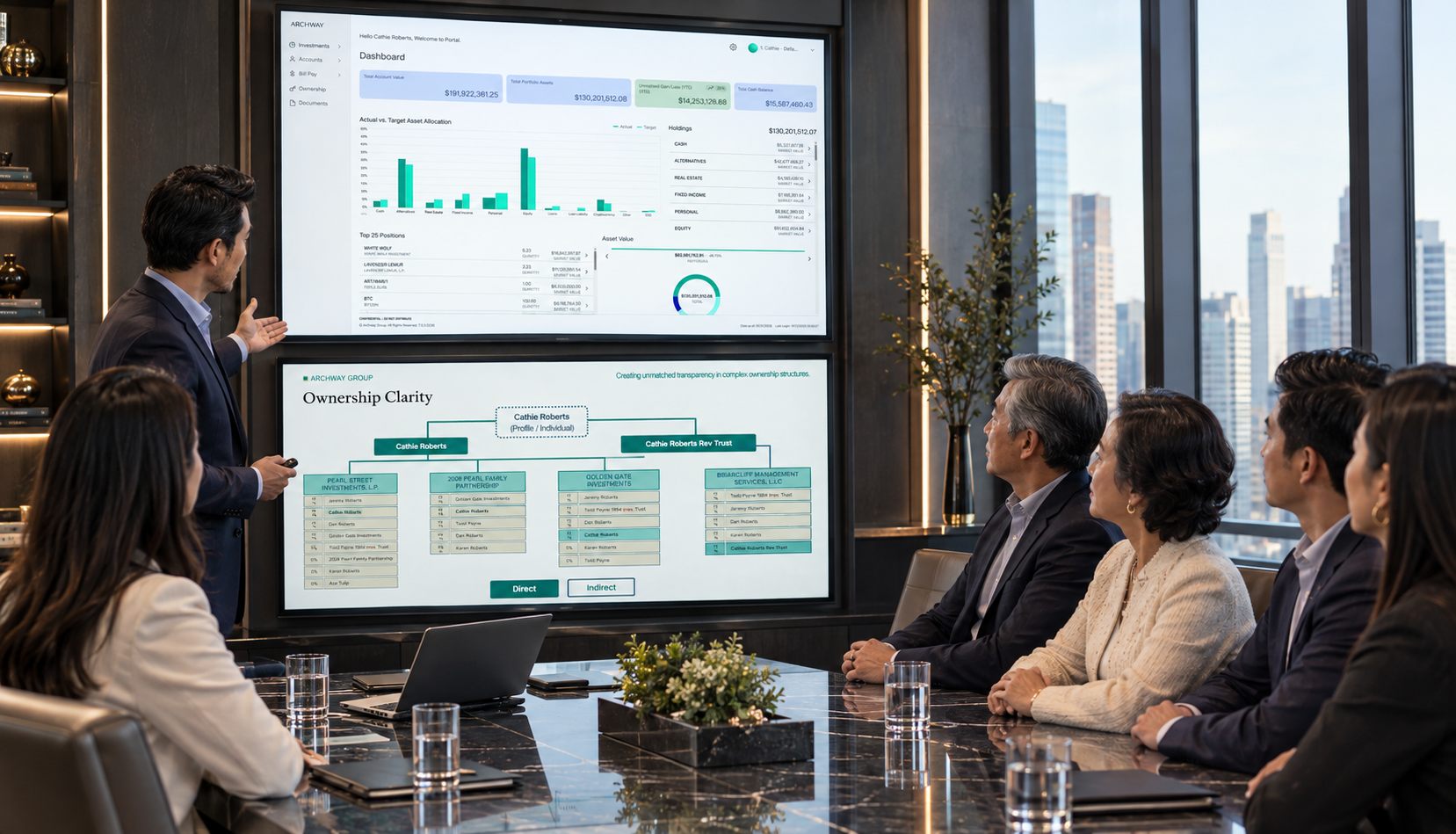
Ownership structures are layered and bespoke. A single investment may sit inside a holding LLC, which feeds a family partnership, which distributes to individual family members through trusts established at different times for different purposes. Each layer needs its own set of books. Getting consolidated reporting right means looking through every layer, eliminating intercompany balances so the same asset is not counted twice, and showing each beneficial owner their true economic exposure across the full structure. Most of these structures were built for estate planning or tax efficiency, not operational simplicity, and few follow a standard template.
We start with the governing documents which define preferred interests, profit interests held by family members, stuffing and other special allocations that split income, and gains differently across branches of the family. The accounting follows the governing documents precisely, and general-purpose platforms were not built for that level of complexity and layering.
Book to tax is an annual scramble. Most family offices run on a cash or accrual basis all year, then hand everything to an external tax advisor to convert to tax basis and prepare Form 1065s and K-1s. That process is only as good as the records underneath it. In a layered structure, one entity's K-1 feeds the next entity's return before that return can be completed, so the reconstruction starts from the bottom up, one layer at a time. In a structure with nested trusts, holding LLCs, and family partnerships, that can mean dozens of entities and weeks of professional time before a single K-1 is produced.
The increase in illiquid asset investments increases the long tail in valuations further complicating the matter. Private equity, real estate, hedge funds, direct investments: most do not price daily, and some have no formal valuation cadence at all. Without a policy for carrying values between valuation dates, the family office waits on every manager and appraiser before it can close the books. Many do exactly that. Consolidated reporting arrives 90 or more days after quarter end, well after it could have informed the decision it was meant to support.
Capital accounts require daily reconciliation. Every contribution, distribution, allocation, and transfer between entities, including in-kind transfers of real estate or private securities must be captured and posted accurately, or the account quickly stops reflecting reality. Left unaddressed, small discrepancies compound until reconciling them becomes a project rather than a routine.
Amid the myriad functions that are already stretching small finance teams, communication becomes its own layer of complexity. Why one branch of the family received a different allocation than another is not always self-evident, even when it is entirely correct under the partnership agreement. Those nuances are easily resolved through proactive communication, adding yet another step that needs to be thoughtfully managed by the same small team.
Where Most Family Offices Fall Short
The common failure is not a single mistake. It is an accumulation of workarounds that made sense at a time. A spreadsheet built to handle one partnership becomes the model for five. The one accountant who understands the allocation logic never writes it down. K-1 season is an annual scramble because partnership accounting and investment reporting live in two systems that were never built to agree.
Family offices are also investing more in formal governance: investment committees, valuation policies, approval matrices. J.P. Morgan's 2026 Global Family Office Report found that 48% of business-owning families have established formal governance bodies, compared with 40% of non-business-owning families. But governance defines control and accountability. Operations determine whether the controls are actually followed. Knowing where decisions are made means little if the numbers they need are being assembled by hand.
The result is not necessarily wrong numbers. It is a fragile operation: accuracy depends on specific people staying in their seats, reporting always runs a quarter behind, and the governing documents, investment reporting, and accounting records have quietly drifted apart in ways nobody has fully mapped. When a key person leaves, or the family's complexity outgrows the infrastructure supporting it, the cost of reconstruction is always higher than the cost of building it right would have been.
How Archway Can Help
Archway's platform maintains multi-entity ownership structures, parallel capital account bases, and allocation logic configured to the terms of each governing document. Investment reporting and partnership accounting run on the same general ledger, so the number in the report and the number in the books are the same number.
For family offices that also need accounting support, Archway’s Family Office Accounting team works as an extension of the family office’s own staff. The staffing challenges that make partnership accounting fragile in most family offices (attrition, coverage during leave, demand spikes at audit season and tax time) become Archway's to manage, not the family office's. The family gets consistent, high-quality accounting that does not depend on one person staying in their seat.



August 4, 2026
Article
·
Single Family Offices
·
time
-min
read
Bill Payment
Client Service
Family Office Bill Pay: The Complexity Behind Cash and Expense Management
Learn how family offices can strengthen bill pay, cash management, fraud prevention, reporting, and operational control with a modern workflow.
Megan Greer
While family offices perform a myriad of functions, their primary purpose is to manage the complex financial lives of the families they serve. One key activity they perform is ensuring that the families’ bills are paid accurately, on time, and with appropriate oversight and safeguards.
Bill payment and related treasury functions often receive less attention than investment strategy, estate planning, philanthropy, or family governance. All too often, cash and expense management activities are under-resourced, rely on outmoded or point-solution technology, and can be prone to errors or worse.
Bill pay often gains executive attention only when something goes wrong, such as when the office receives a call from a family member about a missed or incorrect payment. This lack of focus, however, belies its importance. The downstream effects are real: missed or incorrect payments can impact a family member’s plans, trigger penalties, and damage credit relationships. Poor transaction oversight can expose a family member to fraud. The lack of coordination with a comprehensive treasury and accounting function can lead to overdrafts, duplicate payments, and late fees. Poor documentation hinders oversight and reporting and can complicate tax and audit preparation. Current approaches may lack scalability and redundancy and may not meet operational demands as family wealth structures grow more complex. As the number of entities grow and the volume and variety of invoices multiply, staff can quickly become overwhelmed.
This article examines the key challenges family offices face in managing bill payments and cash management, the risks created by inadequate processes and technology, and the principles and approaches that family offices need to adopt to modernize this important function.
Why Family Office Bill Pay Is So Complex
In most instances, family offices are managing payments for multiple entities in an ecosystem of fragmented financial interests and structures. A typical ultra-high-net-worth family may hold assets and require disbursements through a combination of the following:
- Personal residences and vacation properties in multiple states or countries
- Revocable and irrevocable trusts for estate planning purposes
- Family limited partnerships and limited liability companies
- Private foundations and donor-advised funds
- Operating businesses and holding companies
- Investment accounts and special purpose vehicles
The personal lifestyles of individual family members also generate a broad array of recurring and, at times, irregular payment obligations, including:
- Property management and related fees across multiple residences
- Household staff payroll, benefits, and employment taxes
- One-time or periodic purchases of luxury items: cars, aircraft, art, and yachts
- Luxury asset maintenance
- Personal security services
- Educational expenses
- Medical concierge services and ongoing healthcare
- Subscriptions, memberships, and club dues
- Family member-specific tax obligations
- Charitable pledges and recurring donations
- Capital call obligations for private fund investments
It is easy to see how quickly the payment environment can become complex as each payment category involves different vendors, payment frequencies, levels of urgency, approval processes, and sources of funds. Invoices must be paid for by the correct entity and from the correct bank account. Some family members or entities may have their own bank account, payment obligations, and accounting requirements. Others may simplify the process by paying invoices from one entity and allocating expenses across the partnership structure through the accounting process. All of this needs to be reconciled across multiple transactions, statements and recorded in the accounting system.
Complexity increases when families maintain residences, businesses, and service relationships across multiple jurisdictions. This can result in invoices in multiple currencies, international wire transfers, currency conversion, correspondent banking fees, and cross-border compliance requirements, adding another layer of complexity to the bill pay process.
Operational Challenges
Legacy family offices may rely on less formalized or consistently documented processes. Invoices arrive through multiple channels, often in hard copy, including paper mail, email, vendor portals, and property management systems. Invoices are often handled in hard copy with little tracking or workflow management. It is easy to make duplicate payments when invoices are received through multiple channels and processed independently. Misplaced invoices and missed payments can also arise when invoices fall through communication gaps or are simply lost.
Expense approval and oversight can be haphazard. Family offices typically maintain payment approval thresholds, with amounts below which staff can authorize payments independently and amounts above which principal or trustee approval is required. In practice, these frameworks are frequently informal and inconsistently applied, lacking approval documentation, tracking capabilities, and an audit trail.
Many family offices use spreadsheets, small business accounting software, or a combination of the two to manage their bill payment process. While flexible and familiar, spreadsheets present fundamental limitations for payment management, including:
- Poor spreadsheet access controls can allow any user with file access to alter payment data without an audit trail.
- The lack of version management can result in staff working from outdated files, creating conflicting records.
- There is little workflow to support the end-to-end process.
- Manual data entry can lead to errors.
- There is little system integration, with data manually entered into other recordkeeping and accounting systems, creating redundant work that is time-consuming and may diverge from the official books and records.
Many accounting platforms pose their own set of challenges. They are not designed for family office complexity and may lack integration among payment processing, cash reconciliation, and the general ledger. Workarounds that allow these platforms to approximate family office requirements can create duplicative processing and reconciliation of data between systems, increasing the risk of errors. In addition, they have significant reporting limitations that require manual effort to overcome.
Finally, a key challenge is the lack of staff redundancy. Family offices frequently have lean staffing models. Often, this complex process relies on a single employee or a handful of employees. If someone leaves or is unavailable, this can create a gap in the bill-paying process.
Coordination with Treasury Functions
Communication and coordination with treasury functions present another challenge. Once an invoice is approved for payment, the treasury function must be notified of the correct bank account and the amount of the payment. Treasury must then review relevant banking details to ensure adequate funds are available to meet the obligation. Treasury then notifies the bill pay team to execute the transaction. Without a robust workflow and platform, this process often relies on email and callbacks and is prone to errors.
Fraud Prevention Can Be Weak
Not surprisingly, family offices are potential targets for financial fraud. The combination of substantial assets, lean staffing, informal processes, and lack of systemic controls can create an environment that sophisticated fraudsters can easily exploit.
One approach is known as a Business Email Compromise (BEC) attack. Fraudsters compromise or spoof the email account of a trusted party — a property manager, investment manager, attorney, or one of the principals themselves — and issue fraudulent invoices or payment instructions to family office staff.
A vendor impersonation scheme is another fraudster favorite. A fraudster monitors family office communications and business relationships to learn of important vendor relationships. In a typical vendor impersonation scheme, attackers send invoices using spoofed or lookalike domains that closely resemble legitimate vendors, request bank account changes for future payments, and exploit informal vendor management practices that lack verification protocols. Without fraud detection and prevention processes, it is easy for busy staff to miss fraudulent activity.
Family offices are also not immune from internal fraud. They often operate with insufficient segregation of duties in their payment functions. A single employee may have authority to add new vendors, initiate payments, and reconcile bank accounts — three functions that should ideally be performed by separate individuals to create appropriate segregation of duties and oversight.
New Solutions and Best Practices
Leading family offices are addressing these challenges by taking a fresh approach to bill pay and the broader cash and expense management process. Through a combination of technology, organizational design, workflow tools, process discipline, and outsourcing to a third party, they are adding significant scale, efficiency, and safeguards.
Purpose-built family office bill payment platforms can now provide capabilities specifically designed for the multi-entity, multi-bank, multi-currency environment. These platforms consolidate and digitize invoice receipt and capture and allow for invoice tracking and multi-tier approvals with complete audit trails. They enable payment execution across multiple payment entities, automatic reconciliation with accounting systems, and consolidated reporting across all entities. Also included are important aspects of the treasury function to ensure funds are available to meet obligations and payments are made from the correct accounts. By outsourcing this function, a family office can gain access to a best-of-class technology platform and achieve scalability and personnel redundancy.
Key Components of a Modern Bill Pay Workflow
Whether managed internally or with an outsourced partner, a modern family office bill pay workflow should include the following components.
.png)
How Archway Can Help
Bill payment management sits at an unusual intersection in the family office: it is operationally essential yet often organizationally undervalued, technically complex yet frequently entrusted to informal processes, and financially significant yet rarely properly resourced.
Archway’s Cash and Expense Management solution addresses the treasury, accounting, and bill pay needs of complex family offices. Our secure, permission-based platform manages the full operational lifecycle of the payment process, from invoice receipt and approval through payment generation, reconciliation, general ledger integration, and reporting. Clients can delegate the full process to the Archway team or retain control over selected activities, including approvals and fund disbursements.
Recognizing the value of an enterprise-grade treasury and accounts payable platform can achieve more timely bill payment, better cash management, more accurate reporting, stronger fraud detection, and a more efficient payment process.

August 4, 2026
Article
·
Single Family Offices
·
time
-min
read
Family Office Software
Financial Reporting
5 Signs Your Family Office Has Outgrown Spreadsheets
Spreadsheet dependency often develops gradually, creating hidden costs through manual workflows, fragmented data, and increasingly complex reporting processes. As family offices grow, a centralized financial foundation becomes essential for improving visibility, reducing operational risk, and supporting long-term scalability.

Richard Griffith
The Hidden Costs of Spreadsheet-Driven Family Office Operations
Most family offices do not wake up one morning and decide to build a spreadsheet-driven operating model.
It happens gradually.
A spreadsheet created to solve one reporting challenge becomes two, then ten. Over time, critical financial information becomes dispersed across workbooks, shared drives, email attachments, and manual processes. What began as a practical solution transformed into operational dependency.
For many organizations, that dependency develops quietly. Reporting continues to be delivered. Financial statements are produced. Capital activity is tracked. Ownership schedules are maintained. The process may not appear broken, but the effort required to sustain it increases with every new entity, investment, account, and stakeholder added to the environment.
The issue is not Excel itself. Spreadsheets remain one of the most valuable tools available to finance professionals. The challenge emerges when spreadsheets evolve from analytical tools into systems of record that support critical family office accounting, reporting, and operational processes.
As family offices grow more complex, the hidden costs of spreadsheet-driven operations become increasingly difficult to ignore.
Why Spreadsheet Dependency Persists
For many family offices, spreadsheets offer speed, flexibility, and familiarity—enabling quick reporting and custom analysis without relying on technology resources. That flexibility is valuable, but it also drives deep reliance on spreadsheets in daily operations.
Over time, they become the default solution for increasingly complex needs: investment data in one workbook, ownership in another, capital accounts elsewhere, and reporting assembled manually. Individually manageable, these processes collectively create an operating environment that is difficult to scale, govern, and sustain.
Where the Real Effort Is Hidden
When finance and operations teams evaluate their reporting processes, they typically focus on whether reports are ultimately delivered accurately and on time. While those outcomes matter, they do not always reveal the amount of effort required to achieve them.
Many family offices spend significant time collecting information from custodians, investment managers, banks, accounting systems, fund administrators, and third-party providers before reporting can even begin. Data must be validated, reconciled, reformatted, consolidated, and reviewed. Adjustments are made manually, and supporting schedules are frequently maintained outside core systems.
This work is often treated as a normal part of the reporting cycle because it has existed for years. But the true cost is the cumulative burden created by hundreds of manual activities across every close, every reporting cycle, every capital activity update, and every year-end process.
When Complexity Outgrows the Spreadsheet
Family office environments present operational challenges that differ significantly from those of mature businesses with enterprise-scale finance organizations.
Many organizations manage multiple legal entities, trusts, partnerships, foundations, operating companies, investment vehicles, and family ownership structures simultaneously. Reporting requires information to be consolidated across operating entities, investment entities, trusts, partnerships, and beneficiaries. Capital account reporting, partnership allocations, intercompany activity, trust distributions, and investment reporting all introduce layers of complexity that are difficult to manage when information resides across disconnected spreadsheets.
As complexity grows, spreadsheets become increasingly difficult to maintain. A change to an ownership structure may require updates across multiple workbooks. A new investment may introduce additional reporting requirements. Partnership allocations must be calculated, validated, and reflected consistently across capital accounts. Intercompany transactions must be reconciled. Custodian data must be normalized before it can be used in consolidated reporting for family offices.
Even straightforward reporting requests will require substantial manual effort when accounting data, investment data, ownership records, and supporting schedules are maintained across different files and systems.
Several warning signs often emerge.
- Reporting Cycles Become Longer
Finance teams spend more time gathering and validating information before analysis and reporting can begin. Month-end, quarter-end, and year-end processes become increasingly dependent on manual coordination, especially when reporting packages require data from multiple custodians, investment managers, entities, and accounting schedules.
- Reconciliations Become More Difficult
Multiple versions of the same information begin to exist across different files and teams. Custodian data may not match accounting records. Investment manager statements may need to be reconciled against internal books. LP capital account balances may require manual validation before year-end reporting or K-1 production can move forward.
- Knowledge Becomes Concentrated
Critical reporting processes become dependent on a small number of individuals who understand how spreadsheets were built, linked, and maintained. If a controller, accountant, or operations lead leaves, the family office may lose the institutional knowledge behind how key reporting, allocation, and reconciliation processes actually work.
- Visibility Declines
As information becomes fragmented across systems and files, it becomes more difficult to obtain a complete view of financial activity across the organization. Leadership may struggle to quickly understand liquidity positions, entity-level exposures, ownership relationships, and overall portfolio performance without waiting for manual consolidation.
- Growth Creates Additional Strain
What worked effectively for ten entities may not work for fifty. What worked for a handful of investments may not work for hundreds. As entities, accounts, partnerships, and reporting stakeholders increase, the effort required to sustain spreadsheet-driven processes often grows faster than the team supporting them.
These challenges create operational and investment risk. They also affect confidence.
Why This Matters More Than Ever
Family offices have the volume, complexity, and pace of information more akin to large and mature business yet maintain lean staffing more like a small business.
Many entities have significant or complex accounting and accounts payable needs. Investment portfolios are more diversified. Reporting expectations continue to rise. Stakeholders expect faster access to information and greater transparency across assets, entities, and ownership structures. At the same time, many family offices are being asked to do more with lean teams and finite resources.
Many organizations are also exploring automation, advanced reporting capabilities, and artificial intelligence to improve efficiency and decision-making. These initiatives have real potential, but they depend on one common prerequisite: reliable data.
Organizations cannot automate inconsistent processes. They cannot generate meaningful insights from fragmented information. They cannot fully benefit from AI if the underlying data lack’s structure, consistency, and governance.
Technology can accelerate existing processes, but it cannot compensate for poor data quality.
Excel Still Has an Important Role
None of this suggests that family offices should eliminate spreadsheets.
Excel remains one of the most effective tools available for financial analysis, forecasting, budgeting, modeling, and scenario planning. It provides flexibility that many systems cannot replicate.
The objective is not to remove spreadsheets from the finance function. The objective is to ensure that spreadsheets support analysis rather than serve as the primary repository for critical operational and financial information.
Organizations that establish this distinction are often better positioned to improve family office reporting, strengthen controls, reduce operational risk, and support future growth.
How Archway Can Help
Archway helps family offices bring accounting, investment data, and reporting together within a single platform.
With support for multi-entity accounting, complex ownership structures, capital account accounting, consolidated reporting, and family office-specific workflows, Archway helps reduce manual effort while improving visibility, consistency, auditability, and control.
That matters in the areas where spreadsheet dependency creates the most strain: ownership allocations, entity-level reporting, intercompany reconciliation, capital account tracking, and the ability to trace numbers back to the source.
For organizations seeking additional support, Archway’s Family Office Accounting services can help with bookkeeping, accounting, investment reporting, and related operational workflows.
The result is a stronger foundation for reporting, governance, scalability, and long-term growth.
Looking Ahead
Spreadsheet dependency is often a symptom of growth. As family offices become more sophisticated, the operating practices that once supported the organization may become increasingly difficult to sustain.
The next step is not simply replacing spreadsheets. It is creating a stronger foundation for financial data, reporting, governance, and decision-making.
In the next article, we explore what that foundation looks like and why it has become increasingly important as family offices prepare for a future shaped by automation, advanced reporting, and artificial intelligence.

June 2, 2026
Article
·
Single Family Offices
·
time
-min
read
Family Office Trends
Family Offices & Artificial Intelligence
A Strategic Framework for Addressing Data Challenges
Explains the next stage of AI readiness for family offices, focusing on data governance, infrastructure, pilot projects, and scaling responsibly.

Ethan Wishnick
·
Chief Operating Officer
Data Alone Isn’t Enough: The Next Stage of AI Readiness
Earlier in this series, we discussed why “having good data” is one of the most important first steps in any artificial intelligence strategy. Clean, accurate, and organized information creates the foundation AI systems rely on to generate meaningful insights and support better decision-making.
However, data quality is only one piece of the equation. For Family Offices and wealth management organizations, AI success also depends on the infrastructure, governance, integrations, and operational processes surrounding that data. Even strong datasets can create challenges when information is fragmented across systems, managed inconsistently, or difficult to access in real time.
The next stage of AI readiness is about creating an environment where data can move efficiently, securely, and intelligently across the organization. In this article, we’ll explore what that looks like in practice and why operational readiness is becoming just as important as data quality itself.
Phase 1: Data Governance and Stewardship
Effective data management requires clear governance structures that define roles, responsibilities, and decision-making authority. Who owns the data? Who is responsible for data quality and integrity? Who approves sensitive data access requests? Who sets data retention policies? Clear answers to these questions are essential.
In family offices, governance is further complicated by the involvement of multiple stakeholders: family members, investment staff, external advisors, and service providers, each of whom may have different views on data priorities, privacy requirements, and acceptable uses. Establishing and maintaining consensus requires active governance mechanisms.
For AI specifically, governance policies must address additional questions: What data can be used for model training? How should models be validated before deployment? What level of human oversight is required for AI-generated recommendations? How are model decisions documented and explained? Who can deploy new AI capabilities?
Governance must also extend to third-party service providers. How are they using your data? What safeguards are they maintaining, particularly for the most sensitive information?
Phase 2: Foundation Building
Before deploying sophisticated AI capabilities, family offices must establish solid data foundations. This phase focuses on four priorities:
- Comprehensive data inventory. Catalog all data sources, document their contents and update frequencies, identify gaps and quality issues, and map data flows between systems. This baseline understanding clarifies what data resources exist and where improvement is needed.
- Data consolidation. Deploy a data lake or similar solution to create a unified view of family office assets and eliminate siloed information.
- Data quality processes. Implement validation rules, exception reporting, and correction workflows. Define data ownership and accountability. Establish metrics for measuring quality and track improvements over time.
- Data catalogs. As data ecosystems grow in complexity, the ability to find and understand available data becomes critical. Data catalogs inventory available datasets, document their contents and lineage, and facilitate discovery. For AI implementations, they help data scientists identify relevant datasets, support model debugging, and facilitate impact analysis when data sources change. Maintaining comprehensive data catalogs, however, requires dedicated effort and appropriate tooling.
Phase 3: Targeted AI Pilots
With foundational data infrastructure in place, family offices can begin experimenting with AI through targeted pilot projects. Pilots serve multiple purposes: demonstrating value, building internal expertise, uncovering unforeseen challenges, and refining implementation approaches.
Successful pilots share common characteristics. They address well-defined problems with measurable outcomes, leverage data that is already relatively clean and accessible, have executive sponsorship and appropriate resources, and include mechanisms for capturing lessons learned.
Example pilot projects might include:
- Portfolio rebalancing optimization using machine learning to minimize tax impact
- Document processing automation for extracting data from fund statements or K-1 tax forms
- Anomaly detection for identifying unusual transactions or market movements
- Natural language processing for analyzing investment research reports or earnings call transcripts
Phase 4: Scaling and Integration
Successful pilots provide the foundation for broader AI adoption. The scaling phase focuses on expanding AI capabilities across additional use cases, integrating AI insights into decision-making workflows, and building organizational muscle memory for maintaining and improving AI systems.
This phase requires balancing expansion with sustainability. Adding new AI capabilities without corresponding investments in data infrastructure, governance, and talent can produce poor results. Successful scaling requires disciplined program management, continued focus on data quality, and ongoing capability development.
Best Practices and Recommendations
Start with Data, Not Algorithms
The allure of sophisticated AI models can tempt organizations to prematurely focus on algorithm selection and model development. Resist this temptation. No algorithm, however advanced, can compensate for poor-quality or inaccessible data. Invest first in data infrastructure, quality, and governance, including the unglamorous but essential work of data cleaning, standardization, and consolidation.
Embrace Incremental Progress
Transformative AI capabilities are built incrementally, not through sweeping all-at-once implementations. Start with focused projects that deliver tangible value quickly, use early wins to build momentum and secure resources, and iterate based on experience. This approach reduces risk, facilitates learning, and maintains stakeholder engagement.
Build Privacy and Security In
Security and privacy cannot be afterthoughts. Design data architectures with privacy preservation from the outset. Implement encryption, access controls, and audit logging while consistently evaluating outside vendors rigorously on their security practices.
Develop Governance and Internal Capabilities
Establish a clear governance structure and processes early. Invest in internal capabilities through hiring, training, and hands-on experience. Even small family offices can cultivate basic data literacy and AI fluency among existing staff; internal expertise enables more effective vendor management and supports long-term sustainability.
Measure and Monitor
Establish metrics for evaluating AI initiatives. Track data quality indicators, model performance, user adoption rates, and business impact. Regular monitoring surfaces issues early, supports continuous improvement, and demonstrates value to stakeholders. What gets measured gets managed, and that principle extends to third-party providers as well.
Build vs. Buy
Organizations must determine the right approach to their data management challenges. Building internal capabilities offers control and customization but requires significant investment. Purchasing packaged solutions from third-party providers can enable faster, more cost-effective deployment but may sacrifice flexibility. A hybrid approach, combining in-house capabilities with external service providers, potentially guided by consultants or advisors, is another viable path. The right choice depends on organizational size, available resources, and technology sophistication.
How Archway Can Help
The data challenges described in this post are precisely the problems the Archway Platform was designed to solve. For nearly 25 years, Archway has helped family offices and financial institutions aggregate, consolidate, standardize, and manage their key financial data and documents.
The Archway Platform addresses core data readiness challenges in several ways:
- Consolidated data in a single environment. The platform brings together accounting and investment data across custodians, asset classes, and currencies, eliminating the fragmented, multi-silo environments. With a single, reconciled source of financial truth, AI tools have the clean, comprehensive dataset they need to function effectively.
- Structured, auditable financial data. Archway's foundational general ledger automatically books journal entries as transactions are processed, producing well-labeled, consistently formatted data as a natural byproduct of normal operations, exactly what AI systems require.
- Alternative investment data ingestion. Through ingestion tools and partnerships with companies like Canoe Intelligence and Arch, the platform streamlines the extraction and processing of alternative investment data. Capital calls, distribution notices, K-1s, and fund statements are among the most persistent data gaps for family offices seeking AI-ready data, and they are handled more efficiently within the platform.
- Built for complexity and scale. The platform is designed for the unique demands of UHNW family offices, including multi-entity structures, multi-generational ownership, and multi-asset portfolios. As data needs grow, the platform scales with them.
For family offices looking to build the data foundation that makes AI possible, Archway provides both the technology and operational support to get there.
Artificial Intelligence will reshape wealth management, but the firms that benefit most will be those building to enable it. That means investing in the data infrastructure, governance, and processes outlined throughout this series, not just pursuing AI on its own.
The question is not whether AI will transform the industry. It will. The more important question is which organizations will be ready to harness it effectively.

May 22, 2026
Article
·
Single Family Offices
·
time
-min
read
Family Offices & Artificial Intelligence
Is Your Data Ready for Artificial Intelligence?
Frames AI readiness around the quality, structure, and accessibility of family office data, including fragmentation, privacy, and scalability challenges.
Ethan Wishnick
·
Chief Operating Officer
In a previous post, Catherine Fankhauser, Partner and Practice Leader of Family Office Advisory Services at Ernst & Young (EY), joined our CEO, Anthony Abenante, to outline five steps Family Offices should take when starting an AI journey. "Having good data" topped the list. In this post, I want to go deeper on what that means in practice.
AI Demands Better Data
Artificial intelligence represents more than an incremental technology upgrade, it offers a fundamental transformation in how family offices can operate. Advanced AI systems promise capabilities that were once the stuff of science fiction: real-time portfolio optimization across all asset classes, predictive analytics for market movements and liquidity needs, automated compliance monitoring, intelligent tax optimization, and natural language interfaces for complex financial queries, analysis, and reporting.
These capabilities, however, are built on a foundation of quality data. Unlike traditional software that can function on partial or inconsistent inputs, AI systems depend fundamentally on comprehensive, well-structured, and properly labeled datasets. The AI readiness gap facing family offices is therefore not primarily about AI technology itself -- it is about the underlying data infrastructure required to make AI effective.
The Data Challenges Facing Family Offices are Unique
Family offices differ from other financial organizations in four critical ways, and understanding these differences is essential to addressing their data challenges:
- Diverse asset portfolios. Family offices manage holdings that extend well beyond public securities to include private equity, real estate, hedge funds, collectibles, family businesses, and other alternative investments. Each asset class generates different types of data with varying levels of reporting frequency, standardization, and transparency.
- Multiple external service providers. Family offices typically work with custodians, prime brokers, fund administrators, tax advisors, and legal counsel, each maintaining separate data systems with different formats and update frequencies. This creates a naturally fragmented data environment where consolidation is a persistent challenge.
- Sensitive family information. Beyond financial assets, family offices manage estate plans, philanthropic activities, and personal data that require strict confidentiality. These privacy requirements can conflict with the data aggregation and sharing mechanisms that AI systems typically rely on.
- Wide variation in size and sophistication. Many single-family offices operate with lean teams and limited technology resources, making large-scale data initiatives especially challenging.
Fragmentation: The Core Data Problem
The most pervasive data challenge facing family offices is fragmentation. Investment holdings data are frequently dispersed across an array of disconnected systems, creating several problems for AI implementation. Machine learning algorithms require integrated datasets to identify patterns and generate insights and when data resides in isolated silos, AI systems lose the holistic view essential for meaningful analysis.
Data silos also increase the risk of inconsistency and duplication. The same investment may be recorded differently across systems, which confuses AI models and can lead to erroneous conclusions.
The Multi-Custodian Problem
Many family offices maintain relationships with multiple custodians to access specialized services, manage counterparty risk, or accommodate the preferences of individual family members. While this diversification offers operational benefits, it significantly complicates data management.
Historical Data Gaps
AI and machine learning models typically require substantial historical data to train effectively and identify meaningful patterns. Family offices may have years of investment history, but accessing that data in structured, usable formats is often difficult. Legacy systems may have been replaced, historical records may exist only on paper or in PDFs, and data standards may have shifted over time.
Even when historical data exists electronically, it may rely on outdated categorizations or lack key fields needed for modern analysis. Without adequate historical data, AI models cannot perform back-testing or learn from past market cycles.
Privacy Requirements
Family offices manage highly sensitive information that extends well beyond financial data to include personal family matters, health information, estate plans, philanthropic intentions, and business strategies. Protecting this information can limit or complicate access to certain datasets needed for AI implementation.
Family Offices Must Evolve
Many family offices rely on legacy technology systems that were never designed with AI integration in mind. These systems may lack modern APIs (Application Programming Interfaces) or data export capabilities that AI tools require.
The rapid evolution of AI also means that a leadership team's expertise can quickly become outdated. Continuous learning is essential. Family office staff need opportunities to develop new skills, experiment with emerging technologies, and stay current with industry developments, which requires investment in training, professional development, conference attendance, and collaboration with academic institutions or industry groups. Organizations that cultivate a learning culture -- one where experimentation is encouraged and failure is tolerated -- are better positioned to adapt to technological change.
Finally, family offices are not static entities, and data infrastructure must accommodate growth without requiring constant re-architecture. An AI platform that performs well with $500 million in assets across 50 positions may struggle when a portfolio grows to $2 billion across hundreds or thousands of positions spanning multiple asset classes and jurisdictions. Scalability must be a design priority from the outset.
Preparing for What’s Next
AI has the potential to reshape how family offices operate, but meaningful results depend on the strength of the data foundation beneath it. For many organizations, the challenge is not a lack of information, but fragmented systems, inconsistent reporting, and operational complexity that limit visibility and scalability. As portfolios expand across asset classes, entities, custodians, and jurisdictions, these challenges only intensify, increasing the need for structured, integrated, and reliable data.
In Part 2, we’ll explore what it takes to move forward in practice, including how to strengthen data strategy and align the right operating model. Effective AI starts with disciplined accounting and a clear operational foundation. At Archway, we combine purpose-built technology with deep accounting expertise to help family offices bring structure and consistency to increasingly complex environments.

May 14, 2026
Article
·
Single Family Offices
·
time
-min
read
Family Offices & Artificial Intelligence
Family Offices & Artificial Intelligence: Time to Get Educated
Curates practical AI education resources for family office leaders, from institutional research and platforms to courses, books, and consulting perspectives.

Archway Family Office Services
In a recent post, we outlined five focus areas for starting an AI journey, with Get Educated as the essential first step. Given the enormous amount of buzz and hype surrounding AI, we wanted to point you toward sources that go beyond the headlines and offer substantive, fact-based information and perspectives.
Below is a curated list of educational resources for Family Offices looking to build their AI knowledge. We start with our top recommendations: MIT, Stanford, and Harvard, three institutions at the forefront of AI research and among the most authoritative sources for insights on artificial intelligence trends and developments. Leading AI platforms OpenAI and Claude also offer helpful educational content. For current news and developments, Forbes and Wired are solid starting points. We've also included online courses for those seeking deeper immersion, a selection of books offering both accessible and in-depth perspectives, and research from several leading consulting firms.
Top Recommendations
- MIT Technology Review – No hype; written by practitioners. technologyreview.com | MIT AI News
- Stanford AI Index Report – hai.stanford.edu/ai-index
- Stanford Digital Economy Lab – digitaleconomy.stanford.edu
- OpenAI – Leading AI platform; research, tools, and product updates (ChatGPT). openai.com
- Claude – Leading AI platform; research, tools, and product updates. claude.ai
- The Batch (DeepLearning.AI) – Explains what matters in AI. deeplearning.ai/thebatch
- Harvard Business Review – AI case studies. hbr.org
- Artificial Intelligence News – Trends and real-world applications. artificialintelligence-news.com
- Forbes AI – forbes.com/ai
- Wired – Artificial Intelligence – AI use cases and analysis. wired.com/tag/artificial-intelligence
Educational Courses
- Coursera – AI courses and specializations from Stanford and DeepLearning.AI, including Andrew Ng's "Machine Learning" and "AI for Everyone." coursera.org
- edX – Courses from MIT, Harvard, Microsoft, and others, covering foundational to advanced AI topics. edx.org
- Udacity – Nanodegree programs in AI, Machine Learning, Deep Learning, and more, with a hands-on project focus. udacity.com
- Udemy – A wide range of AI courses for all levels, with practical, real-world applications. udemy.com
- DataCamp – Specializes in data science and AI through interactive coding tutorials and projects. datacamp.com
- Google AI – Free tutorials, resources, and hands-on labs via the "Learn with Google AI" portal. ai.google
Books and Reading Material
- You Look Like a Thing and I Love You by Janelle Shane – Funny and accessible; a great introduction to how AI actually works.
- The Second Machine Age by Andrew McAfee and Erik Brynjolfsson – Written for a general audience; no technical background required.
- AI Superpowers by Kai-Fu Lee – Examines the real-world impact of AI across industries and geographies.
- Artificial Intelligence: A Modern Approach by Stuart Russell and Peter Norvig – The definitive AI textbook.
- Deep Learning by Ian Goodfellow, Yoshua Bengio, and Aaron Courville – A comprehensive guide to deep learning techniques.
- Hands-On Machine Learning with Scikit-Learn, Keras & TensorFlow by Aurélien Géron – Practical projects and clear explanations for building AI applications.
Consulting Firms
- McKinsey – State of AI report. mckinsey.com
- Boston Consulting Group – AI insights and research. bcg.com
- EY – Family enterprise and family office perspectives. ey.com
- Campden Wealth – Research focused on family offices and wealth. campdenwealth.com
- Family Office Exchange (FOX) – A leading association for family offices; sponsors peer research and education on technology issues. familyoffice.com
This list is by no means exhaustive, but we've aimed to highlight some of the most respected and accessible sources available — a solid starting point with a range of options to suit different learning styles and goals. We believe now is the time for family office leaders to begin their AI journey and, as we said in our earlier post, take the AI plunge. Have fun, and good luck; we're always here to help.
David O'Kane, Head of Product, Archway

March 16, 2026
Article
·
Single Family Offices
·
time
-min
read
Family Offices & Artificial Intelligence
Family Offices & Artificial Intelligence: Getting Started
Introduces practical first steps for family offices beginning an AI journey, emphasizing education, governance, data quality, and access control.
Archway Family Office Services
Below is a recap of the keynote fireside chat from Archway's Immersion Lite Conference in Dallas, presented from the perspective of Archway’s CEO, Anthony Abenante.
Family Offices & Artificial Intelligence: Getting Started
I recently had the opportunity to sit down with Catherine Fankhauser, Partner and Practice Leader, Family Office Advisory Services at Ernst & Young (EY), where she shared her insight on Family Offices and how they are approaching the utilization of Artificial Intelligence (AI). She brought a well-informed perspective given that she spends 100% of her time with Single Family Offices (SFOs) in areas including operations, governance, and risk.
As we began our conversation, there was clear agreement that AI represented lots of things to lots of people; discussion and debate is clearly ubiquitous at this point, both professionally and personally. As EY works with a broad swath of Family Offices, I asked Catherine to provide insight into how they’re collectively thinking about the implications of AI adoption for their operations. In effect, what's driving both their motivation to adopt AI as well as their fear of its implications?
Further, a growing – and now prevailing – swath of their clients is fully aware that they can no longer ignore AI but just don’t know how to get started. It's as if people are lined up with their toes at the edge of a swimming pool, looking to see which of their friends have jumped in. They’re seeing other organizations in their ecosystem -- like banks and investment firms -- getting in said pool. And as a result, they ask: should we get in the AI pool as well? She thought many are waiting for that first real use case representing a tangible reason to take the plunge. In many ways, her swimming pool analogy was a perfect way to summarize current state.
And, at the same time as they are standing by that AI pool, we see these Family Office leaders reading about the vast amounts of money pouring into projected required infrastructure to facilitate LLMs by the likes of Alphabet, Meta, and Microsoft. So instead of asking how cold the water is, they should be asking how and/or where to commence their respective AI journeys. What should they be thinking about in a practical way, as to not get stuck in a sinkhole of discovery while overspending and ending up with intangible results
Given all the above, the natural next question to pose was around how people should think about getting started?
What follows are Catherine’s suggested five areas of focus for initiating an AI journey…
1. Get Educated
When people talk about AI, they employ a uniquely different and growing vernacular. Get educated on the types of AI, its componentry and its terms. To be clear, not all these terms are interchangeable: Robotic Process Automation is not machine learning; Large Language models (LLMs) are not agentic AI. Simply put, it’s imperative to get educated.
Further to that point, I made reference to a growing set of great sources of AI information available and that Archway plans on subsequent posts highlighting many of these resources as we all collectively learn, develop, and share better AI deployment and utilization practices. Stay tuned.
2. Have Good Data
Catherine stressed that AI capabilities and functionality are only going to be as good as the data it is processing. Bad data = bad output, rendering AI utilization of no use. She gave the example of an EY client Family Office where the client was having a horrendous time with wash sales and preparing tax returns. EY has an AI tool to analyze all your different accounts and come up with your wash sales. Unfortunately, the Family Office couldn't make use of the tool because they couldn't generate the data to feed it. We both agreed that now is time to start getting your data organized into modernized data storage structure(s) housed in a repository where you can aggregate all your data sources.
3. Access Control
When thinking about access control, I typically conjure images of keeping the humans away from technology. This is not what Catherine meant. She was saying, conversely, to keep the technology away from the humans (and their sensitive data and information…). AI does not discriminate. It will take everything -- including highly sensitive data -- and use that information to train itself. Organizations need to think about how they are going to put a fence around the AI while being judicious around what data to feed it. Catherine stressed the need to perform curative work around properly ringfencing and/or deleting data that shouldn’t be consumed by an LLM. This work is just one of the many steps around forward AI governance that will need to be developed, evolved and continuously applied with unfailing rigor.
4. Privacy Policy
Catherine added that Family Offices need to think about the other aspects of managing their data, aside from Access Control. They need to determine what data is off limits: How long should it be kept? Who has access to the data? Do we have a retention policy? What is our privacy policy? She suggested that once you come up with those parameters, memorialize them and make sure they are clearly understood.
In addition to internal data, think about the data your venders have access to as well: What information do our lawyers, accountants, and other service providers have about our organization? Do we want them to have it if they are using AI? Do we want our information training their models? These third parties need to be part of your privacy footprint.
5. Governance
This topic might be the most important area in which we spend significant time thinking about here at Archway. How best to implement and manage AI usage & deployment in your organization? Who should be the architects of your AI policy and in what form should they be structured: cross-functional team members in committee form or do you stand up a board of governance? It can -- and should -- also be manifest in a set of guidelines that everyone agrees to abide by. Catherine said to think of governance as the guardrails and controls for implementing AI throughout your complex. It determines who decides why and where AI is used, what data will be available to the language models, and who has access to results. It can also assess risks and determine if the AI capability is delivering on promised functionality. As our clients consider this question, we continue to manage Archway’s AI discovery and deployment journey with these nuanced decisions in mind.
In conclusion, we’re very grateful to Catherine for taking the time to share her insights with us. I found her five-step plan to be an insightful and effective guide for helping to frame one’s thinking around getting started with their respective AI journey. Here’s to hoping that this will help more people take the plunge and get into the pool.
Anthony Abenante | CEO Archway Group


