




Article
·
time
-min
read
·
June 5, 2019
Investment Reporting for High-Net-Worth Families
Explains why family offices need purpose-built investment reporting technology and what features to evaluate across data, performance, customization, and delivery.

Chelsea Francis
·
Head of Strategy
Topics
Reporting
Software
Categories
Family Office Reporting
Financial Reporting
How Family Offices and Financial Institutions Can Leverage Reporting Technology
The ultra-wealthy market segment continues to increase year-over-year in both population and net worth. According to an analysis by Wealth-X, the ultra-wealthy population rose by 12.9% alongside a combined net asset growth of 16.7% in 2017 alone. As family offices and financial institutions begin supporting more family members with more money, it becomes increasingly clear that antiquated means of reporting – like spreadsheets and manual processes – cannot keep pace.
So how do firms move forward to meet their end-clients sophisticated reporting expectations?
They leverage financial reporting technology.
Breaking the Addiction to Spreadsheets
Client reporting is challenging enough without having to rely upon clunky, makeshift tools for tracking and reporting on your client’s financial position. We understand why your firm may not be jumping up and down at the thought of replacing your existing processes and spreadsheets in lieu of high-tech reporting. If you’re like many family offices, you’ve been using the same processes and spreadsheets for years, so it’s only natural to be content with the status quo.
Nevertheless, it’s important to consider the limitations that innately come with spreadsheets. Although easy to use and universally understood, spreadsheets are not intended to be the baseline reporting tool for complex family offices. Here’s why:
Reason #1 – Lack of Accessibility
An application like Excel isn’t designed to support live collaboration. In a family office, it’s quite possible that while you are entering data and running reports in one entity, a colleague may be doing the exact same thing in a different entity.
If that data sits in the same spreadsheet, whose entries get saved? Or, unfortunately, whose entries get saved over? With numerous individuals working on multiple variations of a spreadsheet, it’s nearly impossible to say which version is correct and most up-to-date – which is a recipe for reporting incorrect information.
Reason #2 – Lack of Scalability
Excel is highly customizable, but it’s not scalable across larger volumes of more complex data. And while you may be tempted to create complicated macros and formulas, the reality is that few peers exist in your organization capable of supporting these more complex mechanisms should they break.
Put simply, spreadsheets are not designed to be used in scenarios involving intricate ownership structures, various investment types, multiple currencies and sophisticated reporting requirements – all of which are trademarks of a modern family office.
Reason #3 – Lack of Security
Excel lacks the security and sophistication of purpose-built reporting databases maintained inside of world-class hosting facilities. When it comes to family office security, this goes far beyond password protecting your spreadsheets and locking your computer when you leave the office for the day.
If server backups, data encryption and vulnerability assessments aren’t a part of your security playbook, you’re not doing enough to protect the family’s personal and financial data, and you’re leaving your spreadsheets open to security breaches.
Adopting Family Office Reporting Software
When considering a financial reporting software, it’s important to define expectations across the back-office accounting and investment teams as well as the family members and their advisors.
Before you invest in a reporting software solution, it’s best to figure out what type of reporting you want to produce. We suggest starting with an evaluation of both your investment strategy as well as your current reporting process. A few key factors to consider:
- Asset Types. What types of assets are you reporting on? Should the software be able to handle both public equities and alternative investments? What about personal assets like homes, artwork and jewelry?
- Advanced Accounting. Are you able to track book and tax basis? Do you have a means of capturing and reporting on complex transactions such as mergers, spinoffs and splits? Do you need visibility into underlying tax lots? Do you use complicated inventory relief methods?
- Data. Where is your data coming from? Can the reporting engine receive data electronically from multiple custodians and managers? How is alternative investment data received?
- Performance Calculations. Do you need to be able to run time-weighted and money-weighted returns? If not now, what about in the future?
- Benchmarks. Do you currently rely on benchmarks to gauge investment performance? Does the software allow you to create custom benchmarks or are you limited to industry-standard indices?
- Report Generation. Can you automate report creation? Can you combine multiple reports into a single document? Will you be able to create a table of contents?
- Report Delivery. How do you plan to deliver the reports? Are you interested in email or client portal functionality?
- Customization. Do you need the ability to build ad hoc reports? Do you use user-defined investment grouping or categorizations? Do you need to control the branding of the reports?
Citing James Day, Managing Director of Peritus Investment Consultancy, WealthBriefing’s white paper on must-have reporting capabilities for modern wealth managers addresses the need for sophisticated reporting that goes beyond market values to incorporate metrics like asset allocation, fixed income characteristics and performance calculations.
But, more importantly, the article states that while all of these features lend themselves to better reporting, the core purpose of client reporting is to increase client engagement – which means providing end-clients with the information they want to see in a format that is easy for them to understand.
Finding the Right Tools for the Job
Investing in a reporting software that offers a wide variety of features and functionality will give you a greater degree of flexibility to adapt to your clients’ evolving interests and needs – with the end-goal being increased client engagement. We know that reporting requirements can vary greatly between clients, so to help you set the foundation we’ve outlined several reporting software features that frequently come up among prospective family office clients.
Standard Report Library
Oftentimes, a family office’s first instinct is to seek out a reporting solution that allows for absolute customization. However, they quickly find that starting with a blank canvas can be overwhelming, which can undermine the flexibility of the solution. To help clients become comfortable with the software, many technology providers offer a report library that contains a suite of standard reports such as traditional financial statements, asset allocation, investment activity, performance and risk reports.
With on-demand access to the report library, family offices and financial institutions can quickly analyze data to help them answer their client’s financial questions without having to create complex reports on the fly.
Having said that, it’s been our experience working with hundreds of family offices that no two clients are the same. We’ve taken that notion and built upon the report library concept, allowing clients to select from a list of parameters on each report – we call this controlled customization. With the ability to toggle between investment classifications, types of inputs, performance calculations and report layouts, family offices and financial institutions can easily configure reporting to meet the varying expectations of their end-clients.
Flexible Performance Reports
Not all reporting software is created equal and the topic of performance can further complicate the reporting landscape.
At the most basic level, you’ll find providers that focus on delivering the bare minimum – the kind of reporting that only displays transaction data and rarely aggregates positions across managers or custodians. These providers often lack the ability to provide detailed data at the position-level and are limited to simple investment types, like equities and mutual funds. Among these providers, performance may or may not calculated.
At the next level, you’ll find providers that offer data aggregation across multiple custodians, but provide limited investment analysis information and oftentimes lack an ability to properly track more sophisticated investments like hedge funds, private equity, derivatives and options.
At the most sophisticated level, reporting software providers have built functionality that allows users to measure performance across both public and private investments. These providers offer performance reporting that takes into account things like the timing of activity, cash flows, income, gain/loss, accrued income, pending trades and terminal values.
For many family offices, these providers are the only viable option given the ever-changing investment diversification strategies employed by the HNW population.
Automated Reporting
The ability to aggregate data into meaningful reports is the primary consideration when selecting a reporting software provider. But finding a provider with ease-of-use features in their platform comes in as a close second.
When evaluating reporting software providers, it’s important to consider whether or not the technology will make your job easier. With reporting software, you’ll certainly have more data at your fingertips, but if you can’t produce or deliver the reporting content efficiently, it will hardly add value.
Having the ability to combine multiple reports into a single document allows you to produce a customizable, comprehensive report package – your client’s complete financial picture. Combined with report scheduling and automation tools, you not only create an automated, repeatable internal reporting process but you also provide your end-clients with a predictable and familiar reporting experience.
Flexible Reporting Output and Delivery Methods
Before you select a reporting technology, we encourage you to sit down with your end-clients to understand their report delivery expectations. It’s important to recognize that reporting expectations may vary between generations. For instance, G1 may prefer in-person meetings with hard-copy reports and real-time discussion, whereas G2 and G3 may opt to access their reports on their mobile device while traveling abroad.
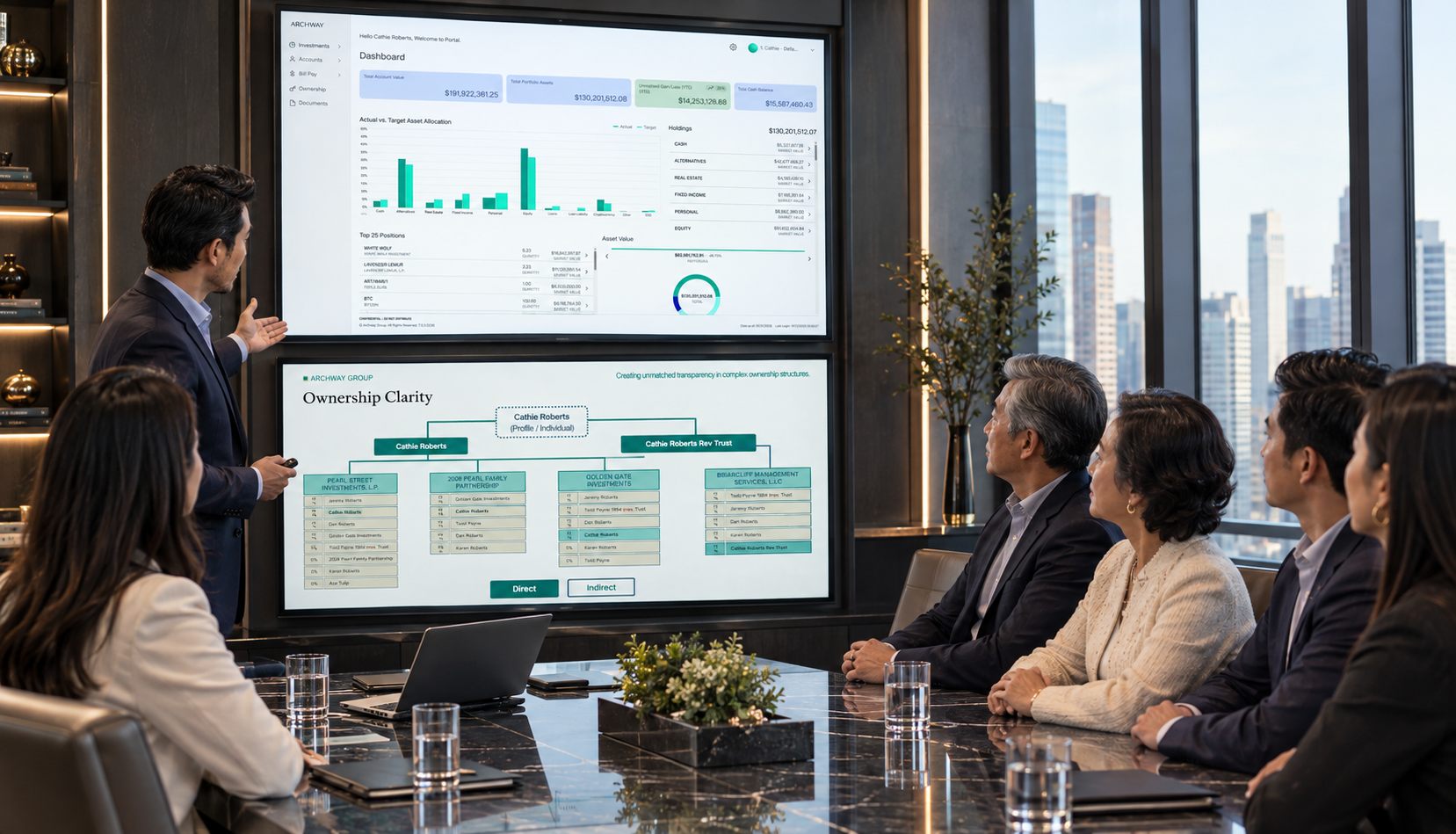
As you evaluate the technology’s features and functionality, make a point to ask about output options and delivery methods. Can you save reports to an external FTP server? Can you email reports directly from the application? Does the software provider offer document storage or client portal tools? Can the technology include interactive dashboard-style reporting?
As technology continues to evolve, so will your client’s preferences and expectations around the way they consume their financial information. By selecting a reporting software that can adeptly handle these requests, you will be better poised to successfully engage your client and maintain their trust.
Find out how Archway Family Office Services addresses complex reporting requirements for hundreds of family offices and financial institutions.
Related reading