





Article
·
time
-min
read
·
June 2, 2026
A Strategic Framework for Addressing Data Challenges
Explains the next stage of AI readiness for family offices, focusing on data governance, infrastructure, pilot projects, and scaling responsibly.

Ethan Wishnick
·
Chief Operating Officer
Topics
AI
Software
Industry
Operations
Categories
Family Office Trends
Family Offices & Artificial Intelligence
Data Alone Isn’t Enough: The Next Stage of AI Readiness
Earlier in this series, we discussed why “having good data” is one of the most important first steps in any artificial intelligence strategy. Clean, accurate, and organized information creates the foundation AI systems rely on to generate meaningful insights and support better decision-making.
However, data quality is only one piece of the equation. For Family Offices and wealth management organizations, AI success also depends on the infrastructure, governance, integrations, and operational processes surrounding that data. Even strong datasets can create challenges when information is fragmented across systems, managed inconsistently, or difficult to access in real time.
The next stage of AI readiness is about creating an environment where data can move efficiently, securely, and intelligently across the organization. In this article, we’ll explore what that looks like in practice and why operational readiness is becoming just as important as data quality itself.
Phase 1: Data Governance and Stewardship
Effective data management requires clear governance structures that define roles, responsibilities, and decision-making authority. Who owns the data? Who is responsible for data quality and integrity? Who approves sensitive data access requests? Who sets data retention policies? Clear answers to these questions are essential.
In family offices, governance is further complicated by the involvement of multiple stakeholders: family members, investment staff, external advisors, and service providers, each of whom may have different views on data priorities, privacy requirements, and acceptable uses. Establishing and maintaining consensus requires active governance mechanisms.
For AI specifically, governance policies must address additional questions: What data can be used for model training? How should models be validated before deployment? What level of human oversight is required for AI-generated recommendations? How are model decisions documented and explained? Who can deploy new AI capabilities?
Governance must also extend to third-party service providers. How are they using your data? What safeguards are they maintaining, particularly for the most sensitive information?
Phase 2: Foundation Building
Before deploying sophisticated AI capabilities, family offices must establish solid data foundations. This phase focuses on four priorities:
- Comprehensive data inventory. Catalog all data sources, document their contents and update frequencies, identify gaps and quality issues, and map data flows between systems. This baseline understanding clarifies what data resources exist and where improvement is needed.
- Data consolidation. Deploy a data lake or similar solution to create a unified view of family office assets and eliminate siloed information.
- Data quality processes. Implement validation rules, exception reporting, and correction workflows. Define data ownership and accountability. Establish metrics for measuring quality and track improvements over time.
- Data catalogs. As data ecosystems grow in complexity, the ability to find and understand available data becomes critical. Data catalogs inventory available datasets, document their contents and lineage, and facilitate discovery. For AI implementations, they help data scientists identify relevant datasets, support model debugging, and facilitate impact analysis when data sources change. Maintaining comprehensive data catalogs, however, requires dedicated effort and appropriate tooling.
Phase 3: Targeted AI Pilots
With foundational data infrastructure in place, family offices can begin experimenting with AI through targeted pilot projects. Pilots serve multiple purposes: demonstrating value, building internal expertise, uncovering unforeseen challenges, and refining implementation approaches.
Successful pilots share common characteristics. They address well-defined problems with measurable outcomes, leverage data that is already relatively clean and accessible, have executive sponsorship and appropriate resources, and include mechanisms for capturing lessons learned.
Example pilot projects might include:
- Portfolio rebalancing optimization using machine learning to minimize tax impact
- Document processing automation for extracting data from fund statements or K-1 tax forms
- Anomaly detection for identifying unusual transactions or market movements
- Natural language processing for analyzing investment research reports or earnings call transcripts
Phase 4: Scaling and Integration
Successful pilots provide the foundation for broader AI adoption. The scaling phase focuses on expanding AI capabilities across additional use cases, integrating AI insights into decision-making workflows, and building organizational muscle memory for maintaining and improving AI systems.
This phase requires balancing expansion with sustainability. Adding new AI capabilities without corresponding investments in data infrastructure, governance, and talent can produce poor results. Successful scaling requires disciplined program management, continued focus on data quality, and ongoing capability development.
Best Practices and Recommendations
Start with Data, Not Algorithms
The allure of sophisticated AI models can tempt organizations to prematurely focus on algorithm selection and model development. Resist this temptation. No algorithm, however advanced, can compensate for poor-quality or inaccessible data. Invest first in data infrastructure, quality, and governance, including the unglamorous but essential work of data cleaning, standardization, and consolidation.
Embrace Incremental Progress
Transformative AI capabilities are built incrementally, not through sweeping all-at-once implementations. Start with focused projects that deliver tangible value quickly, use early wins to build momentum and secure resources, and iterate based on experience. This approach reduces risk, facilitates learning, and maintains stakeholder engagement.
Build Privacy and Security In
Security and privacy cannot be afterthoughts. Design data architectures with privacy preservation from the outset. Implement encryption, access controls, and audit logging while consistently evaluating outside vendors rigorously on their security practices.
Develop Governance and Internal Capabilities
Establish a clear governance structure and processes early. Invest in internal capabilities through hiring, training, and hands-on experience. Even small family offices can cultivate basic data literacy and AI fluency among existing staff; internal expertise enables more effective vendor management and supports long-term sustainability.
Measure and Monitor
Establish metrics for evaluating AI initiatives. Track data quality indicators, model performance, user adoption rates, and business impact. Regular monitoring surfaces issues early, supports continuous improvement, and demonstrates value to stakeholders. What gets measured gets managed, and that principle extends to third-party providers as well.
Build vs. Buy
Organizations must determine the right approach to their data management challenges. Building internal capabilities offers control and customization but requires significant investment. Purchasing packaged solutions from third-party providers can enable faster, more cost-effective deployment but may sacrifice flexibility. A hybrid approach, combining in-house capabilities with external service providers, potentially guided by consultants or advisors, is another viable path. The right choice depends on organizational size, available resources, and technology sophistication.
How Archway Can Help
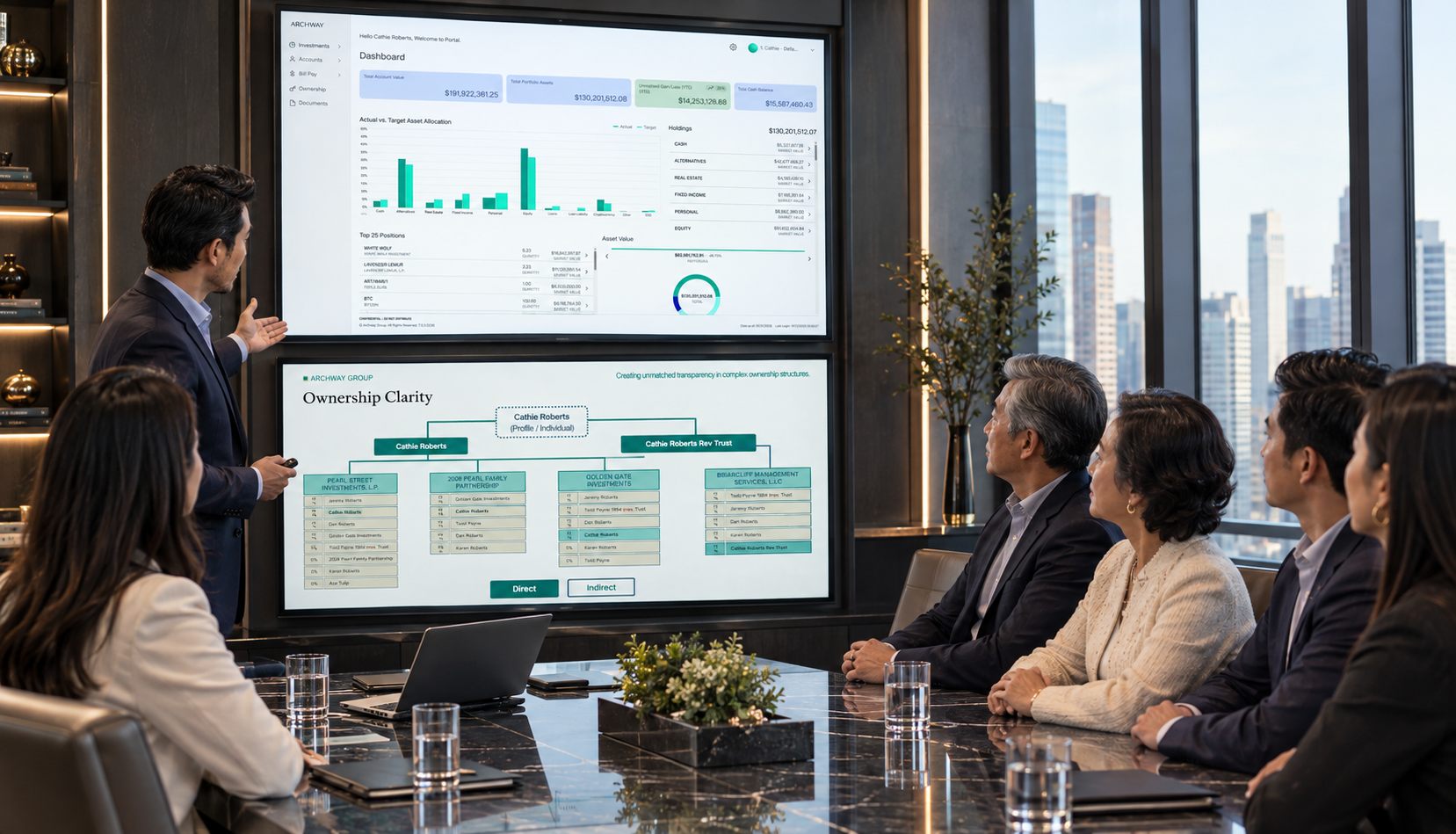
The data challenges described in this post are precisely the problems the Archway Platform was designed to solve. For nearly 25 years, Archway has helped family offices and financial institutions aggregate, consolidate, standardize, and manage their key financial data and documents.
The Archway Platform addresses core data readiness challenges in several ways:
- Consolidated data in a single environment. The platform brings together accounting and investment data across custodians, asset classes, and currencies, eliminating the fragmented, multi-silo environments. With a single, reconciled source of financial truth, AI tools have the clean, comprehensive dataset they need to function effectively.
- Structured, auditable financial data. Archway's foundational general ledger automatically books journal entries as transactions are processed, producing well-labeled, consistently formatted data as a natural byproduct of normal operations, exactly what AI systems require.
- Alternative investment data ingestion. Through ingestion tools and partnerships with companies like Canoe Intelligence and Arch, the platform streamlines the extraction and processing of alternative investment data. Capital calls, distribution notices, K-1s, and fund statements are among the most persistent data gaps for family offices seeking AI-ready data, and they are handled more efficiently within the platform.
- Built for complexity and scale. The platform is designed for the unique demands of UHNW family offices, including multi-entity structures, multi-generational ownership, and multi-asset portfolios. As data needs grow, the platform scales with them.
For family offices looking to build the data foundation that makes AI possible, Archway provides both the technology and operational support to get there.
Artificial Intelligence will reshape wealth management, but the firms that benefit most will be those building to enable it. That means investing in the data infrastructure, governance, and processes outlined throughout this series, not just pursuing AI on its own.
The question is not whether AI will transform the industry. It will. The more important question is which organizations will be ready to harness it effectively.
The family office is paying twice — once for the accounting system, once for the reporting system — and waiting for them to agree.


Related reading