





Article
·
time
-min
read
·
May 22, 2026
Is Your Data Ready for Artificial Intelligence?
Frames AI readiness around the quality, structure, and accessibility of family office data, including fragmentation, privacy, and scalability challenges.

Ethan Wishnick
·
Chief Operating Officer
Topics
AI
Software
Categories
Family Offices & Artificial Intelligence
In a previous post, Catherine Fankhauser, Partner and Practice Leader of Family Office Advisory Services at Ernst & Young (EY), joined our CEO, Anthony Abenante, to outline five steps Family Offices should take when starting an AI journey. "Having good data" topped the list. In this post, I want to go deeper on what that means in practice.
AI Demands Better Data
Artificial intelligence represents more than an incremental technology upgrade, it offers a fundamental transformation in how family offices can operate. Advanced AI systems promise capabilities that were once the stuff of science fiction: real-time portfolio optimization across all asset classes, predictive analytics for market movements and liquidity needs, automated compliance monitoring, intelligent tax optimization, and natural language interfaces for complex financial queries, analysis, and reporting.
These capabilities, however, are built on a foundation of quality data. Unlike traditional software that can function on partial or inconsistent inputs, AI systems depend fundamentally on comprehensive, well-structured, and properly labeled datasets. The AI readiness gap facing family offices is therefore not primarily about AI technology itself -- it is about the underlying data infrastructure required to make AI effective.
The Data Challenges Facing Family Offices are Unique
Family offices differ from other financial organizations in four critical ways, and understanding these differences is essential to addressing their data challenges:
- Diverse asset portfolios. Family offices manage holdings that extend well beyond public securities to include private equity, real estate, hedge funds, collectibles, family businesses, and other alternative investments. Each asset class generates different types of data with varying levels of reporting frequency, standardization, and transparency.
- Multiple external service providers. Family offices typically work with custodians, prime brokers, fund administrators, tax advisors, and legal counsel, each maintaining separate data systems with different formats and update frequencies. This creates a naturally fragmented data environment where consolidation is a persistent challenge.
- Sensitive family information. Beyond financial assets, family offices manage estate plans, philanthropic activities, and personal data that require strict confidentiality. These privacy requirements can conflict with the data aggregation and sharing mechanisms that AI systems typically rely on.
- Wide variation in size and sophistication. Many single-family offices operate with lean teams and limited technology resources, making large-scale data initiatives especially challenging.
Fragmentation: The Core Data Problem
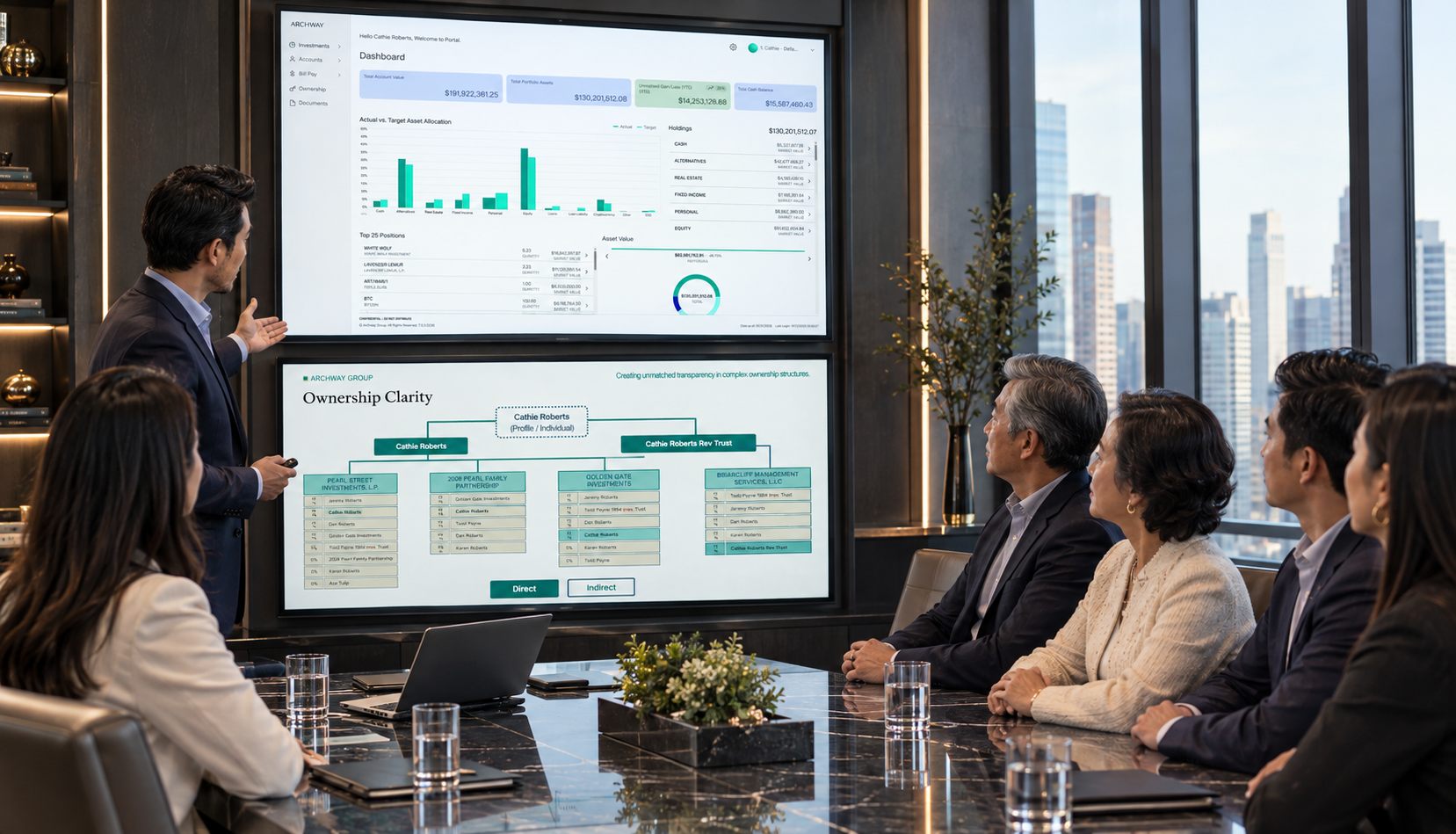
The most pervasive data challenge facing family offices is fragmentation. Investment holdings data are frequently dispersed across an array of disconnected systems, creating several problems for AI implementation. Machine learning algorithms require integrated datasets to identify patterns and generate insights and when data resides in isolated silos, AI systems lose the holistic view essential for meaningful analysis.
Data silos also increase the risk of inconsistency and duplication. The same investment may be recorded differently across systems, which confuses AI models and can lead to erroneous conclusions.
The Multi-Custodian Problem
Many family offices maintain relationships with multiple custodians to access specialized services, manage counterparty risk, or accommodate the preferences of individual family members. While this diversification offers operational benefits, it significantly complicates data management.
Historical Data Gaps
AI and machine learning models typically require substantial historical data to train effectively and identify meaningful patterns. Family offices may have years of investment history, but accessing that data in structured, usable formats is often difficult. Legacy systems may have been replaced, historical records may exist only on paper or in PDFs, and data standards may have shifted over time.
Even when historical data exists electronically, it may rely on outdated categorizations or lack key fields needed for modern analysis. Without adequate historical data, AI models cannot perform back-testing or learn from past market cycles.
Privacy Requirements
Family offices manage highly sensitive information that extends well beyond financial data to include personal family matters, health information, estate plans, philanthropic intentions, and business strategies. Protecting this information can limit or complicate access to certain datasets needed for AI implementation.
Family Offices Must Evolve
Many family offices rely on legacy technology systems that were never designed with AI integration in mind. These systems may lack modern APIs (Application Programming Interfaces) or data export capabilities that AI tools require.
The rapid evolution of AI also means that a leadership team's expertise can quickly become outdated. Continuous learning is essential. Family office staff need opportunities to develop new skills, experiment with emerging technologies, and stay current with industry developments, which requires investment in training, professional development, conference attendance, and collaboration with academic institutions or industry groups. Organizations that cultivate a learning culture -- one where experimentation is encouraged and failure is tolerated -- are better positioned to adapt to technological change.
Finally, family offices are not static entities, and data infrastructure must accommodate growth without requiring constant re-architecture. An AI platform that performs well with $500 million in assets across 50 positions may struggle when a portfolio grows to $2 billion across hundreds or thousands of positions spanning multiple asset classes and jurisdictions. Scalability must be a design priority from the outset.
Preparing for What’s Next
AI has the potential to reshape how family offices operate, but meaningful results depend on the strength of the data foundation beneath it. For many organizations, the challenge is not a lack of information, but fragmented systems, inconsistent reporting, and operational complexity that limit visibility and scalability. As portfolios expand across asset classes, entities, custodians, and jurisdictions, these challenges only intensify, increasing the need for structured, integrated, and reliable data.
In Part 2, we’ll explore what it takes to move forward in practice, including how to strengthen data strategy and align the right operating model. Effective AI starts with disciplined accounting and a clear operational foundation. At Archway, we combine purpose-built technology with deep accounting expertise to help family offices bring structure and consistency to increasingly complex environments.
Related reading