




Article
·
time
-min
read
·
May 25, 2021
What Is Integrated Family Office Technology (and 45 Other Fintech Terms Family Offices Should Know)
Defines common family office technology and fintech terms, helping family office teams understand the language used in software evaluations and technology strategy.

Chelsea Francis
·
Head of Strategy
Topics
Software
Industry
Categories
Technology Due Diligence
A Glossary of Common Terms and Phrases Used by Family Office Technology Providers
Family offices in and of themselves use a language all their own. But intermingled with technology terms, it can be difficult to understand the jargon that is regularly used to describe family office software solutions and the problems they help solve.
To help you establish a basic understanding of the terms we—and many technology firms like us—use regularly, we’ve put together a list of simple definitions so that you can feel more comfortable engaging in a discussion around family office technology.
A
Account: A portfolio managed by a financial institution or a group of like assets such as hedge funds, private equity investments or personal assets.
Aggregation: The process of assimilating data across an individual’s or family’s assets—including cash, equities, fixed income, alternative investments, real estate and personal assets—to present a total net worth picture.
Application Programming Interface (API): A set of tools that allow a family office’s entire technology ecosystem to communicate by programmatically passing secured data between applications.
B
Best of Breed Family Office Technology: A solution with a singular, business-specific function such as alternative investment data aggregation systems, real estate management software, trust accounting platforms, performance reporting applications, expense management tools and document managers.
C
Cash Management: The operation of ensuring a family office has sufficient cash flow or liquidity to cover expenses.
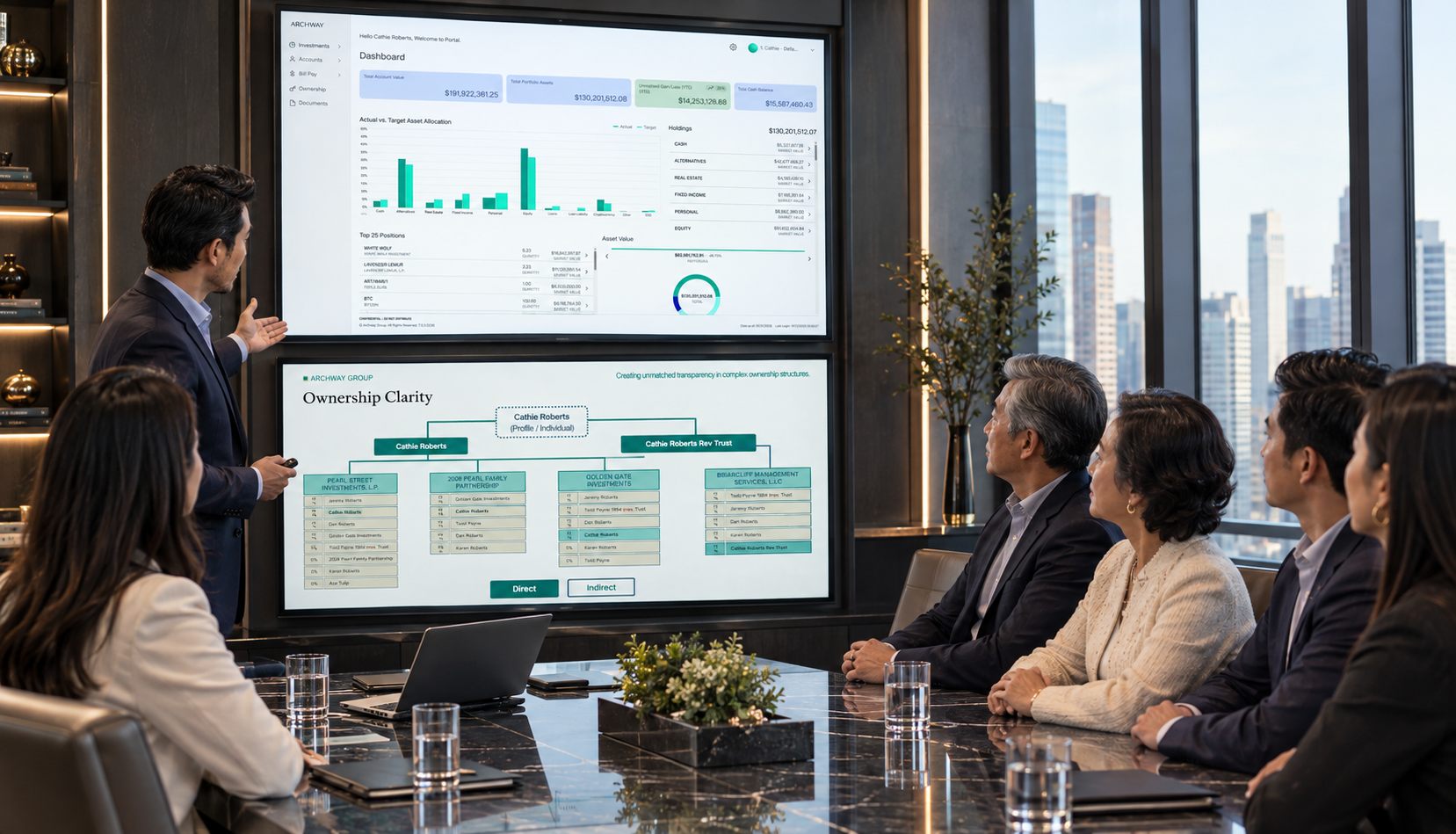
Client Portal: An end-client facing digital reporting tool used to present the individual wealth owner’s total net worth and overall financial position within the family office.
Consolidation: See Aggregation.
D
Data Feed: Programs that automatically retrieve data files on a recurring basis from banks, custodians, brokerage firms and other outside vendors. The files may include daily transaction activity, security pricing, reconciliation data and cash balances.
Drill-Through: The ability to access underlying detail from summary-level financial reporting dashboards. Also can be used to describe the ability to navigate from one screen to another to access supplemental or related information.
E
Entity: A legal entity such as a trust, partnership, foundation, holding company, operating company or individual that requires its own set of financial reports. Most family offices are comprised of many entities.
Exposure: An individual wealth owner’s allocation of an entity’s underlying assets.
F
Family Office Ecosystem: The complete set of technology platforms and third-party service providers that are used to run a family office.
Financial Statements: A collective term used to describe the core set of financials produced by a family office including the balance sheet, income statement, trial balance and cash flow statement. Sometimes this term is broadened to include the entire suite of family office financial reporting, which may include performance, risk, allocation, exposure and holdings reports.
G
General Ledger System: Accounting technology leveraged by family offices that uses a core chart of accounts to balance debits and credits to ultimately track and report on underlying accounting detail.
H
Hybrid Technology Model: The use of software applications by family office staff to manage core, value-add operations while leveraging an outsourcing partner to handle ancillary functions due to capacity or specialization issues.
I
Implementation: The process of standing up a technology solution to reflect the structure of your family office, including entities and their underlying accounts, ownership, investment profiles and accounting rules.
In-House Technology Model: The use of technology by family office staff to manage the full breadth of family office operations and services.
Integrated Family Office Technology: All-in-one family office systems that offer comprehensive functionality across multiple business disciplines—like accounting, investment data aggregation and financial reporting—that utilizes a single, underlying data warehouse.
Integration: See Data Feed.
Investment Reporting: The suite of reports focused on analyzing investments across the family office including reports that depict time-weighted and money-weighted performance returns, Multiple on Invested Capital (MOIC), risk analytics and other relevant investment metrics.
L
Letter of Authorization (LOA): A document granting third-parties, such as technology providers, access to client account information held by outside financial institutions.
Look-Through Reporting: A type of reporting that can be used to consolidate direct and indirect holdings across multiple entities and layers of ownership within a family office.
M
Master/Feeder Structure: See Nesting.
Mobile Responsiveness: The ability for an application to automatically adapt to fit the screen size of multiple devices including smartphones, tablets, laptops and desktops.
N
Nesting: An investment, tax and family office structuring strategy whereby entities own other entities, creating multiple layers of ownership within a family office.
Net Worth: The aggregated value of an individual’s holdings including cash, equities, fixed income, alternative investments, real estate and personal assets, less any liabilities or money owed.
O
Outsourcing Model: Utilizing a third-party service provider to manage and execute the core operations of a family office.
P
Performance History: The collection of data spanning an investment’s entire lifecycle to enable inception-to-date and period-to-date performance comparisons.
Performance Reports: A subset of investment reports produced by family offices to measure the return on investment (ROI) for an individual asset or group of assets.
Portfolio: See Account.
Portfolio Management System: Financial technology used by family offices that aggregates, normalizes and reports on account (portfolio) information.
Profile: See Wealth Owner.
Proof of Concept: A compilation of use-cases designed by the family office to help them validate that a technology solution is capable of handling specific scenarios and core operations.
Q
Query: Unformatted data extracts that can be rendered in .csv or .xls formats to allow family office staff to apply custom formatting or transpose into third-party systems.
R
Reporting Dashboard: A set of on-screen reports, often customizable, that provide summary-level financial insights that are relevant to family office professionals and high-net-worth individuals. Dashboards often feature drill-through capabilities to provide quick access to underlying details.
Risk Analytics: Insights that help family offices measure an investment’s risk profile. Examples may include Sharpe Ratio, standard deviation, drawdown, alpha and beta.
S
Security: An investment or asset owned by a high-net-worth family or individual.
Security Master: The library of investments owned across a family office that are stored and categorized within a financial technology platform.
System Configuration: See Implementation.
T
Third-Party Data Aggregator: A data provider that links with thousands of banks, custodians and brokerage firms to retrieve basic financial information.
Treasury: See Cash Management.
U
User Interface: The front-end of a software application where you are able to input data and interact with the platform’s tools.
User Experience: The usability of a software application’s user interface, such as the ability to quickly add data and intuitively navigate the platform’s tools.
W
Wealth Owner: An individual family member with an ownership stake in all or a portion of the family’s assets.
Widgets: A software component, such as a reporting dashboard insert, that can be added and customized for the end-user.
Now that you have a handle on your family office fintech vocabulary, it’s time to put it into action. Schedule a call with a member of the Archway Family Office Services team to discuss how our family office technology and service solutions can help your family office address its accounting, investment data aggregation and financial reporting challenges.
Related reading