





Article
·
time
-min
read
·
August 4, 2026
5 Signs Your Family Office Has Outgrown Spreadsheets
Spreadsheet dependency often develops gradually, creating hidden costs through manual workflows, fragmented data, and increasingly complex reporting processes. As family offices grow, a centralized financial foundation becomes essential for improving visibility, reducing operational risk, and supporting long-term scalability.

Richard Griffith
Topics
Operations
Categories
Family Office Software
Financial Reporting
The Hidden Costs of Spreadsheet-Driven Family Office Operations
Most family offices do not wake up one morning and decide to build a spreadsheet-driven operating model.
It happens gradually.
A spreadsheet created to solve one reporting challenge becomes two, then ten. Over time, critical financial information becomes dispersed across workbooks, shared drives, email attachments, and manual processes. What began as a practical solution transformed into operational dependency.
For many organizations, that dependency develops quietly. Reporting continues to be delivered. Financial statements are produced. Capital activity is tracked. Ownership schedules are maintained. The process may not appear broken, but the effort required to sustain it increases with every new entity, investment, account, and stakeholder added to the environment.
The issue is not Excel itself. Spreadsheets remain one of the most valuable tools available to finance professionals. The challenge emerges when spreadsheets evolve from analytical tools into systems of record that support critical family office accounting, reporting, and operational processes.
As family offices grow more complex, the hidden costs of spreadsheet-driven operations become increasingly difficult to ignore.
Why Spreadsheet Dependency Persists
For many family offices, spreadsheets offer speed, flexibility, and familiarity—enabling quick reporting and custom analysis without relying on technology resources. That flexibility is valuable, but it also drives deep reliance on spreadsheets in daily operations.
Over time, they become the default solution for increasingly complex needs: investment data in one workbook, ownership in another, capital accounts elsewhere, and reporting assembled manually. Individually manageable, these processes collectively create an operating environment that is difficult to scale, govern, and sustain.
Where the Real Effort Is Hidden
When finance and operations teams evaluate their reporting processes, they typically focus on whether reports are ultimately delivered accurately and on time. While those outcomes matter, they do not always reveal the amount of effort required to achieve them.
Many family offices spend significant time collecting information from custodians, investment managers, banks, accounting systems, fund administrators, and third-party providers before reporting can even begin. Data must be validated, reconciled, reformatted, consolidated, and reviewed. Adjustments are made manually, and supporting schedules are frequently maintained outside core systems.
This work is often treated as a normal part of the reporting cycle because it has existed for years. But the true cost is the cumulative burden created by hundreds of manual activities across every close, every reporting cycle, every capital activity update, and every year-end process.
When Complexity Outgrows the Spreadsheet
Family office environments present operational challenges that differ significantly from those of mature businesses with enterprise-scale finance organizations.
Many organizations manage multiple legal entities, trusts, partnerships, foundations, operating companies, investment vehicles, and family ownership structures simultaneously. Reporting requires information to be consolidated across operating entities, investment entities, trusts, partnerships, and beneficiaries. Capital account reporting, partnership allocations, intercompany activity, trust distributions, and investment reporting all introduce layers of complexity that are difficult to manage when information resides across disconnected spreadsheets.
As complexity grows, spreadsheets become increasingly difficult to maintain. A change to an ownership structure may require updates across multiple workbooks. A new investment may introduce additional reporting requirements. Partnership allocations must be calculated, validated, and reflected consistently across capital accounts. Intercompany transactions must be reconciled. Custodian data must be normalized before it can be used in consolidated reporting for family offices.
Even straightforward reporting requests will require substantial manual effort when accounting data, investment data, ownership records, and supporting schedules are maintained across different files and systems.
Several warning signs often emerge.
- Reporting Cycles Become Longer
Finance teams spend more time gathering and validating information before analysis and reporting can begin. Month-end, quarter-end, and year-end processes become increasingly dependent on manual coordination, especially when reporting packages require data from multiple custodians, investment managers, entities, and accounting schedules.
- Reconciliations Become More Difficult
Multiple versions of the same information begin to exist across different files and teams. Custodian data may not match accounting records. Investment manager statements may need to be reconciled against internal books. LP capital account balances may require manual validation before year-end reporting or K-1 production can move forward.
- Knowledge Becomes Concentrated
Critical reporting processes become dependent on a small number of individuals who understand how spreadsheets were built, linked, and maintained. If a controller, accountant, or operations lead leaves, the family office may lose the institutional knowledge behind how key reporting, allocation, and reconciliation processes actually work.
- Visibility Declines
As information becomes fragmented across systems and files, it becomes more difficult to obtain a complete view of financial activity across the organization. Leadership may struggle to quickly understand liquidity positions, entity-level exposures, ownership relationships, and overall portfolio performance without waiting for manual consolidation.
- Growth Creates Additional Strain
What worked effectively for ten entities may not work for fifty. What worked for a handful of investments may not work for hundreds. As entities, accounts, partnerships, and reporting stakeholders increase, the effort required to sustain spreadsheet-driven processes often grows faster than the team supporting them.
These challenges create operational and investment risk. They also affect confidence.
Why This Matters More Than Ever
Family offices have the volume, complexity, and pace of information more akin to large and mature business yet maintain lean staffing more like a small business.
Many entities have significant or complex accounting and accounts payable needs. Investment portfolios are more diversified. Reporting expectations continue to rise. Stakeholders expect faster access to information and greater transparency across assets, entities, and ownership structures. At the same time, many family offices are being asked to do more with lean teams and finite resources.
Many organizations are also exploring automation, advanced reporting capabilities, and artificial intelligence to improve efficiency and decision-making. These initiatives have real potential, but they depend on one common prerequisite: reliable data.
Organizations cannot automate inconsistent processes. They cannot generate meaningful insights from fragmented information. They cannot fully benefit from AI if the underlying data lack’s structure, consistency, and governance.
Technology can accelerate existing processes, but it cannot compensate for poor data quality.
Excel Still Has an Important Role
None of this suggests that family offices should eliminate spreadsheets.
Excel remains one of the most effective tools available for financial analysis, forecasting, budgeting, modeling, and scenario planning. It provides flexibility that many systems cannot replicate.
The objective is not to remove spreadsheets from the finance function. The objective is to ensure that spreadsheets support analysis rather than serve as the primary repository for critical operational and financial information.
Organizations that establish this distinction are often better positioned to improve family office reporting, strengthen controls, reduce operational risk, and support future growth.
How Archway Can Help
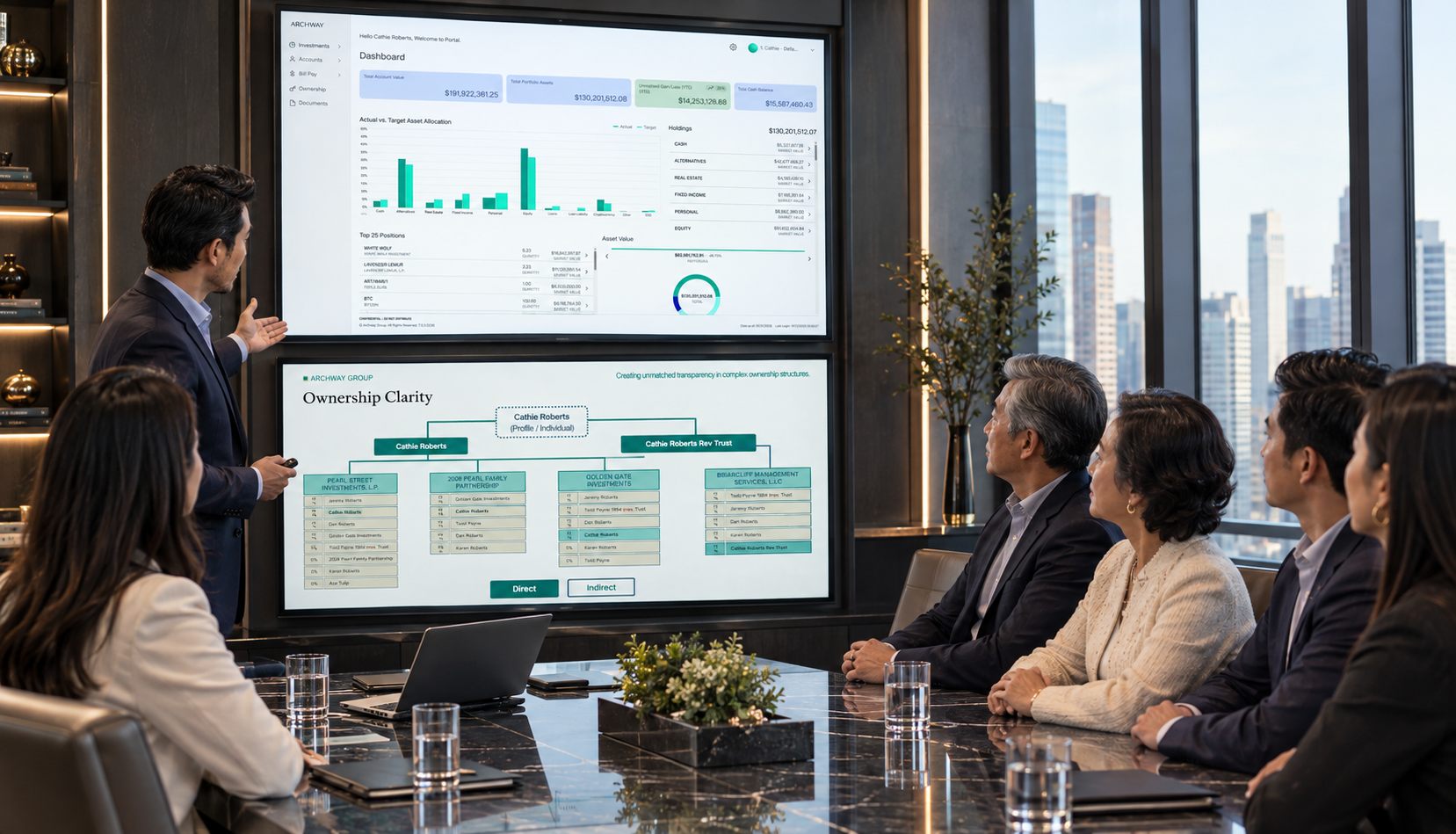
Archway helps family offices bring accounting, investment data, and reporting together within a single platform.
With support for multi-entity accounting, complex ownership structures, capital account accounting, consolidated reporting, and family office-specific workflows, Archway helps reduce manual effort while improving visibility, consistency, auditability, and control.
That matters in the areas where spreadsheet dependency creates the most strain: ownership allocations, entity-level reporting, intercompany reconciliation, capital account tracking, and the ability to trace numbers back to the source.
For organizations seeking additional support, Archway’s Family Office Accounting services can help with bookkeeping, accounting, investment reporting, and related operational workflows.
The result is a stronger foundation for reporting, governance, scalability, and long-term growth.
Looking Ahead
Spreadsheet dependency is often a symptom of growth. As family offices become more sophisticated, the operating practices that once supported the organization may become increasingly difficult to sustain.
The next step is not simply replacing spreadsheets. It is creating a stronger foundation for financial data, reporting, governance, and decision-making.
In the next article, we explore what that foundation looks like and why it has become increasingly important as family offices prepare for a future shaped by automation, advanced reporting, and artificial intelligence.
Operational clarity begins with a centralized foundation for financial data and reporting.


Related reading