




Article
·
time
-min
read
·
November 30, 2022
4 Things Archway Platform℠ Users Can Learn from One Another
Explains how Archway Platform users learn from one another through shared use cases, underused tools, reporting ideas, and peer community discussions.

Natalie Peters
·
Relationship Manager
Topics
Software
Operations
Industry
Categories
Family Office Software
Client Service
Family Office Trends
The Importance of a Family Office Software User Community
At Archway Family Office Services, we have always prided ourselves on our ability to understand the nuances of our ultra-high-net-worth clients. Our teams have extensive experience working through complex issues and one-off scenarios that are unique to family offices and private wealth management organizations. We are, by all accounts, well suited for the job.
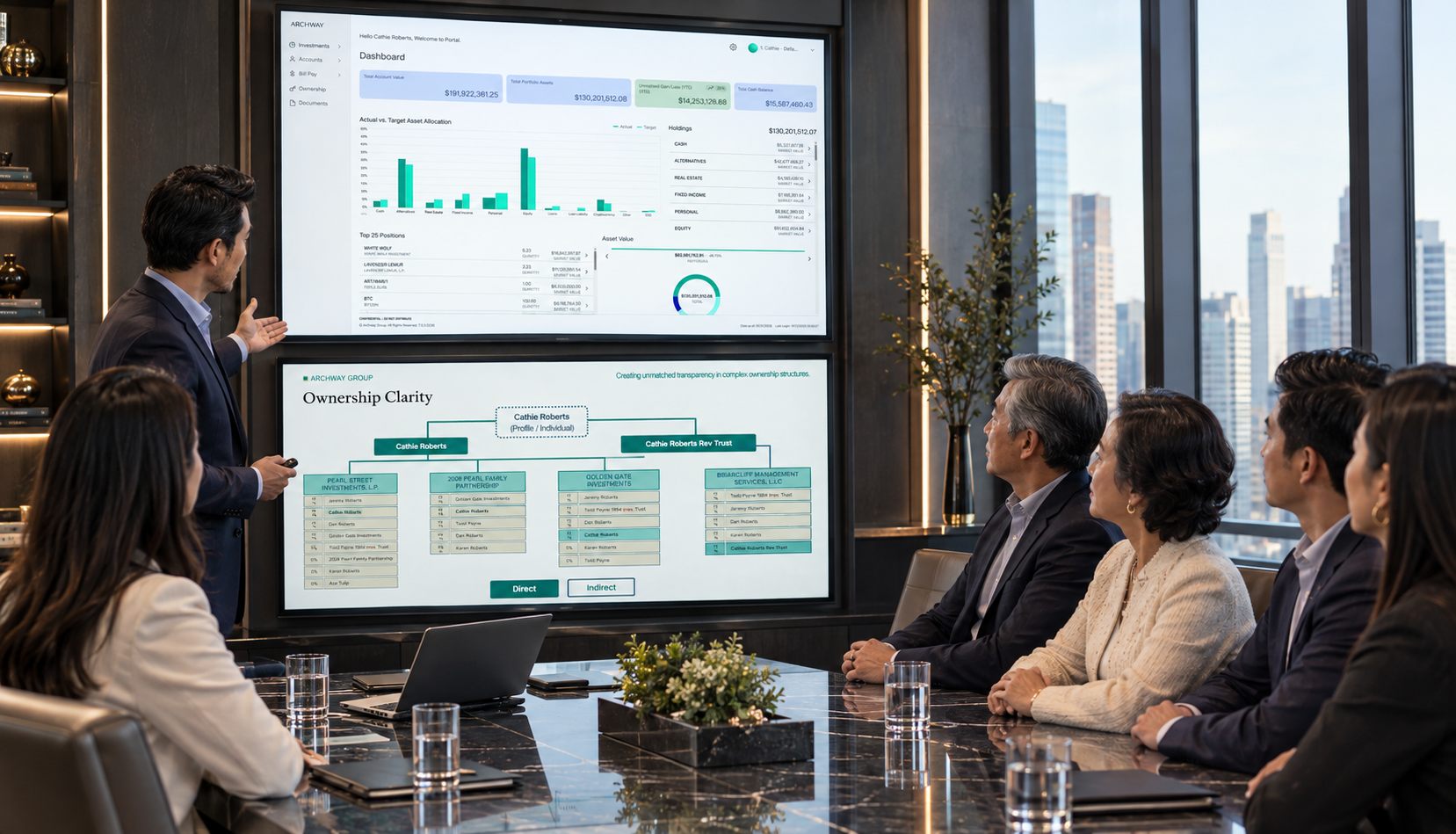
We’ve helped hundreds of family offices leverage the Archway Platform to support critical facets of their operations like central disbursement entities, multi-layered ownership structures, complex equity transfers, and family member-specific reporting requirements.
But even our most tenured team members will tell you: There is no substitute for the opportunity to problem solve amongst your peers.
As mentioned in our blog discussing the what, where, who, and why of Archway’s exclusive Archway Platform User Conference, IMMERSION, the leading request from our clients is access to other members of our family office user community.
So what exactly can family offices who share a common wealthtech solution—say, the Archway Platform—learn from one another?
1. How family offices are using the Archway Platform to solve complex issues.
The evolution of family offices and the development of family office software are undeniably intertwined. As the needs of family offices have shifted over the years, so has the Archway Platform’s suite of tools.
With each product upgrade, we’ve introduced new functionality, built efficiencies and automation into the application, and enhanced the capabilities of our existing tools. As a result, our users have found that there’s often more than one way to do the same thing in the system.
And while we offer release notes, product documentation, and system training, sometimes the easiest way to learn something is to hear from someone else that’s already using it.
Common in-app operations that our clients discuss with one another include:
- How to transfer ownership based on different scenarios, and which Archway Platform tool is most suitable for the desired outcome
- Best practices when using the Archway Platform’s reconciliation tools
- Usage of alternative asset-specific tools to track activity and report on investments
- Accounts payable processes best practices
- Creating ad hoc reports and recurring family member report packages
- Archway Client Portal use cases and adoption strategies for family members and outside stakeholders
2. What Archway Platform tools they could be utilizing, but aren’t today.
When a client begins discussing how they’re using the Archway Platform to solve complex issues, this often leads to another user saying, “We hadn’t thought of doing it that way!”
The fact of the matter is, it’s our human nature to create routines and processes. If a process works, we don’t necessarily go out looking for another way to do it. But, when a step in the process changes, it presents an inflection point: Is there a better way to do this?
And when it’s time for our clients to find that answer, Archway Family Office Services offers multiple channels:
- Reach out to the Archway Family Office Services Client Relations team for product support
- Engage with the Archway Platform Training team for consulting on a new process
- Pose that exact question to other Archway Platform users through a variety of forums and idea exchanges in our secure, online client support portal
Although it’s widely accepted that each family office has its own unique way of operating, we frequently find that there are common threads that tie them together. While our clients’ experiences may not be identical, users may have experienced similar scenarios that can nonetheless lead to the adoption of new tools and the implementation of new processes.
3. Which reports they can use to answer challenging financial questions.
Reporting is the pinnacle of family office wealthtech. It is, after all, how family offices and the family members they advise render and make sense of the data that’s been collected, entered, and validated in the technology. So it’s no surprise that reporting is one of the most comprehensive functions that exists in the Archway Platform.
With a suite of tools consisting of an extensive report library, raw data queries, dashboards, and a client reporting portal, users of the Archway Platform have a variety of options when it comes to reporting on their financial data.
That said, in a perfect world, family office professionals would have plenty of free time to explore the report library, try out new queries, and customize reporting dashboards. But day-to-day responsibilities often prevent that.
So what’s a quick and easy way to discover new reporting ideas? Clever report configurations? Unique data classifications and groupings?
Enter: The Archway Platform user community.
By inquiring with other users to learn what reports they’re using, which metrics they’re leveraging, and how they’re applying parameters and data groupings, family offices can quickly identify the right combination of reports, data points, and formats to get the output they desire—straight from the individuals that have walked the same path.
4. How family offices are handling situations that have nothing to do with the software.
Perhaps the most important thing family offices can learn from one another has nothing to do with technology or operations at all.
As anyone who works in the family office arena knows, it can be excruciatingly difficult for family offices to connect with other family offices. And while there are a variety of family office membership organizations and events that can help, family offices are, generally speaking, incredibly private and confidential, making networking and communicating with one another challenging.
Understanding that gap and recognizing the commonality of our client base, we created a trusted community in which all of the members share a unifying theme: Usage of the Archway Platform.
Sustained through national and regional user conferences, virtual peer dialogues, online user forums, and brokered introductions, our family office software user community presents our clients with the unique opportunity to connect and build relationships with other family office professionals.
Through their expanded network, our clients have gone on to create a variety of breakout peer groups that frequently get together to discuss the issues they face as family offices—whether it pertains to the Archway Platform or not.
These peer groups, though born out of their common usage of the Archway Platform, have grown across a much wider spectrum, where family office professionals can discuss trust law, tax planning, family office restructuring, burgeoning investment strategies, talent acquisition, process documentation and new hire training, and so much more. The community has flourished.
To learn more about joining the Archway Platform user community, schedule a call with a member of our team to discover how other family offices and private wealth management firms are using Archway’s purpose-built wealth management solutions.
Related reading



.png)