





Family Office Accounting
The family office that runs. So you don't have to.
The right family office operation is invisible to the people it serves. The principal doesn't think about the close. The advisor isn't chasing data before the quarterly review. The CFO isn't managing a back-office that can't keep pace. The reporting is ready. The payments cleared. The books held. Archway has run the family office function since 2002 — financial reporting, investment reporting, and cash and expense management — on one general ledger, by one team, under one engagement.

The problem we're solving
The complexity doesn't announce itself. It accumulates.
A new entity was added to the structure. A property acquisition that needs its own financials. A capital event that changes the reporting picture. A principal who needs answers before the quarter closes. An advisor who needs consolidated data before the client review. A CFO managing a back-office that was built for half the complexity it's now carrying.
None of it is insurmountable in isolation. The problem is that the books, the payments, the investment reporting, and the financial statements all have to hold together, across every entity, every account, every asset class, and they all have to be defensible. To the auditor. To the principal. To the next generation inheriting the structure.


Most families reach this point one of three ways. The principal who never wanted to run an office and now effectively is. The advisor whose clients need more operational support than the advisory relationship was built to provide. The CFO whose in-house operation is technically functional but stretched thin.
Archway has run family office accounting since 2002. One general ledger, one accounting team, one engagement — financial reporting, investment reporting, and cash and expense management, handled end-to-end.
How it works
One general ledger. Three core services. One team running them.
Financial reporting, consolidated investment reporting, and cash and expense management — all running on the same general ledger that holds the family's book of record. The dedicated team closing the books is the same team processing the payments and producing the reports. There is no handoff between operations because there is no second system.
01・
Cash and Expense Management
Every payment handled. Every transaction posted. Nothing falling through.
Invoice intake, approval routing, payment creation and reconciliation. Household staff payroll, property management payments, vendor relationships, principal expenses. Every payment posts to the general ledger as a journal entry the moment it clears. The audit trail is complete. The principal doesn't manage the process. The CFO doesn't chase it down.
02・
Consolidated Investment Reporting
Every position reconciled. Every account consolidated. Every report drawn from the same source.
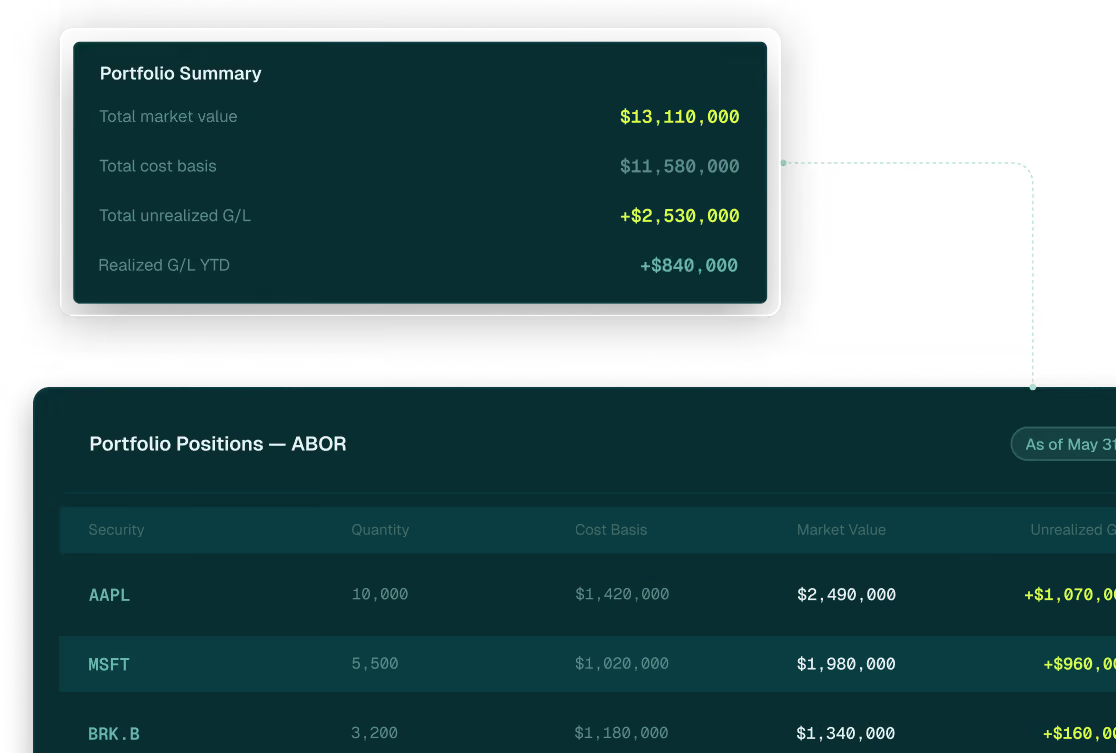
Public and private markets. Liquid and illiquid assets. Every account from every institution reconciled at the position level and posted to the general ledger. Portfolio reconciliation happens at the source. Not imported from a separate system, not reconciled after the fact. Performance reporting, look-through entity reporting, and asset allocation analysis are the output of that accounting work, not a layer built on top of it.
03・
Financial Reporting
Complete and on time month, quarter or year end financial statements.
Every entity in the family's structure — trusts, LLCs, family partnerships, operating businesses, real estate holdings — on one general ledger. Journal entries, period close, financial statements, and audit trail maintained by Archway's accounting team. The CFO has a back-office that keeps pace. The principal has a book of record they can hand to the board or an auditor without preparation. The advisor has financials ready before the client review.



Three ways to run the office
Outsourced is the default. Technology and Hybrid are available for families with existing in-house capacity.
Every family runs on the same platform, the same general ledger, the same book of record — regardless of how they choose to deploy. The Outsourced model is what most families on this service choose. Technology and Hybrid exist for families with existing in-house staff they want to retain, or who want to bring some of the operation in-house over time.
Technology
Your team runs the office on the platform.
For families with existing in-house staff — a controller, a bookkeeper, an operations head — who want to keep the work in-house while running on Archway's platform. Your team manages bookkeeping, payments, reporting, and the portal through the Archway Platform with full access to every capability. Archway provides implementation, training, and ongoing support.
Outsourced
Archway runs the office. The family doesn't.
Archway's accountants and bookkeepers run the bookkeeping, payments, reporting, and portal — end to end. The family or the family's advisor sees the deliverables. The work happens behind the scenes. One dedicated team, one engagement, one point of contact. Most families on this service choose this model.
Hybrid
Your team runs part of the office. Archway runs the rest.
The split is wherever the family or the advisor wants it. Some operations in-house, others handled by Archway. Because both teams work on the same general ledger, there is no handoff, no version gap, no reconciliation step between what your team produces and what Archway produces.
Who runs the office
The service scales to the structure. The standard doesn't change.
Whether a single family office, a multi-family office, or a private bank managing the relationship — the operational complexity is the same. What changes is how Archway fits into the engagement.
Single Family Offices
Multi-Family Offices
Private Banks
Private Funds
For the household that needs the function, without building the firm.
A principal household with complex holdings, multiple entities, and no desire to staff and manage a back-office operation. Archway is the extension of your team and runs the books, the payments, and the reporting end-to-end — financial reporting, consolidated investment reporting, and cash and expense management — on one general ledger, by one dedicated team. The principal has a full family office function without the overhead of running one. The CFO, where one exists, has a back-office that keeps pace with the complexity they're managing.

For the operating firm that needs consistent delivery across every family.
Growth shouldn't mean adding operational headcount for every family you bring on. Archway's family office accounting services run under your firm's engagement, while remaining operationally isolated per family and delivering consistent service across all of them. White-labeled to your brand. Archway is invisible to your clients. The infrastructure scales with your book. The service standard holds regardless of how many families it serves.

For the advisor whose clients need more than the advisory relationship was built to provide.
Families with operational complexity — entity accounting, bill pay, consolidated reporting across custodians, private investments, and illiquid assets — that sits outside the scope of wealth management. Archway runs the family office function alongside the advisory relationship, under your engagement. The family gets a full back-office operation. You stay the relationship of record. Archway stays behind the scenes.
And because the consolidated view spans every account, every custodian, and every asset class the family holds, not just what sits on your platform, the advisor sees the full picture. That's not just better reporting. It's the foundation for a more strategic conversation with the client.

Capital calls, distributions and fund expenses — run by the team closing the books.
Capital call processing, distribution management, expense allocation, and vendor payments — administered by Archway's fund operations team on the same general ledger that closes the books. The team processing the cash movements is the team closing the quarter. Same ledger. Same discretion. Same audit trail.


Clients stay for the team
"Outsourcing bill pay and a portion of our entity accounting to Archway has let us run a leaner internal team without giving up timeliness or control. Because the platform and services sit with the same firm, our staff isn't the coordinator between two vendors."
Single Family Office
·
Chief Investment Officer


FAQ's
The questions we hear most. Answered directly.
Do we have to take the full service, or can we start with one piece?
The service is modular. Families and advisors can begin with investment reporting, reconciliation, cash and expense management, or a broader financial reporting engagement. The scope is defined around the work you need Archway to perform, the complexity of the family’s structure, and the operating model you want to maintain.
What's the difference between financial reporting and investment reporting?
Investment reporting is the consolidated asset view: every position, account, and asset class included in the reporting scope, reconciled and reported from the general ledger. Financial reporting includes investment reporting and adds the full accounting function, including entity-level accounting, period close, budget-to-actual reporting, financial statements, and audit trails across the family's structure. If you need the books closed and the financials produced, that is financial reporting. If you need consolidated investment reporting without the full accounting function, see our Consolidated Investment Reporting solution.
Is the bill pay service always included?
No. Bill pay, invoice intake, approval routing, payment processing, vendor management, and household payroll support can be included as part of a broader financial reporting engagement or scoped as a standalone service – see our Cash and Expense Management solution. Families with existing accounts payable infrastructure do not have to use our bill pay service, while families that need broader operational support can add it at any point.
How does pricing work?
Pricing is based on the scope of the engagement, including the service model, number of entities, and complexity and volume of the investment portfolio. Specific pricing is provided after an initial conversation and scoping process.
What does onboarding look like for a complex family structure?
Archway runs a structured onboarding process that may include setup, historical data migration, entity mapping, chart of accounts configuration, reporting consultation, and training before go-live. For complex structures with multiple entities, accounts, and private investments, Archway defines a realistic implementation plan during scoping and manages the process end to end.
What does the family or advisor actually see?
The Archway Portal gives clients, families, and advisors access to financial statements, investment reports, capital account data, and documents under your firm's brand. Archway is not visible to the end family unless you want it to be. Tax preparers and external advisors can be granted access to specific data sets without seeing the full platform.
If Archway runs the books, what visibility do we retain?
Full visibility, at all times. The general ledger is yours, and the data is yours. Your team, whether an in-house CFO, advisor, or principal, can log into the platform and see the books in real time. Archway runs the operation. You retain complete oversight and control.
How do you handle private investments and alternatives without clean data feeds?
Private investments, illiquid assets, and alternatives without automated feeds can be supported through document-based or manual workflows, depending on available information and engagement scope. Statements, capital account notices, K-1s, and valuation reports can be posted to the general ledger by Archway's accounting team. Manual or document-based data does not automatically exclude an asset from reporting.
Start the conversation
Every family office is different. The conversation should be too.
A short call with someone who has run the books at the level your operation runs at. If Archway is the right fit, we'll show you how. If we aren't, we'll say so.
Tell us about your situation — the entities, the complexity, what's working and what isn't. We'll take it from there.
Loading contact form…

Article
·
Single Family Offices
time
-min
read
The Distinction That Gets Overlooked
Most family offices have built serious investment and portfolio reporting. They know what the family holds, what it is worth, and how it has performed. That visibility is necessary. It is not sufficient.
Investment reporting tells you the family holdings and their value. Partnership accounting tells you who owns what, on what basis, under what agreement, and what the accounting, tax and legal consequences are of every allocation, distribution, and transfer. A family office with one but not the other is making decisions on incomplete information and creating liabilities it will not recognize until they surface in an audit, a family dispute, or a K-1 that does not match what someone was told to expect.
Partnership accounting sits at the intersection of investment operations, tax, and estate planning. It is one of the most technically demanding functions inside a family office, and one of the most consequential when it goes wrong. Here is why it is harder than it looks, and where most family offices fall short.
Why Partnership Accounting Is Uniquely Complex
Family offices use partnership and LLC structures extensively: investment holding, estate planning, liability isolation, generational wealth transfer, governance. While the structures themselves are not unusual, the combination of competing demands makes administering them so challenging.
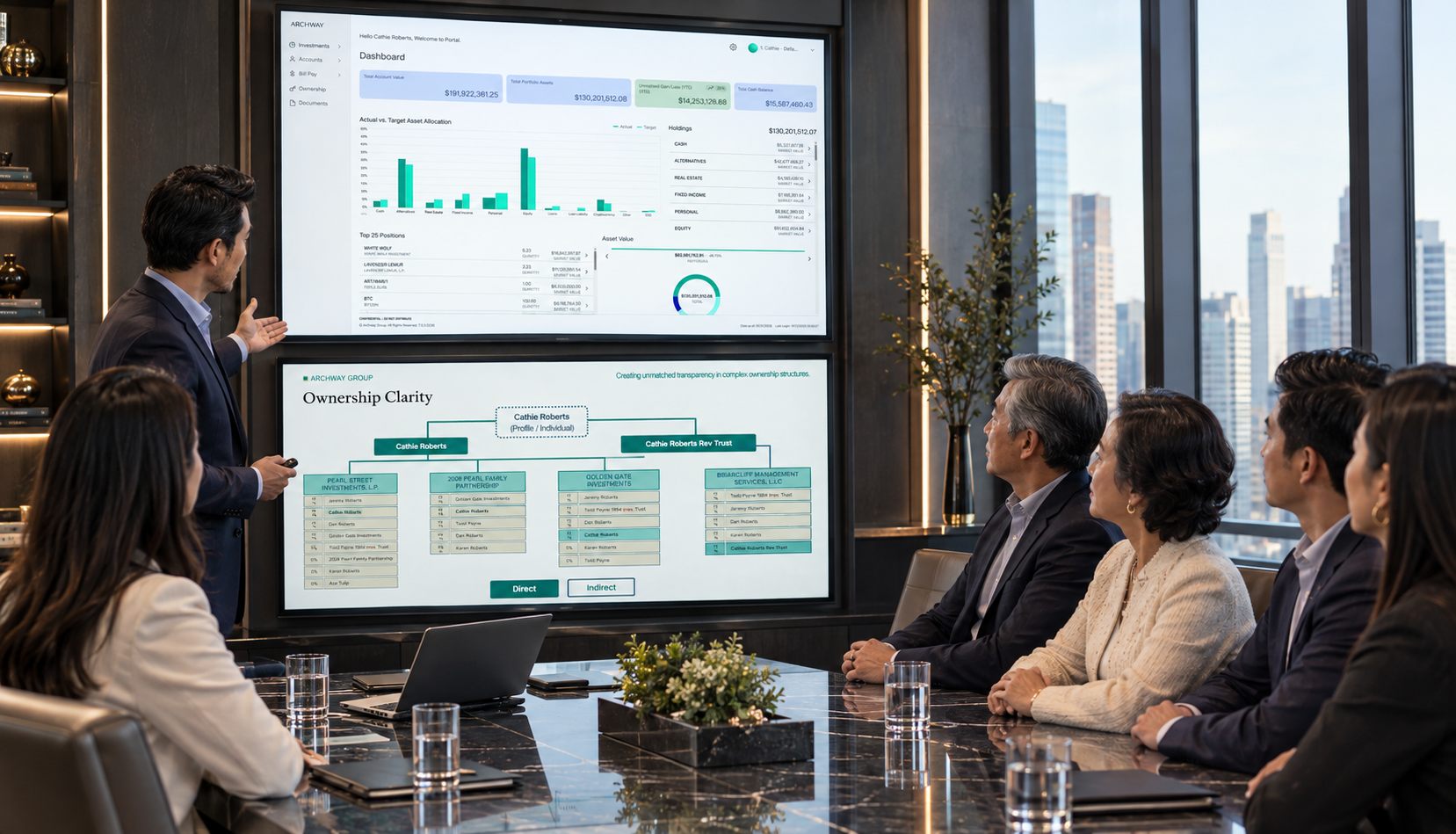
Ownership structures are layered and bespoke. A single investment may sit inside a holding LLC, which feeds a family partnership, which distributes to individual family members through trusts established at different times for different purposes. Each layer needs its own set of books. Getting consolidated reporting right means looking through every layer, eliminating intercompany balances so the same asset is not counted twice, and showing each beneficial owner their true economic exposure across the full structure. Most of these structures were built for estate planning or tax efficiency, not operational simplicity, and few follow a standard template.
We start with the governing documents which define preferred interests, profit interests held by family members, stuffing and other special allocations that split income, and gains differently across branches of the family. The accounting follows the governing documents precisely, and general-purpose platforms were not built for that level of complexity and layering.
Book to tax is an annual scramble. Most family offices run on a cash or accrual basis all year, then hand everything to an external tax advisor to convert to tax basis and prepare Form 1065s and K-1s. That process is only as good as the records underneath it. In a layered structure, one entity's K-1 feeds the next entity's return before that return can be completed, so the reconstruction starts from the bottom up, one layer at a time. In a structure with nested trusts, holding LLCs, and family partnerships, that can mean dozens of entities and weeks of professional time before a single K-1 is produced.
The increase in illiquid asset investments increases the long tail in valuations further complicating the matter. Private equity, real estate, hedge funds, direct investments: most do not price daily, and some have no formal valuation cadence at all. Without a policy for carrying values between valuation dates, the family office waits on every manager and appraiser before it can close the books. Many do exactly that. Consolidated reporting arrives 90 or more days after quarter end, well after it could have informed the decision it was meant to support.
Capital accounts require daily reconciliation. Every contribution, distribution, allocation, and transfer between entities, including in-kind transfers of real estate or private securities must be captured and posted accurately, or the account quickly stops reflecting reality. Left unaddressed, small discrepancies compound until reconciling them becomes a project rather than a routine.
Amid the myriad functions that are already stretching small finance teams, communication becomes its own layer of complexity. Why one branch of the family received a different allocation than another is not always self-evident, even when it is entirely correct under the partnership agreement. Those nuances are easily resolved through proactive communication, adding yet another step that needs to be thoughtfully managed by the same small team.
Where Most Family Offices Fall Short
The common failure is not a single mistake. It is an accumulation of workarounds that made sense at a time. A spreadsheet built to handle one partnership becomes the model for five. The one accountant who understands the allocation logic never writes it down. K-1 season is an annual scramble because partnership accounting and investment reporting live in two systems that were never built to agree.
Family offices are also investing more in formal governance: investment committees, valuation policies, approval matrices. J.P. Morgan's 2026 Global Family Office Report found that 48% of business-owning families have established formal governance bodies, compared with 40% of non-business-owning families. But governance defines control and accountability. Operations determine whether the controls are actually followed. Knowing where decisions are made means little if the numbers they need are being assembled by hand.
The result is not necessarily wrong numbers. It is a fragile operation: accuracy depends on specific people staying in their seats, reporting always runs a quarter behind, and the governing documents, investment reporting, and accounting records have quietly drifted apart in ways nobody has fully mapped. When a key person leaves, or the family's complexity outgrows the infrastructure supporting it, the cost of reconstruction is always higher than the cost of building it right would have been.
How Archway Can Help
Archway's platform maintains multi-entity ownership structures, parallel capital account bases, and allocation logic configured to the terms of each governing document. Investment reporting and partnership accounting run on the same general ledger, so the number in the report and the number in the books are the same number.
For family offices that also need accounting support, Archway’s Family Office Accounting team works as an extension of the family office’s own staff. The staffing challenges that make partnership accounting fragile in most family offices (attrition, coverage during leave, demand spikes at audit season and tax time) become Archway's to manage, not the family office's. The family gets consistent, high-quality accounting that does not depend on one person staying in their seat.

Article
·
Single Family Offices
time
-min
read
Data Alone Isn’t Enough: The Next Stage of AI Readiness
Earlier in this series, we discussed why “having good data” is one of the most important first steps in any artificial intelligence strategy. Clean, accurate, and organized information creates the foundation AI systems rely on to generate meaningful insights and support better decision-making.
However, data quality is only one piece of the equation. For Family Offices and wealth management organizations, AI success also depends on the infrastructure, governance, integrations, and operational processes surrounding that data. Even strong datasets can create challenges when information is fragmented across systems, managed inconsistently, or difficult to access in real time.
The next stage of AI readiness is about creating an environment where data can move efficiently, securely, and intelligently across the organization. In this article, we’ll explore what that looks like in practice and why operational readiness is becoming just as important as data quality itself.
Phase 1: Data Governance and Stewardship
Effective data management requires clear governance structures that define roles, responsibilities, and decision-making authority. Who owns the data? Who is responsible for data quality and integrity? Who approves sensitive data access requests? Who sets data retention policies? Clear answers to these questions are essential.
In family offices, governance is further complicated by the involvement of multiple stakeholders: family members, investment staff, external advisors, and service providers, each of whom may have different views on data priorities, privacy requirements, and acceptable uses. Establishing and maintaining consensus requires active governance mechanisms.
For AI specifically, governance policies must address additional questions: What data can be used for model training? How should models be validated before deployment? What level of human oversight is required for AI-generated recommendations? How are model decisions documented and explained? Who can deploy new AI capabilities?
Governance must also extend to third-party service providers. How are they using your data? What safeguards are they maintaining, particularly for the most sensitive information?
Phase 2: Foundation Building
Before deploying sophisticated AI capabilities, family offices must establish solid data foundations. This phase focuses on four priorities:
- Comprehensive data inventory. Catalog all data sources, document their contents and update frequencies, identify gaps and quality issues, and map data flows between systems. This baseline understanding clarifies what data resources exist and where improvement is needed.
- Data consolidation. Deploy a data lake or similar solution to create a unified view of family office assets and eliminate siloed information.
- Data quality processes. Implement validation rules, exception reporting, and correction workflows. Define data ownership and accountability. Establish metrics for measuring quality and track improvements over time.
- Data catalogs. As data ecosystems grow in complexity, the ability to find and understand available data becomes critical. Data catalogs inventory available datasets, document their contents and lineage, and facilitate discovery. For AI implementations, they help data scientists identify relevant datasets, support model debugging, and facilitate impact analysis when data sources change. Maintaining comprehensive data catalogs, however, requires dedicated effort and appropriate tooling.
Phase 3: Targeted AI Pilots
With foundational data infrastructure in place, family offices can begin experimenting with AI through targeted pilot projects. Pilots serve multiple purposes: demonstrating value, building internal expertise, uncovering unforeseen challenges, and refining implementation approaches.
Successful pilots share common characteristics. They address well-defined problems with measurable outcomes, leverage data that is already relatively clean and accessible, have executive sponsorship and appropriate resources, and include mechanisms for capturing lessons learned.
Example pilot projects might include:
- Portfolio rebalancing optimization using machine learning to minimize tax impact
- Document processing automation for extracting data from fund statements or K-1 tax forms
- Anomaly detection for identifying unusual transactions or market movements
- Natural language processing for analyzing investment research reports or earnings call transcripts
Phase 4: Scaling and Integration
Successful pilots provide the foundation for broader AI adoption. The scaling phase focuses on expanding AI capabilities across additional use cases, integrating AI insights into decision-making workflows, and building organizational muscle memory for maintaining and improving AI systems.
This phase requires balancing expansion with sustainability. Adding new AI capabilities without corresponding investments in data infrastructure, governance, and talent can produce poor results. Successful scaling requires disciplined program management, continued focus on data quality, and ongoing capability development.
Best Practices and Recommendations
Start with Data, Not Algorithms
The allure of sophisticated AI models can tempt organizations to prematurely focus on algorithm selection and model development. Resist this temptation. No algorithm, however advanced, can compensate for poor-quality or inaccessible data. Invest first in data infrastructure, quality, and governance, including the unglamorous but essential work of data cleaning, standardization, and consolidation.
Embrace Incremental Progress
Transformative AI capabilities are built incrementally, not through sweeping all-at-once implementations. Start with focused projects that deliver tangible value quickly, use early wins to build momentum and secure resources, and iterate based on experience. This approach reduces risk, facilitates learning, and maintains stakeholder engagement.
Build Privacy and Security In
Security and privacy cannot be afterthoughts. Design data architectures with privacy preservation from the outset. Implement encryption, access controls, and audit logging while consistently evaluating outside vendors rigorously on their security practices.
Develop Governance and Internal Capabilities
Establish a clear governance structure and processes early. Invest in internal capabilities through hiring, training, and hands-on experience. Even small family offices can cultivate basic data literacy and AI fluency among existing staff; internal expertise enables more effective vendor management and supports long-term sustainability.
Measure and Monitor
Establish metrics for evaluating AI initiatives. Track data quality indicators, model performance, user adoption rates, and business impact. Regular monitoring surfaces issues early, supports continuous improvement, and demonstrates value to stakeholders. What gets measured gets managed, and that principle extends to third-party providers as well.
Build vs. Buy
Organizations must determine the right approach to their data management challenges. Building internal capabilities offers control and customization but requires significant investment. Purchasing packaged solutions from third-party providers can enable faster, more cost-effective deployment but may sacrifice flexibility. A hybrid approach, combining in-house capabilities with external service providers, potentially guided by consultants or advisors, is another viable path. The right choice depends on organizational size, available resources, and technology sophistication.
How Archway Can Help
The data challenges described in this post are precisely the problems the Archway Platform was designed to solve. For nearly 25 years, Archway has helped family offices and financial institutions aggregate, consolidate, standardize, and manage their key financial data and documents.
The Archway Platform addresses core data readiness challenges in several ways:
- Consolidated data in a single environment. The platform brings together accounting and investment data across custodians, asset classes, and currencies, eliminating the fragmented, multi-silo environments. With a single, reconciled source of financial truth, AI tools have the clean, comprehensive dataset they need to function effectively.
- Structured, auditable financial data. Archway's foundational general ledger automatically books journal entries as transactions are processed, producing well-labeled, consistently formatted data as a natural byproduct of normal operations, exactly what AI systems require.
- Alternative investment data ingestion. Through ingestion tools and partnerships with companies like Canoe Intelligence and Arch, the platform streamlines the extraction and processing of alternative investment data. Capital calls, distribution notices, K-1s, and fund statements are among the most persistent data gaps for family offices seeking AI-ready data, and they are handled more efficiently within the platform.
- Built for complexity and scale. The platform is designed for the unique demands of UHNW family offices, including multi-entity structures, multi-generational ownership, and multi-asset portfolios. As data needs grow, the platform scales with them.
For family offices looking to build the data foundation that makes AI possible, Archway provides both the technology and operational support to get there.
Artificial Intelligence will reshape wealth management, but the firms that benefit most will be those building to enable it. That means investing in the data infrastructure, governance, and processes outlined throughout this series, not just pursuing AI on its own.
The question is not whether AI will transform the industry. It will. The more important question is which organizations will be ready to harness it effectively.

Article
·
Single Family Offices
time
-min
read
In a previous post, Catherine Fankhauser, Partner and Practice Leader of Family Office Advisory Services at Ernst & Young (EY), joined our CEO, Anthony Abenante, to outline five steps Family Offices should take when starting an AI journey. "Having good data" topped the list. In this post, I want to go deeper on what that means in practice.
AI Demands Better Data
Artificial intelligence represents more than an incremental technology upgrade, it offers a fundamental transformation in how family offices can operate. Advanced AI systems promise capabilities that were once the stuff of science fiction: real-time portfolio optimization across all asset classes, predictive analytics for market movements and liquidity needs, automated compliance monitoring, intelligent tax optimization, and natural language interfaces for complex financial queries, analysis, and reporting.
These capabilities, however, are built on a foundation of quality data. Unlike traditional software that can function on partial or inconsistent inputs, AI systems depend fundamentally on comprehensive, well-structured, and properly labeled datasets. The AI readiness gap facing family offices is therefore not primarily about AI technology itself -- it is about the underlying data infrastructure required to make AI effective.
The Data Challenges Facing Family Offices are Unique
Family offices differ from other financial organizations in four critical ways, and understanding these differences is essential to addressing their data challenges:
- Diverse asset portfolios. Family offices manage holdings that extend well beyond public securities to include private equity, real estate, hedge funds, collectibles, family businesses, and other alternative investments. Each asset class generates different types of data with varying levels of reporting frequency, standardization, and transparency.
- Multiple external service providers. Family offices typically work with custodians, prime brokers, fund administrators, tax advisors, and legal counsel, each maintaining separate data systems with different formats and update frequencies. This creates a naturally fragmented data environment where consolidation is a persistent challenge.
- Sensitive family information. Beyond financial assets, family offices manage estate plans, philanthropic activities, and personal data that require strict confidentiality. These privacy requirements can conflict with the data aggregation and sharing mechanisms that AI systems typically rely on.
- Wide variation in size and sophistication. Many single-family offices operate with lean teams and limited technology resources, making large-scale data initiatives especially challenging.
Fragmentation: The Core Data Problem
The most pervasive data challenge facing family offices is fragmentation. Investment holdings data are frequently dispersed across an array of disconnected systems, creating several problems for AI implementation. Machine learning algorithms require integrated datasets to identify patterns and generate insights and when data resides in isolated silos, AI systems lose the holistic view essential for meaningful analysis.
Data silos also increase the risk of inconsistency and duplication. The same investment may be recorded differently across systems, which confuses AI models and can lead to erroneous conclusions.
The Multi-Custodian Problem
Many family offices maintain relationships with multiple custodians to access specialized services, manage counterparty risk, or accommodate the preferences of individual family members. While this diversification offers operational benefits, it significantly complicates data management.
Historical Data Gaps
AI and machine learning models typically require substantial historical data to train effectively and identify meaningful patterns. Family offices may have years of investment history, but accessing that data in structured, usable formats is often difficult. Legacy systems may have been replaced, historical records may exist only on paper or in PDFs, and data standards may have shifted over time.
Even when historical data exists electronically, it may rely on outdated categorizations or lack key fields needed for modern analysis. Without adequate historical data, AI models cannot perform back-testing or learn from past market cycles.
Privacy Requirements
Family offices manage highly sensitive information that extends well beyond financial data to include personal family matters, health information, estate plans, philanthropic intentions, and business strategies. Protecting this information can limit or complicate access to certain datasets needed for AI implementation.
Family Offices Must Evolve
Many family offices rely on legacy technology systems that were never designed with AI integration in mind. These systems may lack modern APIs (Application Programming Interfaces) or data export capabilities that AI tools require.
The rapid evolution of AI also means that a leadership team's expertise can quickly become outdated. Continuous learning is essential. Family office staff need opportunities to develop new skills, experiment with emerging technologies, and stay current with industry developments, which requires investment in training, professional development, conference attendance, and collaboration with academic institutions or industry groups. Organizations that cultivate a learning culture -- one where experimentation is encouraged and failure is tolerated -- are better positioned to adapt to technological change.
Finally, family offices are not static entities, and data infrastructure must accommodate growth without requiring constant re-architecture. An AI platform that performs well with $500 million in assets across 50 positions may struggle when a portfolio grows to $2 billion across hundreds or thousands of positions spanning multiple asset classes and jurisdictions. Scalability must be a design priority from the outset.
Preparing for What’s Next
AI has the potential to reshape how family offices operate, but meaningful results depend on the strength of the data foundation beneath it. For many organizations, the challenge is not a lack of information, but fragmented systems, inconsistent reporting, and operational complexity that limit visibility and scalability. As portfolios expand across asset classes, entities, custodians, and jurisdictions, these challenges only intensify, increasing the need for structured, integrated, and reliable data.
In Part 2, we’ll explore what it takes to move forward in practice, including how to strengthen data strategy and align the right operating model. Effective AI starts with disciplined accounting and a clear operational foundation. At Archway, we combine purpose-built technology with deep accounting expertise to help family offices bring structure and consistency to increasingly complex environments.

Article
·
Single Family Offices
time
-min
read
A New Way to Synthesize, Visualize, and Analyze Family Office Data
With reporting at the center of nearly every family office software buying decision, the Archway Platform has offered a robust suite of reporting tools since its earliest days.
Launching with a raw database export capability, a handful of in-app performance visualizations, and roughly two dozen statement-style reports, the Archway Platform’s reporting foundation was set out of the gates.
Within the first five years of being on the market, the solution’s feature set quickly grew to include over 40 distinct reporting options.
By 2009, the Archway Platform featured more than 90 reports within its standard report library and users were first introduced to the concept of dynamic dashboards for quick, on-screen consumption of data. In 2012, the platform’s first standalone client portal application, dubbed FOIL, was released.
Over the course of the next decade, the standard report library ballooned to more than 200 parameter-driven reports, thousands of queries were built, dozens of dashboard inserts were rolled out, data grid customization was implemented throughout the application, and the Archway Client Portal was further enhanced to be an on-demand, mobile reporting tool for end-clients and family members.
Together, the Archway Platform’s standard report library, data queries, dashboards, custom data grids, and client portal served as a powerful, multi-faceted reporting engine.
But with an eye towards innovation, it was always clear that reporting is a function of our solution that can constantly be built upon: More metrics, more insights, more flexibility.
And so, in 2023, we introduced the Archway Platform’s report composer tool.
A unique, interactive reporting experience, the report composer functionality allows family offices to comprehensively analyze their enterprise data in a user-driven, self-service manner. Both elegant and powerful, the latest tool in the Archway Platform’s reporting suite grants nontechnical users the ability to create bespoke data views that deliver better insights and better reporting outputs for their needs.
Pulling from the Archway Platform’s vast database, family offices can assemble custom reports using raw data related to accounts payable, general ledger detail, investor activity, transactions, open positions, alternative assets, and other financial information.
But perhaps most important: The tool is inherently designed with versatility in mind. Featuring a drag-and-drop interface that enables users to build and edit custom reports in real-time, the report composer allows users to add, remove, and reorder data points—all without coding or custom development. And since the tool is embedded directly within the Archway Platform, users can dynamically group, sort, and filter their data based on their existing user-defined data classifications.
Using visualizations and charting tools like pie, bar, and line charts, users can further transform their data into meaningful analytics that help tell a story of trends, comparisons, and measurements.
Although a sophisticated reporting tool by nature, the Archway Platform’s report composer capability offers family offices yet another reporting mechanism built on the principle of simplexity: A simple interface that allows users to access and synthesize complex financial data on demand.
The report composer tool serves an important role in how family offices and advisors to high-net-worth families compile, communicate, and analyze their clients’ financial information, and seamlessly complements the existing suite of Archway Platform reporting capabilities.
Interested in seeing the report composer in action? Request a call with a member of the Archway Family Office Services team to schedule your live tour of the Archway Platform.

Article
·
Private Funds
time
-min
read
Evaluating Family Office Platforms for Specialty, Efficiency, and Connectivity
As a family office software provider, we talk about technology evaluations, well, a lot.
And when we talk about technology evaluations, it’s important to note that the conversation isn’t limited to prospective users and industry consultants trying to better understand our offering.
In fact, the most constant tech evaluation the team here at Archway Family Office Services participates in is the one we conduct ourselves: an ongoing assessment of how we can improve the Archway Platform and the private wealth management operations it supports.
But if you aren’t a technology provider to hundreds of family offices and financial institutions, this may not be a routine activity for you, which likely has you asking the question, “When should I reevaluate my family office technology?”
Here are three signs that it may be time to revisit your family office tech strategy.
Your technology is designed for the masses, but not for family offices.
Out-of-the-box general ledger, portfolio management, and performance reporting solutions work extremely well for out-of-the-box scenarios—scenarios of which family offices rarely encounter.
Common pain points family offices may experience with non-specialized technology include:
- Entity consolidations
- Partnership accounting
- Nested ownership calculations
- Centralized disbursements and bill payment
- Enhanced investment analytics
- Complex, multi-pronged transactions
- Net worth and financial report creation
If your family office has found itself experiencing one of the above challenges, it may be a good time to research purpose-built family office solutions—or, at the very least, engage with a consultant that can point you in the right direction.
If your family office has found itself experiencing many of the above challenges, it’s an even better time.
Despite having a technology solution in place, you still predominately rely on manual processes.
Ideally, when you implement a technology platform, your family office will see a negative correlation in manual work: More automation, less human intervention.
But when the solution in place is non-specialized, or simply ill equipped to handle the nuances of ultra-high-net-worth wealth, family office professionals may find themselves doing a significant portion of work outside of the system.
A few manual tasks here and there certainly isn’t enough to move the needle, but if you find that you are routinely performing manual rework in other applications, moving data to spreadsheets, writing physical checks, or building financial reports using presentation slides, it may be time to ask yourself if your current technology solution is serving its intended purpose—or if it’s just collecting digital dust.
Your current technology platform doesn’t connect with outside data providers or third-party systems.
Across industries, it’s generally accepted that technology silos can cause a variety of problems. Aside from clouding transparency and stunting collaboration, technology silos can prove to be a massive drain on efficiency. Often requiring duplicative data entry, technology silos at best waste resources, and at worst open the door to data discrepancies and risk across systems.
But technology silos and multiple systems don’t need to be synonymous. There can be immense value in selecting modern family office platforms that are able to communicate by securely passing relevant data to and from one another—whether through automated data feeds, APIs, or customizable data extracts and queries.
To that end, if your current family office tech stack lacks the ability to automatically collect data from multiple sources, integrate data across multiple systems, or produce comprehensive reporting, it may be worth reviewing the technology solutions that are preventing your family office from breaking down those verticals.
If your family office has seen the signs and is interested in revisiting your current tech stack, check out our simple wealthtech strategy evaluation to help you think through and build your organization’s long-term technology strategy.

Article
·
Single Family Offices
time
-min
read
A Look at 4 Key Areas of Strategic Focus Expected in 2023
As the end of the year looms near, so do project deadlines, final data reviews, and annual reporting deliverables. With family offices bogged down by the mechanics of reconciliations and closing the year-end books, strategic planning can unintentionally get pushed to the bottom of the pile.
But whether strategy is top of mind or not, the family office space is in flux—changing now more than ever—which warrants consideration of several key focus areas.
Outsourcing
Continuing a multi-year conversation, outsourcing has been a trending topic in the market for some time now. With more family offices reviewing internal operations and a growing appetite amongst financial institutions to offer a more holistic set of services to its ultra-high-net-worth clients, we at Archway Family Office Services believe outsourcing will continue to be the centerfold in the ongoing assessment of operations and resources.
Employed as a long-term strategy or as a trusted stopgap during unanticipated events, outsourced services can create meaningful capacity within family offices. Although family office outsourcing is often synonymous with professional services like tax and regulatory compliance or cybersecurity, it can also be impactful in core operational areas like data aggregation and reconciliation, partnership administration, and routine reporting.
Process automation
When the Archway Platform℠ was introduced in the early 2000s, it offered family offices the opportunity to automate the manual ticking and tying of prior decades. It offered automated data aggregation and the creation of financial statements and client reports. It offered automated partnership allocations, investment performance calculations, bill payment, and more. And all of this automation offered family offices something they’d long been after: Time.
Now 20 years later, countless technology solutions have been introduced to automate family office functions from A to Z, each offering a new layer of efficiency—and potentially adding hours back into the work week for family office professionals.
Enhanced analytics
Ultra-high-net-worth investors and next gen wealth owners are clamoring for data. They want more transparency, deeper insights, and a higher probability of success. For family office professionals, this translates into looking beyond traditional performance measurements and delivering enhanced analysis across a variety of metrics and results like attribution, benchmarking, value-at-risk, stress testing, exposure mapping, and what-if scenarios.
Entity and tax restructuring
While most family offices don’t endeavor to restructure every single year, certain events can lead to this conversation taking a front row seat during annual strategic planning. Impending tax laws, new regulations, and political posturing can all lead to an evaluation of a family office’s structure. But so can major changes to the nuclear family like deaths, births, divorces, or marriages.
As family offices and their tax attorneys consider tax advantages and implications, entity restructuring can help families weather the changes—political, social, environmental, or personal.
At Archway Family Office Services, we can’t overstate the importance of having the right family office software in place to manage the restructure, automate asset transfers, define new ownership, and validate the changes through reporting. With the help of the right tools, family offices can make the restructuring process feel nearly seamless—or at least as seamless as restructuring goes.
While it’s likely that your to-do list is long and the countdown to the New Year is short, we encourage family offices and advisors to high-net-worth clients to spend some time reviewing the outcomes of the past year and strategizing for the next.
![3 Common Family Office Technology Myths [And What to Expect Instead]](https://cdn.prod.website-files.com/6a171e486d27c62c8ac46f9e/6a4fed35069198a323060d9c_3%20Common%20Family%20Office%20Technology%20Myths.webp)
Article
·
Private Funds
time
-min
read
Debunking common family office software misconceptions
There are plenty of opinions when it comes to family office technology: Integrated versus best of breed, non-specialized versus purpose-built, in-house versus outsourced, IBOR (Investment Book or Records) versus ABOR (Accounting Book of Records). The list goes on.
And given the sheer number of opinions out there, occasionally a mistruth is bound to emerge. To help separate fact from fiction, here are three well-circulated myths about family office technology, and what you can expect instead.
Myth #1: You have to go it alone.
Selecting, implementing, and operating a technology platform can feel like an oversized task for family offices with limited staffing and capacity. Fearing that more sophisticated, purpose-built family office tools will compound resource constraints, it’s not uncommon for family offices to stick with non-specialized, seemingly low-maintenance software.
From their vantage point, without the internal infrastructure or headcount to support the ongoing maintenance of a new system, the likelihood of adoption is low.
Here’s the truth:
Utilizing generic software packages for general ledger, investment data aggregation, partnership accounting, bill payment, and client reporting can actually hinder efficiency. Burdened with manual processes and disconnected technologies that beckon duplicative work, this approach can ultimately require more time to manage than enterprise-level family office software.
On the other hand, it is true that dedicated family office tools are often accompanied by a bit of a learning curve, but the long-term gains in efficiency, dependability, and accuracy can be tremendous.
Technology doesn’t need to be exclusively managed by an organization’s in-house staff.
In many cases, technology vendors offer outsourced services that family offices can leverage to supplement their own staffing. Similarly, family offices can partner with consultants and contractors to assist with upfront technology implementations and offload recurring, resource-heavy operations, like portfolio reconciliation, partnership accounting, and monthly reporting.
By working alongside external teams with operational or technology-specific expertise, family offices can reap the benefits of dedicated family office technology, while lightening the operational load associated with day-to-day data management.
Myth #2: Siloed technology and specialized technology are one in the same.
The wealthtech boom over the past decade introduced a variety of solutions that are hyper focused on specific family office functions—areas like alternative assets, portfolio intelligence, risk analysis, manager due diligence, bill payment, data aggregation, and benchmarking.
With so many options, family offices may find themselves leveraging two, three, five, and sometimes more disparate solutions. Hence the myth that these solutions must live in mutually exclusive silos.
Here’s the truth:
Today’s family office tech stacks are indeed more sophisticated than ever. But family office technology is also displaying unprecedented levels of interconnectivity. From strategic partnerships across firms, like the recently expanded relationship between Archway’s Archway Platform℠ and Canoe Intelligence, to the widespread adoption of APIs, file exchanges, and data warehouses, family offices have an increasingly wide array of options when it comes to integrating their financial data hub.
Myth #3: Technology is an expense, not an investment.
Family office or not, industry-specific technology rarely comes cheap. Built according to the nuanced operations and unique data structures of its user base, purpose-built family office technology comes with a commensurate price tag. But simply because modern wealthtech costs more than legacy systems and spreadsheets, doesn’t mean it’s not worth the price.
Here’s the truth:
Like most things in business, you get what you pay for. And while adopting family office-specific tools comes with a cost, using non-specialized software does too.
Oftentimes undetected, these costs may not come in the form of a price tag on a license agreement, but make no mistake, your family office could be paying in manual rework, duplicative efforts, multi-step data entry, time-consuming consolidations, and labor-intensive reporting.
Meanwhile, investing in purpose-built, process-driven family office solutions can introduce automation, native workflows, validation systems, increased data accuracy, and enhanced reporting, all of which can pay dividends in terms of time and resources.
Which begs the question: What’s that worth to your family office?
Originally authored by Archway for publication on Family Office Exchange.

Article
·
Single Family Offices
time
-min
read
The Importance of a Family Office Software User Community
At Archway Family Office Services, we have always prided ourselves on our ability to understand the nuances of our ultra-high-net-worth clients. Our teams have extensive experience working through complex issues and one-off scenarios that are unique to family offices and private wealth management organizations. We are, by all accounts, well suited for the job.
We’ve helped hundreds of family offices leverage the Archway Platform to support critical facets of their operations like central disbursement entities, multi-layered ownership structures, complex equity transfers, and family member-specific reporting requirements.
But even our most tenured team members will tell you: There is no substitute for the opportunity to problem solve amongst your peers.
As mentioned in our blog discussing the what, where, who, and why of Archway’s exclusive Archway Platform User Conference, IMMERSION, the leading request from our clients is access to other members of our family office user community.
So what exactly can family offices who share a common wealthtech solution—say, the Archway Platform—learn from one another?
1. How family offices are using the Archway Platform to solve complex issues.
The evolution of family offices and the development of family office software are undeniably intertwined. As the needs of family offices have shifted over the years, so has the Archway Platform’s suite of tools.
With each product upgrade, we’ve introduced new functionality, built efficiencies and automation into the application, and enhanced the capabilities of our existing tools. As a result, our users have found that there’s often more than one way to do the same thing in the system.
And while we offer release notes, product documentation, and system training, sometimes the easiest way to learn something is to hear from someone else that’s already using it.
Common in-app operations that our clients discuss with one another include:
- How to transfer ownership based on different scenarios, and which Archway Platform tool is most suitable for the desired outcome
- Best practices when using the Archway Platform’s reconciliation tools
- Usage of alternative asset-specific tools to track activity and report on investments
- Accounts payable processes best practices
- Creating ad hoc reports and recurring family member report packages
- Archway Client Portal use cases and adoption strategies for family members and outside stakeholders
2. What Archway Platform tools they could be utilizing, but aren’t today.
When a client begins discussing how they’re using the Archway Platform to solve complex issues, this often leads to another user saying, “We hadn’t thought of doing it that way!”
The fact of the matter is, it’s our human nature to create routines and processes. If a process works, we don’t necessarily go out looking for another way to do it. But, when a step in the process changes, it presents an inflection point: Is there a better way to do this?
And when it’s time for our clients to find that answer, Archway Family Office Services offers multiple channels:
- Reach out to the Archway Family Office Services Client Relations team for product support
- Engage with the Archway Platform Training team for consulting on a new process
- Pose that exact question to other Archway Platform users through a variety of forums and idea exchanges in our secure, online client support portal
Although it’s widely accepted that each family office has its own unique way of operating, we frequently find that there are common threads that tie them together. While our clients’ experiences may not be identical, users may have experienced similar scenarios that can nonetheless lead to the adoption of new tools and the implementation of new processes.
3. Which reports they can use to answer challenging financial questions.
Reporting is the pinnacle of family office wealthtech. It is, after all, how family offices and the family members they advise render and make sense of the data that’s been collected, entered, and validated in the technology. So it’s no surprise that reporting is one of the most comprehensive functions that exists in the Archway Platform.
With a suite of tools consisting of an extensive report library, raw data queries, dashboards, and a client reporting portal, users of the Archway Platform have a variety of options when it comes to reporting on their financial data.
That said, in a perfect world, family office professionals would have plenty of free time to explore the report library, try out new queries, and customize reporting dashboards. But day-to-day responsibilities often prevent that.
So what’s a quick and easy way to discover new reporting ideas? Clever report configurations? Unique data classifications and groupings?
Enter: The Archway Platform user community.
By inquiring with other users to learn what reports they’re using, which metrics they’re leveraging, and how they’re applying parameters and data groupings, family offices can quickly identify the right combination of reports, data points, and formats to get the output they desire—straight from the individuals that have walked the same path.
4. How family offices are handling situations that have nothing to do with the software.
Perhaps the most important thing family offices can learn from one another has nothing to do with technology or operations at all.
As anyone who works in the family office arena knows, it can be excruciatingly difficult for family offices to connect with other family offices. And while there are a variety of family office membership organizations and events that can help, family offices are, generally speaking, incredibly private and confidential, making networking and communicating with one another challenging.
Understanding that gap and recognizing the commonality of our client base, we created a trusted community in which all of the members share a unifying theme: Usage of the Archway Platform.
Sustained through national and regional user conferences, virtual peer dialogues, online user forums, and brokered introductions, our family office software user community presents our clients with the unique opportunity to connect and build relationships with other family office professionals.
Through their expanded network, our clients have gone on to create a variety of breakout peer groups that frequently get together to discuss the issues they face as family offices—whether it pertains to the Archway Platform or not.
These peer groups, though born out of their common usage of the Archway Platform, have grown across a much wider spectrum, where family office professionals can discuss trust law, tax planning, family office restructuring, burgeoning investment strategies, talent acquisition, process documentation and new hire training, and so much more. The community has flourished.
To learn more about joining the Archway Platform user community, schedule a call with a member of our team to discover how other family offices and private wealth management firms are using Archway’s purpose-built wealth management solutions.

Article
·
Single Family Offices
time
-min
read
Everything you need to know about IMMERSION: Archway’s PlatformSM User Conference
When we ask our clients what would help them become even more successful, we get plenty of answers: Specialized functionality, new reports, more hours in the day. But time and time again, the answer that we hear most often—the one that is echoed over and over by family offices, regardless of location, size, or tenure—is the opportunity to connect with other family offices.
And so, nearly a decade ago, the IMMERSION User Conference was born.
Let’s take a look at the history of IMMERSION: What it is, where it happens, who attends, and why it’s become a mainstay in the Archway Family Office Services training program.
What is IMMERSION?
The IMMERSION User Conference is a multi-day training and networking event hosted by Archway Family Office Services. We invite our family clients from across the globe to join us for a three day immersive experience (see what we did there?), where they’re given the opportunity to:
- Receive firsthand training from our team of experts
- Preview new Archway Platform enhancements
- Join roundtables discussing family office best practices
- Hear from strategic partners about additional family office solutions
- Build their network of family office professionals
While at IMMERSION, attendees can choose from a menu of expertly curated, CPE-accredited sessions. Focusing on key functional areas of our family office software platform, these sessions deliver best practices, tips, and tricks in areas like troubleshooting system issues, completing reconciliations, managing accounts payable, tracking alternative investments, measuring performance, and producing family office reporting.
In 2016, we introduced our first-ever New User Workshop, giving new clients the opportunity to get up to speed prior to the more advanced sessions at the main conference. Not surprisingly, the New User Workshop has become a cornerstone of our event and has expanded to include not only new users, but existing users simply looking for a refresher on Archway Platform blocking and tackling.
Where does IMMERSION take place?
Since the inaugural IMMERSION was hosted in our hometown of Indianapolis, IN, in 2014, we’ve had the chance to collect plenty of feedback over the course of several events, allowing us to evolve the format of the event, the topics we cover, how we deliver the content, and even where we host the conference.
Following our first IMMERSION User Conference, we decided that we would alternate between the large global conference in even-numbered years and smaller, regional user conferences in odd-numbered years.
We followed this cadence through 2019, hosting two additional IMMERSION User Conferences in Indianapolis and a dozen regional user conferences across the country, from New York to Dallas to San Francisco—and many more in between.
But like most firms, Archway Family Office Services took IMMERSION virtual in 2020 and 2021 as we adjusted to the world around us. Broadcasting live from a pop-up studio in our Indianapolis office and powered by a newsroom-worthy studio crew, we were able to carry on the IMMERSION tradition despite the obstacles that inherently come with transitioning a typically in-person event to being fully online.
And now, in October 2022, we are back in-person and we’ve moved. This year, our global conference is being hosted in Austin, TX.
Who goes to IMMERSION?
IMMERSION is an exclusive, invitation-only event for our family office and private wealth clients. By bringing together a group of family office professional that all share a common usage of the Archway Platform, we create an intimate, secure environment where users can connect, share ideas, collaborate, and learn together.
Today, IMMERSION has become a core tenant of the Archway Family Office Services training program. Outside of its discernible popularity amongst clients, the event has grown be so much more than a training exercise for users.
IMMERSION is an opportunity for our team to connect with one another, to put faces to names, and build lasting relationships with our clients. Sure, we spend a lot of time talking about partnership accounting, performance validation, and data management.
But we spend an equal amount of time talking about the things that happen in our lives outside of the four walls we work within. IMMERSION is about discovery and learning and bringing people together: Some of the most human elements we all possess.
After 20 years working with family offices, the team at Archway Family Office Services understands how critical your technology partner—and the people who comprise it—is to your success. Which is why we invite our clients to come together for a day—or three—every year so that we can continue to grow together.
Discover the many ways Archway Family Office Services connects with our family office clients through education, support, and training in our mini ebook, Our Commitment to Exceptional Client Service.

Article
·
Single Family Offices
time
-min
read
Leveraging Family Office Software and Outsourced Services to Help Your Operations Stay Balanced
The very nature of a family office is to provide multiple services, across multiple households, across multiple generations. To that end, it goes without saying that family offices are rarely, if ever, afforded a singular operational focus.
The ubiquity of daily, multi-entity data management, routine monitoring of inflows and outflows, evolving investment strategies, shifting ownership structures, and seemingly always-on-the-horizon tax and reporting deadlines can make running a family office inherently challenging. Compounded by social, economic, and political influences, running a family office can truly become a balancing act.
And when you’re juggling that many balls at the same time, it can be difficult to know which ones to keep in the air and which to hand off to someone else.
Luckily, growth and innovation in the family office space have created a host of options to help lighten the operational burden.
Struggling with your family office’s financial data management? Evaluating or implementing a new technology solution? Wanting to connect with other family office professionals to talk shop? From purpose-built family office technology to exclusive family office communities, dedicated family office service providers, and experienced consultants, the answers are out there. You just need to know where to look.
Here are three universal strategies that can help your family office identify solutions and overcome its unique challenges—big or small.
Pursue all of the training, education, and networking opportunities.
You’ve probably said it, we’ve definitely said it, and you’ve surely heard it: We don’t know what we don’t know. But more often than not, someone is willing and able to help you learn—and what better way to connect and share experiences than through training, education, and networking events?
Nevertheless, even on our best days, when your capacity is already hitting the limiter, it can be hard to look at a new opportunity and say, “Yes, I want to add more to my plate.”
We get it: It’s hard to make time. We’ve all felt the pinch, but when it comes to training, education, and networking, we at Archway Family Office Services firmly believe it’s worth the reward.
Let’s look at a few examples:
Scheduling one-on-one or team training with your technology provider
Pros: Expand your knowledge of the application; Explore new tools and functionality; Smooth out workflows; Discover ways to automate processes and reduce clicks
Cons: Requires time out of your schedule; May incur a financial cost
Attending a family office conference
Pros: Connect with other family office professionals; Discuss alternative solutions to shared operational challenges; Learn about new technology and service providers; Gain insight into regulatory changes, investment trends, and other strategic topics
Cons: Requires time out of your schedule; May incur a financial cost
Among the weary, the busy, and the cost-conscious, a natural response is to say “I don’t have the time” or “It’s not in the budget.” But a shift in mindset to say “It is worth my time” or “It is worth the cost” can pave the way to new connections, elevated conversations, and creative ideas that just may hold the solution to your most stubborn challenges.
Don’t be afraid to outsource underserved operations.
Sometimes it’s not a matter of training, education, or networking—after all, even a creative solution can’t add hours to the day. And if you’re not in a position to hire additional staff, capacity challenges can quickly become overwhelming.
But the situation doesn’t have to be dire. The industry is laced with experienced, trusted service providers that specialize in family office operations.
Take Archway Family Office Services for example. Given our deep roots in family office software, it’s only natural that we offer outsourced services to our clients that either augment or replace their in-house usage of the Archway PlatformSM.
Ranging from portfolio reconciliation and consolidated client reporting to personal expense management and partnership administration, our menu of solutions helps our clients create a bespoke combination of technology and services that is right-sized for their family office or financial institution.
Still on the fence? Check out the Top 10 Reasons Private Wealth Managers Choose an Outsourcing Partner.
So, whether you’re looking for expertise in broader areas like financial data management and tax planning, or more niche areas like private foundation management and family governance, there’s a good chance you can find a service provider that specializes in it.
Which brings us to the world of consultants.
Partner with an experienced consultant.
When in doubt, reach out to a consultant.
Oftentimes leveraging in-depth assessments and contextual reviews, consultants are equipped to help make recommendations that are appropriately suited for your family office. Their range of expertise and their unbiased opinion can help your family office identify key pain points, evaluate viable solutions, partner with experienced technology and service providers, and implement long-term strategies.
Read How Consultants Can Help Family Offices to get a deeper understanding of the three primary roles of family office consultants: Administrative consulting, technology consulting, and operational consulting.
Contact Archway Family Office Services to find out how our suite of technology and service solutions helps our clients overcome their accounting, investment data aggregation, and reporting challenges.
Just need a suggestion for a family office consultant or conference? We can do that too.

Article
·
Single Family Offices
time
-min
read
What to Look for When Selecting Client Portal Technology for Your Family Office
Client portals have taken many shapes throughout the years. With nearly every modern financial institution offering clients some form of digital access to their financial information, online portal technology is a far cry from its infancy.
The same can be said for family office client portals.
To paint the picture, let's take a look at the evolution of the Archway PlatformSM and its portal technology.
Originally introduced in the early 2000s, our initial portal concept was referred to simply as Investor Login. Limited to a handful of configuration options, the Archway Platform's Investor Login served as an online access point for individual users to view performance returns, capital activity, fees, and a select number of reports.
Since those early days, we have rolled out several iterations of the portal using a combination of client requests, internal feedback, and a healthy dose of innovative thinking.
Which brings us to today, where the Archway Client Portal gives end-clients on-demand access to an interactive, mobile financial reporting tool.
Based on our experience developing and enhancing our own family office software and client portal, here are several key financial insights you should consider looking for when selecting client portal technology for your family office or financial institution.
1. Consolidated net worth
This seemingly simple request can actually be one of the most difficult to questions to answer, especially when it comes to high-net-worth (HNW) individuals.
Your family office’s client portal should be able to—at a minimum—tell your end-client exactly how much they are worth, inclusive of cash, investments, property, and indirect exposure to additional holdings, at the click of a button.
We recommend looking for family office portal technology that can:
- Consolidate net worth across entities, portfolios, and assets
- Compute net worth based on direct and indirect holdings
- Show net worth changes over time based on investment performance, purchases, sales, contributions, withdrawals, accruals, and other types of activity
2. Aggregated holdings
Having the means to answer the question “How much am I worth?” is powerful, but being able to show the assets that make up your client’s net worth can have an even greater appeal.
A standard family office client portal should allow your end-clients to view individual holdings. An elite family office client portal should allow your end-clients to consolidate, group, filter, and categorize their holdings in ways that are meaningful to their understanding.
We recommend looking for family office portal technology that can:
- Aggregate holdings data across all types of assets such as equities, bonds, cash, real estate, personal assets, and alternative investments like private equity, hedge funds, and cryptocurrency
- Assess changes in market values over time
- Maintain user-defined asset categories or groupings
3. Investment performance
Being able to analyze investment performance falls into family office reporting 101—and serves as a key capability of any financial reporting tool. But to really hit the mark, a family office client portal should feature the ability to attribute performance to factors like asset type, portfolio manager, strategy, or region.
We recommend looking for family office portal technology that can:
- Render performance data in both graphic and tabular formats
- Compare performance against benchmarks
- Measure performance over time, across multiple periods
- Use multiple performance calculations such as time-weighted and money-weighted returns
4. Cash balances
Understanding how much cash is available at any point in time is vital to a client’s financial health, particularly amongst individuals that have high transaction volumes or large purchase amounts.
Even for clients whose bills are paid by family office staff or an outsourced bill payment service, it’s always helpful to know how much money is available for day-to-day expenses.
We recommend looking for family office portal technology that can:
- Pull in daily cash activity from banks, custodians, and brokerage firms
- Provide on-demand cash balances as of a point in time
- Display cash flows and changes in cash balances over time
5. Expense and spending detail
Speaking of expenses, it can be easy for a family office or HNW advisor to focus their client portal search on tools that primarily show investment-related detail. But there can be tremendous value in being able to share accounting and investment data within a single portal.
By selecting a tool that can summarize expenses, identify spending habits, and even compare outflow detail against budgets and cash inflows, end-clients are able to be more in control of their recurring cash flow.
We recommend looking for family office portal technology that can:
- Categorize expenses based on user-defined expense categories
- Display summary-level expense data as well as underlying detail such as vendors, payment terms, and invoices
Beyond financial analytics and insights, we recommend assessing for other features as well, including things like bill payment approval functionality, document management, and customizable reporting dashboards.
To find tips, tricks, and best practices for adopting a client portal in your family office, check out Best Practices to Transition Your Family Office into the Age of Digital Reporting.
A family office client portal featuring valuable financial insights can introduce a new approach to traditional family office reporting.
Better yet, when offered as an interactive, user-controlled reporting experience, family offices can engage end-clients in ways that far surpass anything paper reports provide to create contemporary, meaningful connections with current and future wealth owners.
But if you’re still debating the merits of a client portal for your family office, start by checking out the Archway Client Portal’s flexible reporting dashboards, comprehensive financial insights, and easy-to-use tools. Operating as a seamless extension of the Archway Platform, our client portal can serve as the link you need between your family office staff and the family members they serve.

Article
·
Single Family Offices
time
-min
read
Explaining the Many Roles of Family Office Consultants
The role of family office consultants is far-reaching and the range and depth of the services they offer can vary significantly. From entity and organizational structuring to technology selections and operational support, consultants can wear quite a few hats throughout the lifecycle of a family office.
While Archway Family Office Services tends to interact with consultants most commonly during due diligence, selection, implementation and ongoing usage of the Archway PlatformSM, consultants can play a much larger role that expands well beyond family office software.
Broadly grouped into three primary areas of focus, here are a few examples of how family offices can work with consultants across their businesses.
Administrative Consulting
Largely focused on formative and strategic initiatives, family offices can partner with consultants to help with traditional administrative tasks such as:
- Family office creation
- Legal entity structuring
- Tax and estate planning
- Foundation and non-profit strategy
- Governance
- Next-gen and transition planning
Administrative consulting can also span to include niche consultancy like:
- Personal security and risk assessment
- Family education
- Legacy preservation
- Executive talent search
- Travel and household management
Administrative consulting can come in the form of a one-time project or as a recurring function as restructuring and intermittent evaluations are needed.
Technology Consulting
As a 20-year veteran in the family office software space, Archway Family Office Services has the most exposure in the technology-focused area of family office consulting. Over the years, we’ve worked with a number of consultants to help family offices on their technology journey.
Technology consulting projects can include:
- Technology needs and goals assessments
- Technology strategy planning
- Database infrastructure
- Family office technology selection
- Technology implementation project management
- Cybersecurity
- Client portal development and/or implementation
Though it’s common to associate technology consulting with the more familiar accounting and investment software solutions, it can also extend to the broader family office technology ecosystem, inclusive of hyper-targeted tools like digital family office communication apps, document managers, grant-making software, CRMs, dashboard-style portals and compliance platforms.
Consultants tend to have a large network of viable solutions that they are able to take to the table and recommend based on the unique needs of each family office. For this reason, technology consulting can be a very involved, but rewarding initiative for family offices.
Operational Consulting
This type of consulting lends itself more to ongoing service than one-off consulting efforts, but is nonetheless an important function of family office consultants.
Like administrative and technology consulting, operational consulting can include a variety of functions such as:
- Technology implementation project resourcing
- Software administration
- Accounting and investment data validation and reconciliation
- Monthly financial reporting
- Tax preparation
- Annual charitable gift planning
While not all consultants can perform the operational functions in-house, most are able to advise on a trusted service provider that will be a sound, long-term partner for the family office.
Archway Family Office Services has a long history of working with family office consultants across the globe. Schedule a call with a member of our team to learn more about our family office solutions and how we can work with your preferred consultant to support you from technology evaluation to ongoing usage of Archway's Platform.

Article
·
Single Family Offices
time
-min
read
What 20 Years of Working with Family Offices Has Taught Archway Family Office Services
As the Archway PlatformSM celebrates its 20th year serving family offices, Archway Family Office Services is looking back on the lessons we’ve learned throughout two decades of client service interactions, thousands of product development hours and seemingly endless internal discussions.
Here is a list of 20 lessons we’ve learned since the Archway Platform got its launch in 2002:
- Family offices require purpose-built accounting and investment tools. Wrought with limitations around entity consolidation, complex transaction processing, investment data aggregation and end-client reporting, industry-agnostic software is simply not designed to handle the intricacies of ultra-high-net-worth (UHNW) wealth. As family offices have become increasingly sophisticated, so have our solutions, allowing our clients to handle their particular nuances like complex entity structures, multiple households, vast portfolios and diverse investments.
- …but there is no one-size-fits-all approach when it comes to family offices. Although it’s been said countless times before, each family office presents its own unique organizational structure, investment strategy and set of operational processes. Family office software should be flexible enough to adapt to each family office’s distinct needs.
- Financial reporting can only be as good as the underlying data. The only way to ensure reliable reporting is to input clean, accurate data into your system of record from the start. Period.
- We can all agree: Excel is not a long-term reporting solution. Spreadsheets permeate nearly every walk of life, but they are not sustainable when it comes to financial reporting for modern family offices. Whether the need arises out of a desire for greater automation, accuracy or security, family offices seek out applications that simplify and streamline complex reporting processes.
- Technology presents myriad opportunities to automate key family office operations. Family office technology, including the Archway Platform, has come a long way since the early 2000s. From accounting close processes and investor allocations to bill payment approvals and wealth reporting, workflows have been built to automate an incredible number of historically manual processes—and today’s family offices demand more automation than ever before.
- We know what we are—and what we aren’t. Archway Family Office Services delivers a comprehensive suite of accounting, investment data aggregation and reporting capabilities. We specialize in partnership, portfolio and corporate accounting alongside bill payment, investment management and multi-asset class data aggregation. We handle complex cash management, transfers and gifting and fee billing. We offer hundreds of financial statements, asset allocation overviews, performance analytics and holdings reports. But we know there’s more to a family office than what the Archway Platform can do, and we don’t strive to over-engineer our solution for a function it was never meant to perform.
- Best of breed and integrated family office software solutions have unique benefits. Fundamentally, the Archway Platform was built to replace multiple applications. But we also know there are a variety of reasons why a family office may continue to use ancillary systems for certain functions. To help family offices interconnect their ecosystem of technology and service providers, we’ve made a significant investment over the years to create integration points with a variety of third-party applications. We’ve learned to help family offices use the Archway Platform as a standalone family office solution, or as a hub of their broader technology ecosystem.
- Technology models should be tailored to the family office. Family offices need options when it comes to how they consume technology solutions. After all, not every family office is equipped—nor wants—to run an enterprise application. To that end, Archway Family Office Services has adapted how our clients are able to leverage the Archway Platform, allowing them to use the technology in-house, outsource the work to us or employ some combination of both in-house and outsourced resources to run the platform.
- Technology and service evaluations require structure. Selecting a technology or service provider is never a decision that should be made lightly. Over the years, we’ve completed countless use-cases, proofs-of-concepts, questionnaires and consultative discussions, making us keenly aware of the importance of those tasks in the decision-making process.
- Scalability is a leading consideration when making a wealthtech decision. A solution that can grow with a family office is far more viable in the long-term than a solution that meets singular needs right now. Throughout the years, we’ve implemented new tools that allow our clients to efficiently expand their usage of the Archway Platform—whether it’s the addition of entities, households, portfolios, assets, users or functionality.
- …and outsourced services can also serve as a mechanism to help family offices create efficiency. When capacity and bandwidth run short, family offices need a strategic partner that can serve as a seamless extension of their internal team. Whether it’s an unexpected short-term gap or a long-term strategic decision, Archway Family Office Services has built an offering that allows our team to work alongside our clients through tailorable partnership administration, personal expense management, portfolio reconciliation, consolidated reporting and family office outsourcing services.
- Technology plays a key role in business continuity—as underscored in 2020. Whether our clients were using the Archway Platform within their own four walls or working with our outsourced service teams, we found that they were well-equipped to handle the migration of their operations from in-person to remote work environments overnight. More notably, the shift reinforced the importance of a trusted, dependable technology provider that is prepared to evolve with you.
- A family office wealthtech strategy is more than functionality. Functionality should not be the sole set of criteria used to define a family office wealthtech strategy. Our experience has illuminated the value of a clearly defined, holistic strategy that takes into account the opinions of multiple stakeholders, technology and staffing infrastructure preferences and data availability.
- Change management is critical for a successful family office wealthtech implementation. Technology conversions require planning, resources and, most importantly, time. Ensuring that our family office clients are properly equipped to manage an implementation project is paramount to meeting deadlines and setting expectations.
- Clients are the greatest driver of product enhancements. The Archway Platform was born out of a need for a better fund accounting solution, but the evolving needs of our clients have shaped the platform into the award-winning family office solution it is today. Their requests, recommendations and feedback have paved our product roadmap throughout the years, and continue to do so today.
- Innovation is not a destination. Our desire to evolve and grow the Archway Platform has been omnipresent since we first entered the family office market in 2002. To this day, we continue to aggressively pursue strategic initiatives, introduce new functionality and evolve the way our clients interact with and consume our technology.
- Product training and education are evergreen. We cannot overstate the importance of our clients and how we interact with them. Over the years, we’ve grown our library of client service mediums to include comprehensive product documentation, self-service support tools, detailed how-to guides, client-specific instructional opportunities and user training conferences—all of which are designed to provide an optimal client experience.
- A strong family office network is priceless. The number of membership organizations, consultants and conference organizers geared towards family offices has soared, even in recent years. Creating a network of peers can be immensely helpful for family offices seeking recommendations, advice or new connections.
- …and our family office client community is one of our greatest successes. For 20 years, we have taken a customer-first approach to our client relationships—and it shows. The impact of our dedication to exceptional client service is evident in the engagement of our client community, their peer-to-peer interactions and our long-lasting relationships with our clients.
- Nothing compares to experience—or the relationships you build gaining it. Like most firms, we’ve felt our fair share of growing pains over the years. But with two decades of knowledge, lessons learned and success to tap into, Archway Family Office Services has developed a staying power few can afford. Our experience has taught us that nothing about family offices—or family office software—is standard, but we’ve built a reputation as a problem-solver, a frontier-leader and an esteemed strategic partner for hundreds of family offices and, in the process, we’ve reaffirmed time and time again that our connections with our clients are made to endure.
With 20 years behind us, and many more in front of us, we are excited for the next era of successes, lessons and innovations. To learn more about our experience working with family offices, schedule a call to connect with the Archway Family Office Services team.

Article
·
Single Family Offices
time
-min
read
Looking Beyond Functionality as You Evaluate Family Office Technology Providers
Around the holidays, lists of all kinds are plentiful. From gift ideas and holiday menus to New Year’s resolutions, it seems as though everyone is creating a list of some sort. And while these examples apply more to our personal lives than our professional careers, we can say nearly the same thing about businesses.
As we approach the end of this year and work through how we plan to execute our strategy in the coming year, nearly all of us are making our lists—and checking them twice.
For family offices and financial institutions that have set their sights on evaluating family office software and service solutions in the New Year, one of the most important lists they’ll make is their family office solution wish list.
More times than not, your list of family office solution requirements begins with the obvious: the features and functionality you hope to gain with a new solution.
But we also believe it’s important to weigh other—sometimes more intrinsic—benefits of your future long-term strategic partner.
Here are five additional ideas to add to your family office solution wish list:
1. An experienced family office solution provider that continues to innovate and grow
Whether you’re expanding your administration to include new households or family members, adjusting your investment strategy or adopting new allocation structures, your family office is constantly evolving. Your family office solution provider should too.
We recommend keeping innovation and growth near the top of your wish list to help you find a family office technology and service provider that has a clear strategic vision, a defined product roadmap and a track record of growing their family office community.
2. A trusted, reputable organization that understands the nuances of family offices and ultra-high-net-worth (UHNW) wealth
Family offices and advisors to UHNW individuals and families face a unique set of challenges when it comes to the accounting, investment data aggregation and reporting operations required to manage complex wealth. By checking this box on your wish list, you’ll feel more confident that your family office solution provider specializes in and understands these specific requirements and can offer flexible, purpose-built technology and outsourced services that simplify these complexities.
3. A reliable, time-tested client service approach
Client service is more than product support. This wish list item can help you discern which family office solution providers truly create a thoughtful and rich educational experience for their clients. Keep an eye out for things like user conferences, training events, comprehensive product documentation and self-service support portals, so that you and your team can extract the full value out of the solution.
4. A family office solution provider that offers flexible technology models
At Archway Family Office Services, the Archway Platform℠ was originally marketed and sold as software-as-a-service (SaaS), meaning family offices used the software in-house. But for some family offices, a technology strategy may not mean they have a desire to run a technology platform themselves. Instead, their wish list includes finding an outsourced service provider that can perform the work while offering a technology-driven reporting experience for their staff and their end-clients.
It can be incredibly beneficial to find a family office solution provider that can do both.
5. A wealthtech system that can integrate with your broader family office technology ecosystem
Technology is not a one-size-fits-all approach and where a single system may suffice for one family office, another family office may require multiple systems that integrate together to accomplish their goals. Adding this to your wish list will help you select a solution provider that can coexist in your family office ecosystem alongside other systems and tools in a seamless, interconnected fashion.
Whether you’re prepped to launch a technology evaluation or simply planning to evaluate your existing wealthtech strategy in the coming year, Archway Family Office Services has a breadth of experience, connections and insights to help you throughout the process.
Schedule a call with a member of our team to let us help you think through your technology strategy and discover how Archway Family Office Services can create a centralized hub for your accounting, investment and reporting operations.

Article
·
Single Family Offices
time
-min
read
Understanding the Pros and Cons of In-House Technology, Outsourced Services, or Hybrid Models
Today’s family offices have more options than ever when it comes to selecting a technology solution. From integrated wealth management technology that comprehensively handles accounting, investment data aggregation and client reporting to best of breed family office tools that provide specialized, hyper-focused capabilities, private wealth management organizations are inundated with choices.
Now, we have all heard that your technology is only as good as the data going into it, but we seldom talk about how the data is being entered, managed and reported on in the first place.
So before you choose a technology solution, it’s important to consider your overarching technology strategy. It’s worth noting that your technology strategy will cover a variety of requirements, like technology infrastructure, capabilities and reporting expectations.
But another important consideration to keep in mind is your resourcing capacity. Specifically, do you plan to run the technology internally or partner with a third-party organization to run the technology on your behalf?
To help you choose the right technology model for your family office, we’ve put together a brief description of these models alongside some thoughts on what makes them great and what makes them challenging.
In-House Family Office Technology
A far cry from on premise servers, local hard drive installations and CD-ROMs, today’s in-house technology is typically web-based software applications that are run by the family office staff. This model requires family offices to have sufficient staffing—and sufficient staffing capacity—to effectively use the software.
Pros:
- Provides greater flexibility in dictating how the data is managed
Since you and your team will be responsible for validating and reconciling the financial data piped into the technology, as well as the ultimate reporting output, in-house technology offers maximum flexibility in how the data is managed and conveyed to your end-clients.
- Gives family offices the ability to create a custom technology ecosystem
Many family offices choose to bolt multiple tools together. For instance, some family offices elect to take an integrated solution like the Archway Platform and leverage APIs to funnel data into their own data warehouse or other complementary systems like alternative investment data extraction technology, tax preparation tools and trust administration software.
Cons:
- Requires dedicated family office staff to run the technology
While some family office software solutions can easily be managed by an individual or a small group of individuals, more sophisticated technology stacks comprised of multiple systems may require additional volume and expertise.
Helpful Tip: While you can’t magically conjure more staff, you can help mitigate this drawback by thoroughly evaluating your technology strategy from the start so that you understand capacity limitations and resource availability within your family office to avoid overextending your team. Additionally, be sure to review your technology vendor’s product documentation to ensure that your team will have access to the right educational and training materials as they begin leveraging the platform more fully.
Family Office Accounting
Although more commonly seen amongst private banks aiming to enhance their HNW client service quality and establish greater scalability across their solutions, outsourcing is becoming increasingly popular amongst single family offices.
In this model, family offices partner with teams of highly-specialized accounting, investment and operations professionals to provide a full suite of family office administration services like portfolio reconciliation, bill payment, partnership accounting and client investment reporting.
Pros:
- Creates scalability and extensibility in your offering
It’s a bit of a misnomer that outsourcing is purely a means of replacing headcount. The reality is, single family offices choose to partner with trusted outsourced service providers so that they can focus on things like estate planning, investment strategies and financial literacy amongst the family members, while their outsourcing partner performs monotonous, data-focused tasks.
Additionally, as rising generations become more active in the family’s wealth story, family offices can quickly expand their services to include additional family members and households with little to no disruption amongst their internal staff.
- Provides business continuity in the event of unexpected conditions
Propelled by the winds of a global pandemic and the resulting disruption it caused to routine business processes, family offices are looking to outsourced service providers to help them uphold business-as-usual. Whether your family office faces employee departure, natural disaster or another scenario that puts your operations in limbo, an outsourced service partner can be a constant source of stability amid changing circumstances.
Cons:
- Makes changes to processes and reporting a bit more difficult
While any outsourced service provider worth its salt offers transparency into how they deliver their services, business process outsourcing (BPO) providers are successful because they create predictable, streamlined processes. After all, it’s how they maintain accuracy and efficiency in their service.
What may seem like a simple alteration in a procedure or a minor adjustment to your end-client reporting may actually turn out to be a material change to the original Service Level Agreement (SLA), which can subsequently introduce lengthy timelines and challenging change orders.
Helpful Tip: To ensure maximum satisfaction, be sure to carefully discuss SLAs with your outsourced service partner during your due diligence and re-contracting periods to ensure both sides are appropriately setting expectations that will meet—and hopefully exceed—your internal and end-client requirements.
Technology + Outsourcing Hybrid for Family Offices
Finally, a scenario where you can indeed have your cake and eat it too. For many family offices, technology is core to their operations. At Archway Family Office Services, we see hundreds of family offices whose accountants, A/P managers, investment professionals and reporting analysts rely on our technology to perform their daily objectives. We also see family offices that need an elevated level of support to make sure that their daily objectives can be met, both on an intermittent and permanent basis.
In the instance of the latter, this model allows the family office to perform a selected set of operations, while leveraging an outsourced service partner, like the Archway Family Office Services team, to perform other tasks.
Pros:
- Offers a wide variety of technology and service combinations
The hybrid model comes in all shapes and sizes, allowing family offices to create an ideal cocktail of in-house technology utilization and outsourced services. For example, if accounting is an area of inefficiency, family offices can choose to perform the bookkeeping for a subset of entities, while offloading the accounting work for more complex entities, like multi-owner family limited partnerships, private funds and other pooled investment vehicles. Or maybe accounting isn’t the issue at all.
Perhaps the volume of work needed to reconcile accounts or prepare client reports is beyond the family office staff’s capacity. Either way, a hybrid approach lets family offices take the most strenuous, time-consuming or just plain mundane tasks and hand them off to a team of capable, trustworthy subject matter experts.
- Provides a stopgap during short-term absences or times of transition
Hybrid approaches don’t have to be forever. In fact, many family offices employ these types of relationships on an as-needed basis. Should your family office find itself in a period of flux, whether it be due to parental leave, retirement or the pending appointment of a new staff member, the right outsourced service provider can quickly step in to fill the void.
This becomes even more prolific if your primary technology provider also offers outsourced services, as the delivery teams are already well-versed in the technology and likely have insight into your ongoing operations.
Cons:
- Requires flexible technology and a nimble set of operations
While some solutions are more intuitive than others, all technology is nuanced. For instance, if your technology provider charges per user, you may find it cost-prohibitive to grant access to additional third-party service providers. Similarly, if the technology solution is not equipped with APIs or data extract tools, you may find it unmanageable to share data between your platform and your service provider’s platform. And technology isn’t the only hitch.
If your operations require technology workarounds, are overly complex or lack documentation, you may find it challenging to bring outsiders up-to-speed, rendering your process transition ineffective.
Helpful Tip: When selecting a technology vendor, be sure to vet out their ability to provide supplementary services. If they are unable to offer outsourcing alternatives, request recommendations for endorsed outsourcing partners or industry consultants that have knowledge of the solution and can be relied upon to perform service contracts should the need arise.
Choosing the right technology model for your family office is key to building efficiency and enhancing the way you and your clients interact with their financial data. Whether you’re exploring family office solutions for the first time, or simply trying to understand what’s new in the market, take some time to evaluate your family office technology strategy to make sure you understand which approach will satisfy your internal staff and end-client needs in a manageable, sustainable fashion.
Originally authored by Archway for publication on Family Office Exchange.

Article
·
Multi-Family Offices
time
-min
read
How 3 Family Offices Are Using Different Technology Models to Operate the Archway Platform℠
Selecting a family office software solution can be an exciting opportunity. Manual processes can be completed with the click of a button and routine workflows can be streamlined and buttoned up.
With the prospect of more automation, greater efficiency and new capabilities on the horizon, it can be easy to overlook one of the most important questions: how will you manage the technology?
For family offices with dedicated resources that are prepared to manage the technology implementation and run the software in-house, the answer is easy.
But for family offices with staffing constraints or capacity limitations, failing to address this critical resourcing question can kneecap an entire technology investment.
Despite its importance, many family offices and financial institutions serving high-net-worth individuals aren’t even aware of which technology models are available—or which is right for their organization.
To help private wealth management firms understand how to choose the right technology model, Archway Family Office Services authored a guest blog for Family Office Exchange that defines and compares three primary family office technology models: in-house, outsourced or hybrid.
Here, we’ll provide three corresponding examples of how those technology models are actively being used by Archway’s family office clients to operate the Archway Platform.
In-House Family Office Technology
What You Need to Know:
After spending more than 18 years juggling two separate accounting systems and a troubling number of spreadsheets, a $1B+ single family office invested in the Archway Platform to better manage its accounting operations, aggregate assets and produce consolidated financial reporting for more than a dozen individual family members across the family’s 2nd and 3rd generations.
How is the 10-person family office staff using the Archway Platform?
Family Office Entity Consolidation: The family office uses a custom, multi-currency Chart of Accounts to perform bookkeeping for approximately 150 entities including individuals, trusts, foundations, LLCs and limited partnerships.
Brokerage and Bank Account Data Aggregation: The family office leverages automated data feeds with nearly 20 financial institutions to aggregate 250+ brokerage accounts and 100+ bank accounts.
Bill Payment and Vendor Management: Using custom check stock, the family office cuts an average of 60 checks per month across 500+ vendors.
Partnership Accounting: The Archway Platform’s sophisticated partnership accounting tools help the family office manage and report on several highly complex, multi-owner pooled investment structures.
Management and Client Reporting: Prior to beginning their implementation of the Archway Platform, the family office had a largely disjointed, inconsistent reporting process. Using the platform’s automated tools, the family office can now streamline their reporting operations to produce financial statements and gather deeper insights into the family’s financial picture including asset allocation, exposure, holdings, performance and net worth reporting.
Outsourced Family Office Services
What You Need to Know:
With a desire to minimize overhead expenses, reduce internal headcount and run a lean financial management operation, a single family office representing three households, and three generations, partners with Archway Family Office Services to administer the books and records for all of the family’s legal entities, which span 20+ individuals, trusts and partnerships, as well as a foundation.
What operations is Archway Family Office Services performing for the family office?
Portfolio Aggregation and Reconciliation: Archway’s accounting administration team consolidates and reconciles investment activity and transactions across 80 unique brokerage and custodial accounts including 125+ alternative and personal asset valuations.
Financial and Client Reporting: Archway Family Office Services prepares standard financial reports for the family office including balance sheets, income statements, cash flow forecasts and partnership-level reporting, as well as quarterly client reports which are delivered to family members online via the Archway Client Portal.
Performance Reporting: Archway Family Office Services provides quarterly NAV calculations and investment performance reporting for each individual family member.
Capital Movements: Due to the unique investment structure of the family office, Archway Family Office Services processes a significant amount of investor capital activity including commitments, calls and distributions into and out of the family’s limited partnership.
Cash and Expense Tracking: Archway Family Office Services works on behalf of the family office to facilitate cash movements to support charitable giving, as well as perform expense calculations and accruals.
Document Management: Using the Archway Platform, Archway Family Office Services stores and organizes financial documents for family office staff and family members to access and view.
Technology + Outsourcing Hybrid for Family Offices
What You Need to Know:
In the wake of unexpected staff turnover, a single family office that originally formed in the early 2010s partners with Archway Family Office Services to assist them with routine accounting administration functions for four of the family’s investment partnership entities, while their in-house staff continues to use the Archway Platform to manage 60+ additional entities.
What operations is Archway Family Office Services performing for the family office?
Complex Partnership Administration: Archway Family Office Services provides comprehensive oversight of the family’s complex investment partnerships, which are owned by underlying investor entities and contain a substantial number of side pockets.
Transaction Processing and Reconciliation: The Archway Family Office Services team processes transactions and completes portfolio- and fund-level reconciliations.
Software Management: The service team maintains and updates accounting records within the Archway Platform including adding new accounts, portfolios and securities for the investment entities.
Alternative Investment Tracking: Archway Family Office Services collects data, organizes documents and inputs alternative investment activity into the Archway Platform including calls, distributions, subscriptions, redemptions and valuations.
Monthly Financial Statements: Archway completes quarterly accounting period closes and conducts preparatory reviews ahead of producing financial statements including balance sheets, income statements, period balances, portfolio profit comparisons, open position summaries and private equity analysis.
How is the family office client using the Archway Platform?
Investor Entity Administration: The family office manages and maintains all family-level investor entities that feed into the investment partnership entities managed by Archway Family Office Services.
Cash Management: The family office’s accounting team executes all cash movements between bank accounts, including to/from family members and to/from investment entities.
Budgeting and Cash Flow Management: The family office maintains family and household budgets to manage expenses, monitor spending and measure cash flows against total assets.
Family Member Reporting: The family office staff prepares, produces and delivers quarterly reporting to family members including net worth, asset allocation history and comparison, performance against benchmarks and traditional financial statements.
At Archway Family Office Services, we understand that technology is not a one-size-fits-all endeavor and we’re prepared to help you think through important questions like:
- Which technology model is right for my family office?
- Who will be responsible for running the technology platform?
- Should I outsource some or all of my family office functions?
Schedule a call with the Archway Family Office Services team to discuss the Archway Platform’s accounting, investment data aggregation and reporting capabilities, and determine whether your family office should run the platform in-house, partner with our team of accounting and operations professionals to do the work for you or some combination of both.
DISCLAIMER: These case studies describe the attributes of a specific Archway Family Office Services client based on objective criteria, including organizational goals, product offering and asset size. Discussion of results is intended to help clients understand Archway’s customized approach and capabilities and should not be regarded as representative of the experience of other clients nor indicative of future results.
![Building a Family Office Technology Stack [Tips + Evaluation]](https://cdn.prod.website-files.com/6a171e486d27c62c8ac46f9e/6a5015101c5fd191e602ec81_Building%20a%20Family%20Office%20Technology%20Stack.webp)
Article
·
Single Family Offices
time
-min
read
Key Considerations for Your Family Office Technology Strategy
In the early 90s, legitimate family office software was, by all accounts, a unicorn.
At the time, there were only a handful of software platforms even partially suitable for family offices. The number of software platforms actually equipped to handle the complexities of managing and reporting on significant wealth was even fewer. Not surprisingly, family offices had limited potential when it came to digitizing and streamlining routine operations.
So for years, family offices and financial institutions serving high-net-worth clients had two options: buy ill-fitting technology for a makeshift solution or build a proprietary technology network for the sole use of their own family office.
The problem with both options was that neither offered a sound, long-term solution.
As wealthtech advanced and high-net-worth individuals began demanding access to modern family office reporting, the age-old debate of buy versus build shifted. Then, in the 2010s, the debate took on a wholly new form: buy an integrated family office platform or build a technology stack that utilized multiple best of breed family office solutions.
Fast forward to today, family offices of all sizes are actively scrutinizing their technology strategies and weighing the benefits of implementing comprehensive technology stacks that replace legacy systems with purpose-built family office technology solutions.
While some of the largest family offices have opted to engage consultants or deploy teams of resources to construct a long-term, multi-faceted solution, others have found it difficult to know where to start.
To help you get your footing, here are a few tips to consider as you jump into this lengthy, but ultimately rewarding, process:
1. Know the requirements of your family office staff and end-clients
You wouldn’t build a house without a blueprint, so why would you build a technology stack without a requirements assessment?
Before you start snapping up a platform—or multiple platforms—you should have pointed conversations with your internal accountants, investment professionals, reporting analysts and family members to understand what they hope to accomplish with modern wealthtech. Equally important, you should take time to understand your team’s capacity and expertise to manage and maintain a technology solution, particularly if you plan to interlink multiple systems.
To help begin this assessment, we’ve put together a list of 50+ evaluation criteria focusing on key decision points related to technology and staffing infrastructure, data collection, functionality and reporting to help you think through your wealthtech strategy.
2. Ask other family office professionals what tools they’re using
The wealthtech landscape has grown rapidly in recent years, but not all family office technology is created equally. Take the time to reach out to your peers in the family office community, attend conferences with other wealth management professionals and chat with industry consultants to learn not only what solutions are out there, but which ones can deliver on their promises and be a trusted, reliable resource for your organization for years to come.
If you’re interested in joining a family office network, check out our blog containing a short list of family office networking and educational resources.
3. Don’t be afraid to implement your family office’s technology strategy in phases
It can be tempting to try to solve all of your problems at once, but we recommend prioritizing the most pressing issues and building out from there.
Think about it this way: if you’re primary goal is to replace your accounting software and automate investment data aggregation, it probably doesn’t make sense to prioritize implementing a client portal, particularly if there’s no data to feed it. Instead, focus on finding a solution—or a combination of solutions—that can meet your accounting, investment and client reporting demands over time.
For instance, when implementing the Archway Platform℠, we suggest that our clients configure their chart of accounts first. From there, we can work alongside the family office to set account balances, build out entity structures, activate automated data feeds and begin the process of creating internal and external reports.
Once the family office staff has met their accounting and investment data requirements, and has established consistency in their daily processes, we can revisit how to set up the Archway Client Portal so that they can begin sharing digital reporting with their end-clients.
By phasing the implementation across multiple stages, we are able to help clients focus on maintaining the integrity of the data and provide proper training on how to use the solution for existing and future needs.
4. Create an evaluation process and follow it
Whether you plan to partner with a technology consultant, create an internal task force or perform your due diligence independently, it’s important to have a process. Establish priorities, curate a list of questions to help you compare potential vendors, create technology proofs of concepts and set realistic timelines for implementing new tools in your family office or financial institution.
By understanding your organization’s requirements and how to properly vet viable solutions, you can better manage expectations around the selection process, technology implementation and the long-term vision for your wealthtech strategy.
Ready to begin strategizing and planning your family office’s wealthtech stack?
Download our short wealthtech strategy evaluation to begin assessing feasibility, needs and outputs to help you add efficiency to your internal family office operations and deliver a more insightful client reporting experience.

Article
·
Multi-Family Offices
time
-min
read
Why Financial Institutions & Family Offices Are Adopting Outsourced Accounting & Investment Reporting Solutions to Serve Their High-Net-Worth Clients
In some corners of the private wealth management world, the word outsourcing, sometimes referred to as business process outsourcing (BPO), has become taboo. Oftentimes considered synonymous with offshoring, outsourcing has erroneously been painted as cheap work performed by unskilled labor.
But it only takes a bit of due diligence to find that these negative connotations are often an inaccurate portrayal of the true value of an outsourced service offering.
To that end, like other outsourced service providers to family offices and financial institutions, the Archway Family Office Services team is frequently faced with questions about our people, our processes and our technology—and, ultimately, why outsourcing may be the right solution.
To help answer this question, here are 10 reasons private wealth managers are leaning into outsourced services.
1. They can enhance your service quality
Enhanced service quality tops the list and it’s quite a simple notion.
Instead of spending time normalizing data, performing consolidations, paying bills or preparing and reviewing report packages, private wealth managers can do the thing they’re passionate about doing: serving their clients and delivering results that build client wealth.
2. They enable you to grow, quickly
A new advisor joins your firm and brings a dozen new clients with him. Is your team prepared to absorb the account aggregation and report preparation responsibilities that will soon follow?
When you’re in high growth mode, the last thing you want to do is realize your team is not equipped to scale. An outsourced service provider like Archway Family Office Services can help financial institutions and family offices smoothly onboard new clients or households, so that wealth managers can focus on helping their clients achieve their wealth goals.
3. They provide business continuity in the event of disaster or significant change
We’ve learned a lot of tough lessons throughout the pandemic, but one that stands out for businesses is strengthening their ability to overcome disruption.
Whether you’re trying to minimize the effects of a health crisis, employee departures or just a simple power outage, having a dependable outsourced service partner helps ensure that you can continue to meet the demands and expectations of your clients despite forces beyond your control.
4. They offer workforce stability in the face of employee turnover
Key man risk is one of the chief concerns amongst family offices and financial institutions. If an employee departs or a position needs to be eliminated, how do you ensure that your operations don’t falter?
From our vantage point, outsourced service providers should operate as a seamless extension of your internal team. Using operational documentation, thorough communication and repeatable processes, an outsourced service team can quickly take on additional responsibilities in the absence of key personnel.
5. They are built on operational expertise
There’s an old adage that says you can be great at one thing or good at a lot of things. We believe that you should always strive for greatness, which may mean leveraging third-party resources to perform key tasks that sit outside of your expertise or aren’t a valuable use of your time.
By partnering with an experienced BPO team, you have the opportunity to work with subject matter experts and highly-skilled operations professionals that are solely focused on a single function. Examples of commonly outsourced activities include:
- Portfolio reconciliation & consolidated investment reporting
- Personal expense management
- Tax preparation
- Partnership administration
- Legal services
- Trust administration
6. They help you manage risk
In some cases, particularly amongst private banks and other financial institutions, there may be compliance requirements related to particular service offerings that necessitate the need for third-party oversight. This oftentimes translates to creating a business relationship with an outsourced service provider.
Financial institutions and family offices can further manage their risk exposure by establishing service-level agreements (SLAs) with outsourced service providers that help define the who, what and when of service delivery.
7. They allow you to customize your solutions offering
We’ve all watched this scene play out before: you’re courting a new client who presents a unique set of wealth management demands and you need to spin up a new solution offering quickly. It can be an anxiety-inducing situation if you don’t already know what’s out there.
On the other hand, if your financial institution or family office has a pre-established relationship with an outsourced service partner, it’s much easier to explore other available services and expand your relationship on an as-needed basis. Additionally, you can craft tiered service offerings that span the range of your clientele—ensuring you’re delivering the right solutions to the right clients.
8. They provide efficiencies in your back-office
Most outsourced services focus on one of two areas: highly repetitive processes or highly specialized processes. The common thread between these two areas is that they both require a significant amount of time to complete.
By allowing an outsourced service team to absorb click-heavy, recurring operations like portfolio reconciliation, or time-consuming, tedious operations like family office partnership accounting, your staff can focus on doing what they do best and not worry about the monotony of data.
9. They can offer access to purpose-built technology
While some people may envision BPO firms as shops filled with endless rows of desks and people, the reality is that most outsourced service organizations rely on a key tool to help drive efficiency: specialized technology.
At Archway Family Office Services, our BPO teams use our proprietary family office software, the Archway Platform℠, to perform the nuanced operations that exist within family offices and financial institutions serving high-net-worth clients.
Then, using the Archway Client Portal, we can securely deliver the processed and formatted data to family office professionals, advisors and their end-clients in an intuitive, easy-to-use platform. This gives them the opportunity to engage with their financial information in an interactive, tech-forward way that may not exist if the family office was exclusively responsible for designing and developing the end-client reporting experience.
10. They can reduce your firm’s overhead costs
Maintaining technology can be expensive, especially if you are the designer, developer, quality assurer and information systems architect.
An outsourced service partner alleviates the need to maintain the technology—and the servers that run it—which can ultimately reduce your overhead IT costs. As both an experienced technology firm and an award-winning outsourcing provider, we can offer:
- Hosting and server maintenance
- Data backup and disaster recovery
- Ongoing technology enhancements via product upgrades and feature releases
- Software quality assurance
- Data collection and normalization
- System connectivity troubleshooting
- Product documentation and training
We know that outsourcing doesn’t always receive the recognition—and appreciation—it deserves, but the benefits of partnering with an outsourced service provider are demonstrated to be plentiful for private wealth management firms.
Whether you are seeking to ease the burden of client reporting, add new concierge services like client bill payment or offload the complex process of private fund bookkeeping and reporting, Archway Family Office Services is prepared to work and grow alongside your firm.
Check out our full suite of technology and outsourced service solutions for family offices and financial institutions to find out how we can help you better serve your high-net-worth clients.

Article
·
Multi-Family Offices
time
-min
read
How Operational Survival Tactics Will Translate In Newly Redefined Work Environments
In the first quarter of 2020, the world saw seismic shifts in the way businesses operated. Employees left their offices, receding into their private residences where the only means of connection was via email, video, phone or online chat.
Without a centralized office, there weren’t any drop-ins or quick sign-offs. Swivel chair processes as we knew them ceased to exist. And, in the thick of it—across geographies, industries and markets—we saw entire operations upended and antiquated workflows grind to a halt.
Much like the rest of the world, many family offices and financial institutions serving wealthy families scrambled to create continuity in the absence of the in-person processes they relied on to serve their clients.
And then we saw something extraordinary.
Wealth management firms became scrappy. Determined to make it to the other side, they mended broken processes with new technology and they invested in teams of people that provided scalability and extensibility in a totally digital world.
Now, as businesses begin to reopen, doors are unlocked and lights begin to flicker back on, the question has become: what will remain? What pieces of remote work will stick as employees find themselves back inside of the physical family office?
Based on our experience working with hundreds of wealth management organizations, here are four pandemic-fueled trends we believe will continue to be front and center for family offices and financial institutions as they balance managing a decentralized staff with providing meaningful client interactions across in-person, remote and hybrid work environments.
Technology Investment
According to Family Office Exchange’s 2021 State of the Ultra-Wealth Business report, an overwhelming percentage of family offices invested in new technology during the pandemic.
Ranging from integrated family office software solutions like the Archway Platform℠ to best of breed and purpose-built solutions like Canoe’s AI-based data extraction technology for alternative assets, family offices are ditching spreadsheets and industry-agnostic data management tools in pursuit of technology designed specifically for private wealth management firms.
Why It Sticks:
We are in the throes of a technological revolution. And while COVID-19 may have throttled the adoption of technology forward amongst wealth managers, we have seen new technology entering into our personal and work peripherals for several years now. Disrupting the status quo and ushering the wealth management industry into a new era of digital engagement, technology is—and has been—changing the way we manage, interact with and exchange wealth information.
As the next generation of wealth owners takes asset control, there will be a greater demand for modernization of all kinds. From tools that facilitate digital touchpoints with wealth managers to technology that offers a better way to track and report on future-facing asset classes like cryptocurrencies, NFTs, SPACs and other types of alternative assets, wealth managers should be prepared for rapid changes in technology expectations amongst younger clients.
At Archway Family Office Services, we believe that family offices and wealth management firms that choose to embrace the abundance of technology at their disposal in pursuit of innovative client experiences will be better able to attract, engage and retain clients moving forward.
Digitization of Routine Processes
It goes without saying that the global COVID-19 pandemic—and the transition from office parks to home offices—exposed critical holes in the operational processes of many family offices and other wealth management firms. Traditionally beset with manual touchpoints and face-to-face interactions, processes like bill payment and client reporting were at risk of failure when social distancing became the norm.
But over the course of roughly 16 months, these organizations were pushed to review their operating procedures. As they identified areas of inefficiency, they were able to utilize new and existing technology solutions to help them remotely complete these historically manual tasks.
Why It Sticks:
Between Q1 2020 and Q2 2021, Archway Family Office Services saw a drastic increase in the number of report packages automatically generated using the Archway Platform’s reporting tools. In June 2021, numbers continued to surge, with over 14,000 unique report sets created in a single month.
Using the platform's tools, clients can virtually collaborate on client reporting by sharing report packages across groups of approved users. The added efficiency of pre-configured, pre-scheduled reporting coupled with the ability to work together regardless of physical location has our clients well positioned to run a largely automated reporting process.
As some employees head back to the office and others continue to work from home, a digitized reporting process helps wealth management organizations effortlessly deliver timely, accurate client reporting.
And reporting isn’t the only process worth automating. Family offices are actively implementing automation when it comes to workflow processes, bill payment approvals, cash movements and financial data collection.
Digital Client Reporting Enablement
Twenty years ago, reporting was a one-dimensional output. Family offices would create basic financial reports using spreadsheets and PowerPoint presentations based on hand-consolidated data from accounting files, custodial statements and bank account summaries.
As time went on, technology companies found ways to pipe data between fintech systems, banks, custodians and asset managers. But reporting remained largely unaffected. PDF and Excel-based reports continued to be the predominant reporting mechanism despite the advancement in technology.
Then, COVID-19 hit. For 12+ months, we were asked to stay home. To avoid close contact with our family, friends and neighbors—and our clients. As in-person meetings fell off of calendars, family offices and financial institutions sought out other means of distributing client reports.
So, rather than sitting down at a desk to discuss quarterly or annual report findings, family offices took to digital tools to share financial insights with their clients.
Why It Sticks:
Tools like the Archway Client Portal became high in demand in as wealth management professionals sought out new ways to connect with their clients. While some family offices opted to only leverage the technology’s document sharing capabilities as a short-term holdover until in-person meetings could resume, others elected to share the technology with their clients in full.
With a bit of configuration and a touch of client service wizardry, family members gained on-demand, secure access to a brand new selection of interactive charts, graphs and tables. They were able to customize their portfolio views using self-defined sorting and grouping options.
And directly from their phones and tablets, they were able to dive deeper into their financial insights—from aggregated holdings, expense summaries, cash balances and net worth calculations to performance, risk and model-to-actual reporting.
Much like Pandora’s Box, once a client portal—and all of its bells and whistles—is open, there’s no dialing it back.
Family Office Outsourcing
Over-extended networks. Natural disasters. Power outages. Illness. Turnover.
Financial services firms across the globe have felt the fallout of the COVID-19 pandemic. Lessons have been learned—and continue to be learned—as we navigate our way back to the office. But amidst it all, one recurring theme has emerged: everyone needs a contingency plan.
In the family office world, that plan has been a resounding need for expanded service relationships, specifically through outsourcing. Necessitated by emergency situations, loss of employees pursuing new opportunities and a desire for continuity, family offices and financial institutions are eager to partner with versatile, client-centric firms.
Why It Sticks:
Life happens. And while we all collectively hope to put COVID-19 behind us, there will most certainly be another scenario that will have us dusting off our business continuity plans. Whether it’s the retirement of your family office controller, the departure of an investment reporting analyst or just a jammed MICR printer that puts you on your heels, it’s imperative to have a solution at the ready.
With more than 50 years of experience partnering with wealth management firms, Archway has had the unique opportunity to curate a powerful combination of technology, process and, most importantly, people—all of which is designed to be tailored to your firm’s specific needs so that you can operate under the most stringent circumstances and continue delivering a seamless, dependable client experience.
If you are interested in discussing how our award-winning technology and outsourced services can help you enhance and fortify your family office operations, schedule a call with a member of the Archway Family Office Services team.
Together, we can identify ways that we can help you:
- Upgrade your family office technology stack and enhance the speed and efficiency of your wealth management operations
- Centralize and automate your core accounting, investment data aggregation and reporting processes
- Introduce an engaging client experience using enriched financial insights and tech-forward digital reporting tools
- Reduce the key-man risk by partnering with a trusted team of accounting and operations professionals to perform certain tasks or functions in conjunction with—or on behalf of—your own family office team

Article
·
Single Family Offices
time
-min
read
Questions You Should Be Asking When Creating a Technology POC
If you’ve been tasked with finding the right technology solution for your family office, you know that a lot is on the line. You know that selecting the right technology solution can improve your family office’s efficiency and catapult your credibility as a decision maker – and selecting the wrong technology solution can put you in the hot seat.
Beyond asking the right questions, it’s important to remember: it’s not enough to take the vendor’s word for what they can do for your family office – they need to prove what they can do for your family office.
One of the best ways to accomplish this is through a well-crafted proof of concept (POC).
POCs allow you to take a deeper dive into the software application, which enables you to determine whether or not the platform’s capabilities can really address your biggest pain points. Furthermore, if proven successful, POCs offer tangible evidence that can be used to help you get buy-in for the investment within your family office and from the family itself.
However, as a family office fintech provider that’s been on the receiving end of thousands of technology evaluations and inquiries over the past two decades, we oftentimes hear family offices ask: what is the best way to come up with a proof of concept?
While there are lots of different ways to conduct a POC, we’ve identified four steps to help you construct a basic outline for a successful proof of concept.
Step 1: Create a proof of concept introduction
The first thing to consider when creating a proof of concept is outlining who you are as a firm and what you hope to accomplish with the POC. This may seem like a no-brainer to most – after all, we know who we are and what we need, don’t we? Truth be told, it’s one of the most overlooked components of a POC but provides your potential technology vendor with tremendous context around the complexity and logic of your processes and operations.
At this stage, it’s also important to provide detail around expectations and deliverables for the POC including goals, timeline and response format.
Step 2: Define your firm's most critical pain points
If you’re going through a family office software selection, we’re sure you already have a laundry list of challenges and inefficiencies you want to address with a new technology solution. But it’s important to narrow the scope in your POC so that the responding vendors can prioritize your biggest pain points and avoid getting bogged down with demonstrating the “nice-to-have” functionality.
At this point, you should be thinking in broad topics and we recommend limiting the scope of your POC to 5-8 pain points.
Examples of common pain points include accounts payable, partnership allocations and alternative asset tracking. As you and your team think through your operations, make sure to account for the volume, regularity and complexity of each pain point to make sure you’re including the most relevant and worthwhile set of scenarios in the POC, which we discuss in the next step.
Step 3: Describe the current and future state of operations
Once you’ve identified your generalized pain points, you can begin mapping each pain point to specific operations and tasks. The goal during this step is to describe how you currently execute these functions and what your expectations are for the future so that you can determine which specific tasks should be included in the use cases.
For instance, if the accounts payable function has been identified as a troublesome spot for your family office, begin outlining the explicit tasks that are challenging. Start by asking yourself which tasks are most difficult or cumbersome to complete: Is it check writing? Is it wire transfers? Is it tracking and reporting on expenses? Is it securely storing AP data like invoices and electronic signatures?
By letting the vendors know where your trouble spots lie, they can more effectively assert value over your current process, which ultimately helps you build buy-in towards the technology solution.
Step 4: Provide detailed use case scenarios
Using the list of tasks associated with each pain point, you can devise concrete examples and requirements for delivering on each component in the POC.
In many cases, your technology vendor may already have scenarios and sample data sets configured to prove out their capability. In other cases, the pain point may be so specific or the requirement so detailed that it makes sense to provide mocked up data for the technology vendor. If you plan to provide sample data, keep in mind whatever data you provide is what the technology vendor will replicate in their system, so make sure that it is accurate and complete before launching your POC.
Whether your family office is managing the due diligence process on its own or partnering with an experienced industry consultant, a POC gives your firm an opportunity to put technology vendors to the test as they vie to win your business. As a result, you are able to attest to the solution’s capabilities and verify that the vendor can, in fact, help alleviate your biggest pain points.
Download our mini ebook Family Office Tech Evaluation: Building a Successful Proof of Concept, which lays out four steps to help create a proof of concept and the questions you should be asking to help get you there.


our solutions
Archway PlatformClient PortalConsolidated Investment ReportingFamily Office AccountingCash & Expense ManagementFund AdministrationCarried Interest Administrationjoin our newsletter
Perspectives, in your inbox
Original thinking from the team, sent when there's something worth sending. No round-ups. No PR. No noise.
