Run one principal's wealth across every entity, every asset class, every generation on one book of record. Built for the operational complexity single family offices actually carry, not the version platforms wish you had.
Run every client family with their own books, their own portal, their own reports all under your firm's brand. One platform underneath. Operationally isolated. Built to scale when families compound and reporting demands grow without warning.
Institutional-grade wealth infrastructure that integrates with your core banking systems and delivers under your bank's brand. The platform UHNW client teams trust when the standard has to hold across every relationship, every audit, every cycle.
Every fund, every vintage, every investor on one auditable book of record. Partnership accounting that runs from the fund agreement, audit trails that hold against every cycle.
The book of record private wealth runs on. One platform holding every position, every entity, every report — built since 2002 for the structural complexity institutional wealth actually carries.
Every report, every statement, every document drawn from the book of record — delivered under your firm's brand. Mobile, tablet, desktop. Branded entirely to you. Archway invisible by design.
Performance, attribution, allocation, look-through entity reporting — every figure drawn from the same general ledger that closes the books. No reconciliation gap between the report and the source. Reporting integrity, by architecture.
Your family doesn't run an office — we do. Bookkeeping, payments, reporting and the portal, all run by Archway's accountants on one general ledger. One engagement. One team. One operation.
Household payments handled with the precision and discretion UHNW principals expect. Invoice intake, approval routing, payment creation and reconciliation — all run by Archway's accountants on the same general ledger that closes the books.
For over two decades, Archway has run partnership accounting for the most complex family office structures in existence. Pooled vehicles, co-investments, complex family partnerships, and nested ownership structures, all on one general ledger built for the work. That same infrastructure runs private funds. Private fund managers need more than accurate books and a team that answers the phone. They need real-time visibility into fund data, a close that happens on schedule, an LP experience that reflects the quality of the fund they're invested in, and a CFO interface that surfaces the data they actually use to strategically run the business. That's what Archway is built to deliver.
Carried interest is employee compensation. The people in the program have real economic stakes, real vesting schedules, and real questions about what they've earned and what it is worth. Most carry programs run on a spreadsheet only one person fully understands, with grant documentation scattered across email threads and participant statements that arrive too infrequently to be useful. Archway administers the full carried interest lifecycle from grant setup through vesting, forfeitures, scenario modeling, and distributions on purpose-built technology with embedded governance controls. Every allocation is traceable. Every change is documented. Every participant has visibility into exactly what they've earned and what it is worth today. The program runs with the rigor the economics demand and the transparency the people in it deserve.
Five Ideas to Include on Your Family Office Solution Wish List
Outlines five non-functional factors family offices should consider when evaluating a long-term technology or service partner.
Chelsea Francis
·
Head of Strategy
Topics
Software
Operations
Industry
Categories
Technology Due Diligence
Client Service
Integrated Financial Tools
Family Office Trends
Looking Beyond Functionality as You Evaluate Family Office Technology Providers
Around the holidays, lists of all kinds are plentiful. From gift ideas and holiday menus to New Year’s resolutions, it seems as though everyone is creating a list of some sort. And while these examples apply more to our personal lives than our professional careers, we can say nearly the same thing about businesses.
As we approach the end of this year and work through how we plan to execute our strategy in the coming year, nearly all of us are making our lists—and checking them twice.
For family offices and financial institutions that have set their sights on evaluating family office software and service solutions in the New Year, one of the most important lists they’ll make is their family office solution wish list.
More times than not, your list of family office solution requirements begins with the obvious: the features and functionality you hope to gain with a new solution.
But we also believe it’s important to weigh other—sometimes more intrinsic—benefits of your future long-term strategic partner.
Here are five additional ideas to add to your family office solution wish list:
1. An experienced family office solution provider that continues to innovate and grow
Whether you’re expanding your administration to include new households or family members, adjusting your investment strategy or adopting new allocation structures, your family office is constantly evolving. Your family office solution provider should too.
We recommend keeping innovation and growth near the top of your wish list to help you find a family office technology and service provider that has a clear strategic vision, a defined product roadmap and a track record of growing their family office community.
2. A trusted, reputable organization that understands the nuances of family offices and ultra-high-net-worth (UHNW) wealth
Family offices and advisors to UHNW individuals and families face a unique set of challenges when it comes to the accounting, investment data aggregation and reporting operations required to manage complex wealth. By checking this box on your wish list, you’ll feel more confident that your family office solution provider specializes in and understands these specific requirements and can offer flexible, purpose-built technology and outsourced services that simplify these complexities.
3. A reliable, time-tested client service approach
Client service is more than product support. This wish list item can help you discern which family office solution providers truly create a thoughtful and rich educational experience for their clients. Keep an eye out for things like user conferences, training events, comprehensive product documentation and self-service support portals, so that you and your team can extract the full value out of the solution.
4. A family office solution provider that offers flexible technology models
At Archway Family Office Services, the Archway Platform℠ was originally marketed and sold as software-as-a-service (SaaS), meaning family offices used the software in-house. But for some family offices, a technology strategy may not mean they have a desire to run a technology platform themselves. Instead, their wish list includes finding an outsourced service provider that can perform the work while offering a technology-driven reporting experience for their staff and their end-clients.
It can be incredibly beneficial to find a family office solution provider that can do both.
5. A wealthtech system that can integrate with your broader family office technology ecosystem
Technology is not a one-size-fits-all approach and where a single system may suffice for one family office, another family office may require multiple systems that integrate together to accomplish their goals. Adding this to your wish list will help you select a solution provider that can coexist in your family office ecosystem alongside other systems and tools in a seamless, interconnected fashion.
Whether you’re prepped to launch a technology evaluation or simply planning to evaluate your existing wealthtech strategy in the coming year, Archway Family Office Services has a breadth of experience, connections and insights to help you throughout the process.
Schedule a call with a member of our team to let us help you think through your technology strategy and discover how Archway Family Office Services can create a centralized hub for your accounting, investment and reporting operations.
Most family offices have built serious investment and portfolio reporting. They know what the family holds, what it is worth, and how it has performed. That visibility is necessary. It is not sufficient.
Investment reporting tells you the family holdings and their value. Partnership accounting tells you who owns what, on what basis, under what agreement, and what the accounting, tax and legal consequences are of every allocation, distribution, and transfer. A family office with one but not the other is making decisions on incomplete information and creating liabilities it will not recognize until they surface in an audit, a family dispute, or a K-1 that does not match what someone was told to expect.
Partnership accounting sits at the intersection of investment operations, tax, and estate planning. It is one of the most technically demanding functions inside a family office, and one of the most consequential when it goes wrong. Here is why it is harder than it looks, and where most family offices fall short.
Why Partnership Accounting Is Uniquely Complex
Family offices use partnership and LLC structures extensively: investment holding, estate planning, liability isolation, generational wealth transfer, governance. While the structures themselves are not unusual, the combination of competing demands makes administering them so challenging.
Ownership structures are layered and bespoke. A single investment may sit inside a holding LLC, which feeds a family partnership, which distributes to individual family members through trusts established at different times for different purposes. Each layer needs its own set of books. Getting consolidated reporting right means looking through every layer, eliminating intercompany balances so the same asset is not counted twice, and showing each beneficial owner their true economic exposure across the full structure. Most of these structures were built for estate planning or tax efficiency, not operational simplicity, and few follow a standard template.
We start with the governing documents which define preferred interests, profit interests held by family members, stuffing and other special allocations that split income, and gains differently across branches of the family. The accounting follows the governing documents precisely, and general-purpose platforms were not built for that level of complexity and layering.
Book to tax is an annual scramble. Most family offices run on a cash or accrual basis all year, then hand everything to an external tax advisor to convert to tax basis and prepare Form 1065s and K-1s. That process is only as good as the records underneath it. In a layered structure, one entity's K-1 feeds the next entity's return before that return can be completed, so the reconstruction starts from the bottom up, one layer at a time. In a structure with nested trusts, holding LLCs, and family partnerships, that can mean dozens of entities and weeks of professional time before a single K-1 is produced.
The increase in illiquid asset investments increases the long tail in valuations further complicating the matter. Private equity, real estate, hedge funds, direct investments: most do not price daily, and some have no formal valuation cadence at all. Without a policy for carrying values between valuation dates, the family office waits on every manager and appraiser before it can close the books. Many do exactly that. Consolidated reporting arrives 90 or more days after quarter end, well after it could have informed the decision it was meant to support.
Capital accounts require daily reconciliation. Every contribution, distribution, allocation, and transfer between entities, including in-kind transfers of real estate or private securities must be captured and posted accurately, or the account quickly stops reflecting reality. Left unaddressed, small discrepancies compound until reconciling them becomes a project rather than a routine.
Amid the myriad functions that are already stretching small finance teams, communication becomes its own layer of complexity. Why one branch of the family received a different allocation than another is not always self-evident, even when it is entirely correct under the partnership agreement. Those nuances are easily resolved through proactive communication, adding yet another step that needs to be thoughtfully managed by the same small team.
Where Most Family Offices Fall Short
The common failure is not a single mistake. It is an accumulation of workarounds that made sense at a time. A spreadsheet built to handle one partnership becomes the model for five. The one accountant who understands the allocation logic never writes it down. K-1 season is an annual scramble because partnership accounting and investment reporting live in two systems that were never built to agree.
Family offices are also investing more in formal governance: investment committees, valuation policies, approval matrices. J.P. Morgan's 2026 Global Family Office Report found that 48% of business-owning families have established formal governance bodies, compared with 40% of non-business-owning families. But governance defines control and accountability. Operations determine whether the controls are actually followed. Knowing where decisions are made means little if the numbers they need are being assembled by hand.
The result is not necessarily wrong numbers. It is a fragile operation: accuracy depends on specific people staying in their seats, reporting always runs a quarter behind, and the governing documents, investment reporting, and accounting records have quietly drifted apart in ways nobody has fully mapped. When a key person leaves, or the family's complexity outgrows the infrastructure supporting it, the cost of reconstruction is always higher than the cost of building it right would have been.
How Archway Can Help
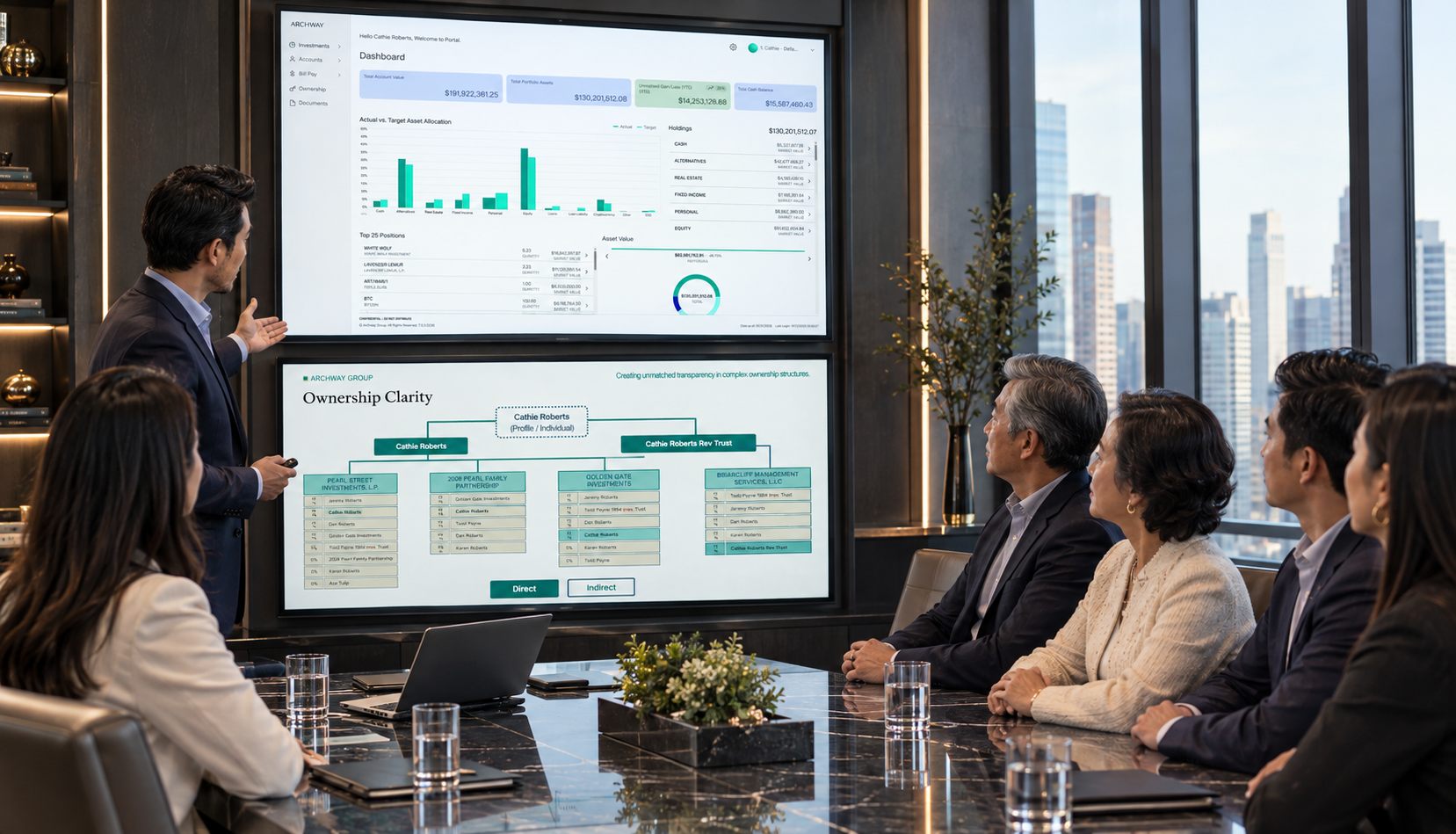
Archway's platform maintains multi-entity ownership structures, parallel capital account bases, and allocation logic configured to the terms of each governing document. Investment reporting and partnership accounting run on the same general ledger, so the number in the report and the number in the books are the same number.
For family offices that also need accounting support, Archway’s Family Office Accounting team works as an extension of the family office’s own staff. The staffing challenges that make partnership accounting fragile in most family offices (attrition, coverage during leave, demand spikes at audit season and tax time) become Archway's to manage, not the family office's. The family gets consistent, high-quality accounting that does not depend on one person staying in their seat.
While family offices perform a myriad of functions, their primary purpose is to manage the complex financial lives of the families they serve. One key activity they perform is ensuring that the families’ bills are paid accurately, on time, and with appropriate oversight and safeguards.
Bill payment and related treasury functions often receive less attention than investment strategy, estate planning, philanthropy, or family governance. All too often, cash and expense management activities are under-resourced, rely on outmoded or point-solution technology, and can be prone to errors or worse.
Bill pay often gains executive attention only when something goes wrong, such as when the office receives a call from a family member about a missed or incorrect payment. This lack of focus, however, belies its importance. The downstream effects are real: missed or incorrect payments can impact a family member’s plans, trigger penalties, and damage credit relationships. Poor transaction oversight can expose a family member to fraud. The lack of coordination with a comprehensive treasury and accounting function can lead to overdrafts, duplicate payments, and late fees. Poor documentation hinders oversight and reporting and can complicate tax and audit preparation. Current approaches may lack scalability and redundancy and may not meet operational demands as family wealth structures grow more complex. As the number of entities grow and the volume and variety of invoices multiply, staff can quickly become overwhelmed.
This article examines the key challenges family offices face in managing bill payments and cash management, the risks created by inadequate processes and technology, and the principles and approaches that family offices need to adopt to modernize this important function.
Why Family Office Bill Pay Is So Complex
In most instances, family offices are managing payments for multiple entities in an ecosystem of fragmented financial interests and structures. A typical ultra-high-net-worth family may hold assets and require disbursements through a combination of the following:
Personal residences and vacation properties in multiple states or countries
Revocable and irrevocable trusts for estate planning purposes
Family limited partnerships and limited liability companies
Private foundations and donor-advised funds
Operating businesses and holding companies
Investment accounts and special purpose vehicles
The personal lifestyles of individual family members also generate a broad array of recurring and, at times, irregular payment obligations, including:
Property management and related fees across multiple residences
Household staff payroll, benefits, and employment taxes
One-time or periodic purchases of luxury items: cars, aircraft, art, and yachts
Luxury asset maintenance
Personal security services
Educational expenses
Medical concierge services and ongoing healthcare
Subscriptions, memberships, and club dues
Family member-specific tax obligations
Charitable pledges and recurring donations
Capital call obligations for private fund investments
It is easy to see how quickly the payment environment can become complex as each payment category involves different vendors, payment frequencies, levels of urgency, approval processes, and sources of funds. Invoices must be paid for by the correct entity and from the correct bank account. Some family members or entities may have their own bank account, payment obligations, and accounting requirements. Others may simplify the process by paying invoices from one entity and allocating expenses across the partnership structure through the accounting process. All of this needs to be reconciled across multiple transactions, statements and recorded in the accounting system.
Complexity increases when families maintain residences, businesses, and service relationships across multiple jurisdictions. This can result in invoices in multiple currencies, international wire transfers, currency conversion, correspondent banking fees, and cross-border compliance requirements, adding another layer of complexity to the bill pay process.
Operational Challenges
Legacy family offices may rely on less formalized or consistently documented processes. Invoices arrive through multiple channels, often in hard copy, including paper mail, email, vendor portals, and property management systems. Invoices are often handled in hard copy with little tracking or workflow management. It is easy to make duplicate payments when invoices are received through multiple channels and processed independently. Misplaced invoices and missed payments can also arise when invoices fall through communication gaps or are simply lost.
Expense approval and oversight can be haphazard. Family offices typically maintain payment approval thresholds, with amounts below which staff can authorize payments independently and amounts above which principal or trustee approval is required. In practice, these frameworks are frequently informal and inconsistently applied, lacking approval documentation, tracking capabilities, and an audit trail.
Many family offices use spreadsheets, small business accounting software, or a combination of the two to manage their bill payment process. While flexible and familiar, spreadsheets present fundamental limitations for payment management, including:
Poor spreadsheet access controls can allow any user with file access to alter payment data without an audit trail.
The lack of version management can result in staff working from outdated files, creating conflicting records.
There is little workflow to support the end-to-end process.
Manual data entry can lead to errors.
There is little system integration, with data manually entered into other recordkeeping and accounting systems, creating redundant work that is time-consuming and may diverge from the official books and records.
Many accounting platforms pose their own set of challenges. They are not designed for family office complexity and may lack integration among payment processing, cash reconciliation, and the general ledger. Workarounds that allow these platforms to approximate family office requirements can create duplicative processing and reconciliation of data between systems, increasing the risk of errors. In addition, they have significant reporting limitations that require manual effort to overcome.
Finally, a key challenge is the lack of staff redundancy. Family offices frequently have lean staffing models. Often, this complex process relies on a single employee or a handful of employees. If someone leaves or is unavailable, this can create a gap in the bill-paying process.
Coordination with Treasury Functions
Communication and coordination with treasury functions present another challenge. Once an invoice is approved for payment, the treasury function must be notified of the correct bank account and the amount of the payment. Treasury must then review relevant banking details to ensure adequate funds are available to meet the obligation. Treasury then notifies the bill pay team to execute the transaction. Without a robust workflow and platform, this process often relies on email and callbacks and is prone to errors.
Fraud Prevention Can Be Weak
Not surprisingly, family offices are potential targets for financial fraud. The combination of substantial assets, lean staffing, informal processes, and lack of systemic controls can create an environment that sophisticated fraudsters can easily exploit.
One approach is known as a Business Email Compromise (BEC) attack. Fraudsters compromise or spoof the email account of a trusted party — a property manager, investment manager, attorney, or one of the principals themselves — and issue fraudulent invoices or payment instructions to family office staff.
A vendor impersonation scheme is another fraudster favorite. A fraudster monitors family office communications and business relationships to learn of important vendor relationships. In a typical vendor impersonation scheme, attackers send invoices using spoofed or lookalike domains that closely resemble legitimate vendors, request bank account changes for future payments, and exploit informal vendor management practices that lack verification protocols. Without fraud detection and prevention processes, it is easy for busy staff to miss fraudulent activity.
Family offices are also not immune from internal fraud. They often operate with insufficient segregation of duties in their payment functions. A single employee may have authority to add new vendors, initiate payments, and reconcile bank accounts — three functions that should ideally be performed by separate individuals to create appropriate segregation of duties and oversight.
New Solutions and Best Practices
Leading family offices are addressing these challenges by taking a fresh approach to bill pay and the broader cash and expense management process. Through a combination of technology, organizational design, workflow tools, process discipline, and outsourcing to a third party, they are adding significant scale, efficiency, and safeguards.
Purpose-built family office bill payment platforms can now provide capabilities specifically designed for the multi-entity, multi-bank, multi-currency environment. These platforms consolidate and digitize invoice receipt and capture and allow for invoice tracking and multi-tier approvals with complete audit trails. They enable payment execution across multiple payment entities, automatic reconciliation with accounting systems, and consolidated reporting across all entities. Also included are important aspects of the treasury function to ensure funds are available to meet obligations and payments are made from the correct accounts. By outsourcing this function, a family office can gain access to a best-of-class technology platform and achieve scalability and personnel redundancy.
Key Components of a Modern Bill Pay Workflow
Whether managed internally or with an outsourced partner, a modern family office bill pay workflow should include the following components.
How Archway Can Help
Bill payment management sits at an unusual intersection in the family office: it is operationally essential yet often organizationally undervalued, technically complex yet frequently entrusted to informal processes, and financially significant yet rarely properly resourced.
Archway’s Cash and Expense Management solution addresses the treasury, accounting, and bill pay needs of complex family offices. Our secure, permission-based platform manages the full operational lifecycle of the payment process, from invoice receipt and approval through payment generation, reconciliation, general ledger integration, and reporting. Clients can delegate the full process to the Archway team or retain control over selected activities, including approvals and fund disbursements.
Recognizing the value of an enterprise-grade treasury and accounts payable platform can achieve more timely bill payment, better cash management, more accurate reporting, stronger fraud detection, and a more efficient payment process.
Data Alone Isn’t Enough: The Next Stage of AI Readiness
Earlier in this series, we discussed why “having good data” is one of the most important first steps in any artificial intelligence strategy. Clean, accurate, and organized information creates the foundation AI systems rely on to generate meaningful insights and support better decision-making.
However, data quality is only one piece of the equation. For Family Offices and wealth management organizations, AI success also depends on the infrastructure, governance, integrations, and operational processes surrounding that data. Even strong datasets can create challenges when information is fragmented across systems, managed inconsistently, or difficult to access in real time.
The next stage of AI readiness is about creating an environment where data can move efficiently, securely, and intelligently across the organization. In this article, we’ll explore what that looks like in practice and why operational readiness is becoming just as important as data quality itself.
Phase 1: Data Governance and Stewardship
Effective data management requires clear governance structures that define roles, responsibilities, and decision-making authority. Who owns the data? Who is responsible for data quality and integrity? Who approves sensitive data access requests? Who sets data retention policies? Clear answers to these questions are essential.
In family offices, governance is further complicated by the involvement of multiple stakeholders: family members, investment staff, external advisors, and service providers, each of whom may have different views on data priorities, privacy requirements, and acceptable uses. Establishing and maintaining consensus requires active governance mechanisms.
For AI specifically, governance policies must address additional questions: What data can be used for model training? How should models be validated before deployment? What level of human oversight is required for AI-generated recommendations? How are model decisions documented and explained? Who can deploy new AI capabilities?
Governance must also extend to third-party service providers. How are they using your data? What safeguards are they maintaining, particularly for the most sensitive information?
Phase 2: Foundation Building
Before deploying sophisticated AI capabilities, family offices must establish solid data foundations. This phase focuses on four priorities:
Comprehensive data inventory. Catalog all data sources, document their contents and update frequencies, identify gaps and quality issues, and map data flows between systems. This baseline understanding clarifies what data resources exist and where improvement is needed.
Data consolidation. Deploy a data lake or similar solution to create a unified view of family office assets and eliminate siloed information.
Data quality processes. Implement validation rules, exception reporting, and correction workflows. Define data ownership and accountability. Establish metrics for measuring quality and track improvements over time.
Data catalogs. As data ecosystems grow in complexity, the ability to find and understand available data becomes critical. Data catalogs inventory available datasets, document their contents and lineage, and facilitate discovery. For AI implementations, they help data scientists identify relevant datasets, support model debugging, and facilitate impact analysis when data sources change. Maintaining comprehensive data catalogs, however, requires dedicated effort and appropriate tooling.
Phase 3: Targeted AI Pilots
With foundational data infrastructure in place, family offices can begin experimenting with AI through targeted pilot projects. Pilots serve multiple purposes: demonstrating value, building internal expertise, uncovering unforeseen challenges, and refining implementation approaches.
Successful pilots share common characteristics. They address well-defined problems with measurable outcomes, leverage data that is already relatively clean and accessible, have executive sponsorship and appropriate resources, and include mechanisms for capturing lessons learned.
Example pilot projects might include:
Portfolio rebalancing optimization using machine learning to minimize tax impact
Document processing automation for extracting data from fund statements or K-1 tax forms
Anomaly detection for identifying unusual transactions or market movements
Natural language processing for analyzing investment research reports or earnings call transcripts
Phase 4: Scaling and Integration
Successful pilots provide the foundation for broader AI adoption. The scaling phase focuses on expanding AI capabilities across additional use cases, integrating AI insights into decision-making workflows, and building organizational muscle memory for maintaining and improving AI systems.
This phase requires balancing expansion with sustainability. Adding new AI capabilities without corresponding investments in data infrastructure, governance, and talent can produce poor results. Successful scaling requires disciplined program management, continued focus on data quality, and ongoing capability development.
Best Practices and Recommendations
Start with Data, Not Algorithms
The allure of sophisticated AI models can tempt organizations to prematurely focus on algorithm selection and model development. Resist this temptation. No algorithm, however advanced, can compensate for poor-quality or inaccessible data. Invest first in data infrastructure, quality, and governance, including the unglamorous but essential work of data cleaning, standardization, and consolidation.
Embrace Incremental Progress
Transformative AI capabilities are built incrementally, not through sweeping all-at-once implementations. Start with focused projects that deliver tangible value quickly, use early wins to build momentum and secure resources, and iterate based on experience. This approach reduces risk, facilitates learning, and maintains stakeholder engagement.
Build Privacy and Security In
Security and privacy cannot be afterthoughts. Design data architectures with privacy preservation from the outset. Implement encryption, access controls, and audit logging while consistently evaluating outside vendors rigorously on their security practices.
Develop Governance and Internal Capabilities
Establish a clear governance structure and processes early. Invest in internal capabilities through hiring, training, and hands-on experience. Even small family offices can cultivate basic data literacy and AI fluency among existing staff; internal expertise enables more effective vendor management and supports long-term sustainability.
Measure and Monitor
Establish metrics for evaluating AI initiatives. Track data quality indicators, model performance, user adoption rates, and business impact. Regular monitoring surfaces issues early, supports continuous improvement, and demonstrates value to stakeholders. What gets measured gets managed, and that principle extends to third-party providers as well.
Build vs. Buy
Organizations must determine the right approach to their data management challenges. Building internal capabilities offers control and customization but requires significant investment. Purchasing packaged solutions from third-party providers can enable faster, more cost-effective deployment but may sacrifice flexibility. A hybrid approach, combining in-house capabilities with external service providers, potentially guided by consultants or advisors, is another viable path. The right choice depends on organizational size, available resources, and technology sophistication.
How Archway Can Help
The data challenges described in this post are precisely the problems the Archway Platform was designed to solve. For nearly 25 years, Archway has helped family offices and financial institutions aggregate, consolidate, standardize, and manage their key financial data and documents.
The Archway Platform addresses core data readiness challenges in several ways:
Consolidated data in a single environment. The platform brings together accounting and investment data across custodians, asset classes, and currencies, eliminating the fragmented, multi-silo environments. With a single, reconciled source of financial truth, AI tools have the clean, comprehensive dataset they need to function effectively.
Structured, auditable financial data. Archway's foundational general ledger automatically books journal entries as transactions are processed, producing well-labeled, consistently formatted data as a natural byproduct of normal operations, exactly what AI systems require.
Alternative investment data ingestion. Through ingestion tools and partnerships with companies like Canoe Intelligence and Arch, the platform streamlines the extraction and processing of alternative investment data. Capital calls, distribution notices, K-1s, and fund statements are among the most persistent data gaps for family offices seeking AI-ready data, and they are handled more efficiently within the platform.
Built for complexity and scale. The platform is designed for the unique demands of UHNW family offices, including multi-entity structures, multi-generational ownership, and multi-asset portfolios. As data needs grow, the platform scales with them.
For family offices looking to build the data foundation that makes AI possible, Archway provides both the technology and operational support to get there.
Artificial Intelligence will reshape wealth management, but the firms that benefit most will be those building to enable it. That means investing in the data infrastructure, governance, and processes outlined throughout this series, not just pursuing AI on its own.
The question is not whether AI will transform the industry. It will. The more important question is which organizations will be ready to harness it effectively.











.png)