







September 30, 2026
Article
·
Single Family Offices
·
time
-min
read
Family Office Trends
Your Investment Reporting Is Excellent. Your Partnership Accounting Is Probably a Liability.
Why family office partnership accounting is harder than it looks.

Megan Greer
The Distinction That Gets Overlooked
Most family offices have built serious investment and portfolio reporting. They know what the family holds, what it is worth, and how it has performed. That visibility is necessary. It is not sufficient.
Investment reporting tells you the family holdings and their value. Partnership accounting tells you who owns what, on what basis, under what agreement, and what the accounting, tax and legal consequences are of every allocation, distribution, and transfer. A family office with one but not the other is making decisions on incomplete information and creating liabilities it will not recognize until they surface in an audit, a family dispute, or a K-1 that does not match what someone was told to expect.
Partnership accounting sits at the intersection of investment operations, tax, and estate planning. It is one of the most technically demanding functions inside a family office, and one of the most consequential when it goes wrong. Here is why it is harder than it looks, and where most family offices fall short.
Why Partnership Accounting Is Uniquely Complex
Family offices use partnership and LLC structures extensively: investment holding, estate planning, liability isolation, generational wealth transfer, governance. While the structures themselves are not unusual, the combination of competing demands makes administering them so challenging.
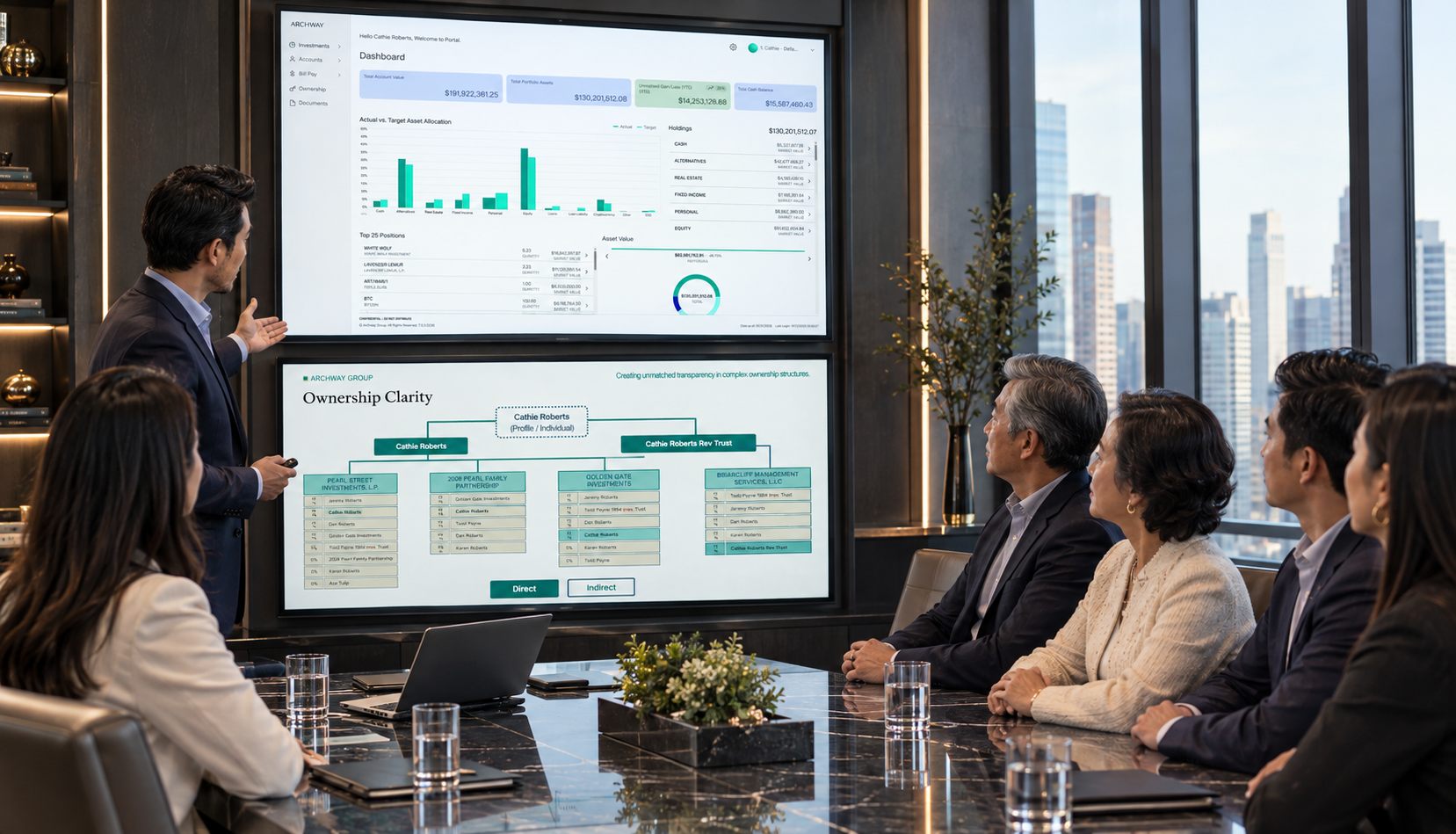
Ownership structures are layered and bespoke. A single investment may sit inside a holding LLC, which feeds a family partnership, which distributes to individual family members through trusts established at different times for different purposes. Each layer needs its own set of books. Getting consolidated reporting right means looking through every layer, eliminating intercompany balances so the same asset is not counted twice, and showing each beneficial owner their true economic exposure across the full structure. Most of these structures were built for estate planning or tax efficiency, not operational simplicity, and few follow a standard template.
We start with the governing documents which define preferred interests, profit interests held by family members, stuffing and other special allocations that split income, and gains differently across branches of the family. The accounting follows the governing documents precisely, and general-purpose platforms were not built for that level of complexity and layering.
Book to tax is an annual scramble. Most family offices run on a cash or accrual basis all year, then hand everything to an external tax advisor to convert to tax basis and prepare Form 1065s and K-1s. That process is only as good as the records underneath it. In a layered structure, one entity's K-1 feeds the next entity's return before that return can be completed, so the reconstruction starts from the bottom up, one layer at a time. In a structure with nested trusts, holding LLCs, and family partnerships, that can mean dozens of entities and weeks of professional time before a single K-1 is produced.
The increase in illiquid asset investments increases the long tail in valuations further complicating the matter. Private equity, real estate, hedge funds, direct investments: most do not price daily, and some have no formal valuation cadence at all. Without a policy for carrying values between valuation dates, the family office waits on every manager and appraiser before it can close the books. Many do exactly that. Consolidated reporting arrives 90 or more days after quarter end, well after it could have informed the decision it was meant to support.
Capital accounts require daily reconciliation. Every contribution, distribution, allocation, and transfer between entities, including in-kind transfers of real estate or private securities must be captured and posted accurately, or the account quickly stops reflecting reality. Left unaddressed, small discrepancies compound until reconciling them becomes a project rather than a routine.
Amid the myriad functions that are already stretching small finance teams, communication becomes its own layer of complexity. Why one branch of the family received a different allocation than another is not always self-evident, even when it is entirely correct under the partnership agreement. Those nuances are easily resolved through proactive communication, adding yet another step that needs to be thoughtfully managed by the same small team.
Where Most Family Offices Fall Short
The common failure is not a single mistake. It is an accumulation of workarounds that made sense at a time. A spreadsheet built to handle one partnership becomes the model for five. The one accountant who understands the allocation logic never writes it down. K-1 season is an annual scramble because partnership accounting and investment reporting live in two systems that were never built to agree.
Family offices are also investing more in formal governance: investment committees, valuation policies, approval matrices. J.P. Morgan's 2026 Global Family Office Report found that 48% of business-owning families have established formal governance bodies, compared with 40% of non-business-owning families. But governance defines control and accountability. Operations determine whether the controls are actually followed. Knowing where decisions are made means little if the numbers they need are being assembled by hand.
The result is not necessarily wrong numbers. It is a fragile operation: accuracy depends on specific people staying in their seats, reporting always runs a quarter behind, and the governing documents, investment reporting, and accounting records have quietly drifted apart in ways nobody has fully mapped. When a key person leaves, or the family's complexity outgrows the infrastructure supporting it, the cost of reconstruction is always higher than the cost of building it right would have been.
How Archway Can Help
Archway's platform maintains multi-entity ownership structures, parallel capital account bases, and allocation logic configured to the terms of each governing document. Investment reporting and partnership accounting run on the same general ledger, so the number in the report and the number in the books are the same number.
For family offices that also need accounting support, Archway’s Family Office Accounting team works as an extension of the family office’s own staff. The staffing challenges that make partnership accounting fragile in most family offices (attrition, coverage during leave, demand spikes at audit season and tax time) become Archway's to manage, not the family office's. The family gets consistent, high-quality accounting that does not depend on one person staying in their seat.


May 25, 2021
Article
·
Single Family Offices
·
time
-min
read
Technology Due Diligence
What Is Integrated Family Office Technology (and 45 Other Fintech Terms Family Offices Should Know)
Defines common family office technology and fintech terms, helping family office teams understand the language used in software evaluations and technology strategy.

Chelsea Francis
·
Head of Strategy
A Glossary of Common Terms and Phrases Used by Family Office Technology Providers
Family offices in and of themselves use a language all their own. But intermingled with technology terms, it can be difficult to understand the jargon that is regularly used to describe family office software solutions and the problems they help solve.
To help you establish a basic understanding of the terms we—and many technology firms like us—use regularly, we’ve put together a list of simple definitions so that you can feel more comfortable engaging in a discussion around family office technology.
A
Account: A portfolio managed by a financial institution or a group of like assets such as hedge funds, private equity investments or personal assets.
Aggregation: The process of assimilating data across an individual’s or family’s assets—including cash, equities, fixed income, alternative investments, real estate and personal assets—to present a total net worth picture.
Application Programming Interface (API): A set of tools that allow a family office’s entire technology ecosystem to communicate by programmatically passing secured data between applications.
B
Best of Breed Family Office Technology: A solution with a singular, business-specific function such as alternative investment data aggregation systems, real estate management software, trust accounting platforms, performance reporting applications, expense management tools and document managers.
C
Cash Management: The operation of ensuring a family office has sufficient cash flow or liquidity to cover expenses.
Client Portal: An end-client facing digital reporting tool used to present the individual wealth owner’s total net worth and overall financial position within the family office.
Consolidation: See Aggregation.
D
Data Feed: Programs that automatically retrieve data files on a recurring basis from banks, custodians, brokerage firms and other outside vendors. The files may include daily transaction activity, security pricing, reconciliation data and cash balances.
Drill-Through: The ability to access underlying detail from summary-level financial reporting dashboards. Also can be used to describe the ability to navigate from one screen to another to access supplemental or related information.
E
Entity: A legal entity such as a trust, partnership, foundation, holding company, operating company or individual that requires its own set of financial reports. Most family offices are comprised of many entities.
Exposure: An individual wealth owner’s allocation of an entity’s underlying assets.
F
Family Office Ecosystem: The complete set of technology platforms and third-party service providers that are used to run a family office.
Financial Statements: A collective term used to describe the core set of financials produced by a family office including the balance sheet, income statement, trial balance and cash flow statement. Sometimes this term is broadened to include the entire suite of family office financial reporting, which may include performance, risk, allocation, exposure and holdings reports.
G
General Ledger System: Accounting technology leveraged by family offices that uses a core chart of accounts to balance debits and credits to ultimately track and report on underlying accounting detail.
H
Hybrid Technology Model: The use of software applications by family office staff to manage core, value-add operations while leveraging an outsourcing partner to handle ancillary functions due to capacity or specialization issues.
I
Implementation: The process of standing up a technology solution to reflect the structure of your family office, including entities and their underlying accounts, ownership, investment profiles and accounting rules.
In-House Technology Model: The use of technology by family office staff to manage the full breadth of family office operations and services.
Integrated Family Office Technology: All-in-one family office systems that offer comprehensive functionality across multiple business disciplines—like accounting, investment data aggregation and financial reporting—that utilizes a single, underlying data warehouse.
Integration: See Data Feed.
Investment Reporting: The suite of reports focused on analyzing investments across the family office including reports that depict time-weighted and money-weighted performance returns, Multiple on Invested Capital (MOIC), risk analytics and other relevant investment metrics.
L
Letter of Authorization (LOA): A document granting third-parties, such as technology providers, access to client account information held by outside financial institutions.
Look-Through Reporting: A type of reporting that can be used to consolidate direct and indirect holdings across multiple entities and layers of ownership within a family office.
M
Master/Feeder Structure: See Nesting.
Mobile Responsiveness: The ability for an application to automatically adapt to fit the screen size of multiple devices including smartphones, tablets, laptops and desktops.
N
Nesting: An investment, tax and family office structuring strategy whereby entities own other entities, creating multiple layers of ownership within a family office.
Net Worth: The aggregated value of an individual’s holdings including cash, equities, fixed income, alternative investments, real estate and personal assets, less any liabilities or money owed.
O
Outsourcing Model: Utilizing a third-party service provider to manage and execute the core operations of a family office.
P
Performance History: The collection of data spanning an investment’s entire lifecycle to enable inception-to-date and period-to-date performance comparisons.
Performance Reports: A subset of investment reports produced by family offices to measure the return on investment (ROI) for an individual asset or group of assets.
Portfolio: See Account.
Portfolio Management System: Financial technology used by family offices that aggregates, normalizes and reports on account (portfolio) information.
Profile: See Wealth Owner.
Proof of Concept: A compilation of use-cases designed by the family office to help them validate that a technology solution is capable of handling specific scenarios and core operations.
Q
Query: Unformatted data extracts that can be rendered in .csv or .xls formats to allow family office staff to apply custom formatting or transpose into third-party systems.
R
Reporting Dashboard: A set of on-screen reports, often customizable, that provide summary-level financial insights that are relevant to family office professionals and high-net-worth individuals. Dashboards often feature drill-through capabilities to provide quick access to underlying details.
Risk Analytics: Insights that help family offices measure an investment’s risk profile. Examples may include Sharpe Ratio, standard deviation, drawdown, alpha and beta.
S
Security: An investment or asset owned by a high-net-worth family or individual.
Security Master: The library of investments owned across a family office that are stored and categorized within a financial technology platform.
System Configuration: See Implementation.
T
Third-Party Data Aggregator: A data provider that links with thousands of banks, custodians and brokerage firms to retrieve basic financial information.
Treasury: See Cash Management.
U
User Interface: The front-end of a software application where you are able to input data and interact with the platform’s tools.
User Experience: The usability of a software application’s user interface, such as the ability to quickly add data and intuitively navigate the platform’s tools.
W
Wealth Owner: An individual family member with an ownership stake in all or a portion of the family’s assets.
Widgets: A software component, such as a reporting dashboard insert, that can be added and customized for the end-user.
Now that you have a handle on your family office fintech vocabulary, it’s time to put it into action. Schedule a call with a member of the Archway Family Office Services team to discuss how our family office technology and service solutions can help your family office address its accounting, investment data aggregation and financial reporting challenges.
April 29, 2021
Article
·
Single Family Offices
·
time
-min
read
Family Office Reporting
Client Portal
What Is a Client Portal and Why Your Family Office Should Be Using One [Explained in Less Than 400 Words]
Explains what a client portal is and outlines five benefits for family offices, including personalized access, engagement, secure sharing, self-service, and document storage.

Natalie Peters
·
Relationship Manager
A List of Five Client Portal Benefits for Family Offices
From a fintech perspective, a client portal is a digital tool used to present an individual’s total net worth and overall financial position.
More often than not, client portals are accessible as a standalone website or mobile app that provides an on-demand snapshot of an individual’s holdings. Most client portals use a combination of reporting elements like tables, graphs and supplemental documents to present the information in an easy-to-consume fashion.
Depending on the power of the underlying family office software and the completeness of the data, client portals can include simple data points like total account value, asset allocation and account value history, as well as more complex analytics like performance, risk and nested – or multi-layered – ownership values.
Although client portals tend to be more widely embraced by family offices working with Gen X and Millennials given their always-on, at-your-fingertips nature, they can also be beneficial for family offices serving older generations.
This has become increasingly evident given the widespread adoption of remote work environments in 2020, particularly as family offices are seeking to digitize specific processes like bill payment approvals and recurring report delivery.
In this new paradigm where physical distance is being supplemented by digital technologies, client portals are becoming an invaluable asset in the client service toolkit.
So what are the core benefits of using a client portal in your family office? Here’s our shortlist:
1. Customized Client Experience
A well-designed client portal will offer family offices the ability to deliver a personalized client experience for each family member using configurable dashboards, custom data groupings and optional functionality.
2. Frictionless Client Engagement
Allow family members to seamlessly participate in family office operations like bill payment approvals using an intuitive, elegant solution designed specifically with the end-client in mind.
3. Secure Data Sharing
Client portals use encrypted data and multi-level security protocols to reduce the risk associated with sharing highly-sensitive financial information between family office staff and end-clients.
4. Self-Service Access
Clients can access financial reporting and investment insights on-demand without requiring a phone call or email exchange with your family office team.
5. Digital Document Storage
In addition to on-screen reporting, many client portals feature document repositories where you can easily share monthly or quarterly reporting as well as other third-party documents.
In short, client portals help alleviate manual touchpoints and simplify how family offices communicate financial information to their end-clients.
Ready to explore a client portal for your family office? Check out the Archway Client Portal to discover how the Archway Platform and its digital reporting tools can help your family office modernize its financial reporting operations and deliver an engaging, interactive reporting experience to your end-clients.
March 30, 2021
Article
·
Private Banks
·
time
-min
read
Bill Payment
Family Office Outsourcing
What Is Outsourced Personal Expense Management and Why Is It So Important for Your Clients?
Explains outsourced personal expense management, how it differs from traditional bill pay, and how it improves high-touch service and financial visibility.

Steven Edelman
·
Managing Director, Institutional Relationships
Learn How an Enhanced Bill Pay Service Can Help You Create a Better Client Experience
Over the years, the term family office has come to represent a variety of organizations. The traditional line of thinking equates to a single family office, where one high-net-worth, often multi-generational, family carries the overhead costs of a dedicated accounting, investment and operations staff.
However, more recently, the term has expanded to include multi-family offices working with unrelated families and high-net-worth divisions of private banks that cater to the needs of wealthy families.
Regardless of how you define a family office, these firms tend to provide a core suite of services that may include investment strategy and measurement, management and client reporting, general bookkeeping, specialized accounting including partnership and trust accounting, tax preparation, and personal expense management.
While any of these services can be outsourced, we commonly see family offices seeking third-party support of one service in particular: personal expense management.
So, what is personal expense management?
Personal expense management traditionally encapsulates bill payment, bank account reconciliation, credit card analysis, vendor management and expense and cash flow reporting.
At this point, you might be wondering what the difference is between personal expense management and more commonly advertised bill payment services?
In general, personal expense management is a more comprehensive set of services that includes enhanced versions of traditional bill payment services alongside white glove concierge services and enriched financial reporting.
Lastly, why do family offices seek to outsource this particular function? For most, it’s a matter of capacity.
Personal expense management is a time-consuming set of operations, especially for family offices serving multiple generations and/or clients. Adding more households increases complexity and, subsequently, the amount of time spent paying bills, reconciling transactions and compiling reports.
Further compounding the situation, some family offices don’t have dedicated accounts payable staff. As a result, the workload is spread across the team or performed by accountants that could be completing more value-added tasks.
To help keep staff focused on nurturing client relationships and growing their business, these firms look to partner with a trusted service organization like Archway Family Office Services, where a dedicated team of operations and accounting professionals are able to absorb the operational intricacies of the family office’s bill payment and expense reporting processes.
But what about your end-clients? How does an outsourced personal expense management service add value for them?
High-Touch Client Service Professionals
Client service is a critical component to any business relationship, especially when your end-clients expect direct access to the individuals delivering the service. When outsourcing bill payment functions to a dedicated personal expense management team, your clients gain access to a group of service professionals operating as a direct extension of your own team.
More importantly, your clients will have the opportunity to interact with individuals who are exclusively focused on the nuances of their expense trends, bill payment requirements and reporting expectations, allowing your own internal teams to concentrate on the strategic, relationship-building discussions and action items.
Turnkey Digital Engagement Tools
Over-the-phone approvals and checks signed by hand are functional, but is there a more efficient alternative? We believe so.
At Archway Family Office Services we’ve built proprietary, cutting-edge technology that automates and digitizes historically manual accounts payable functions. As a result, our personal expense management service includes access to a customizable workflow tool that notifies you and your end-clients when a bill is pending approval, and allows you to quickly and easily submit digital approvals through a secure client portal with the click of a button.
This ultimately translates to a modern, technology-based client experience that doesn’t require technical resources on your end.
Secure, Trusted Operational Processes
As with any type of outsourced service, your third-party partner needs to be dependable and proven. This has become more relevant than ever in the wake of COVID-19 and the remote work environment that followed.
At Archway Family Office Services, we put oversight and security at the forefront of our solutions. Featuring dedicated P.O. boxes, trained staff and a time-tested technology infrastructure, your clients will benefit from decades of bank-grade security assessments, product development and process refinement, taking the onus off of your firm to check these boxes.
Bespoke Cash Flow and Expense Reporting
Most bill payment services can guarantee that your client’s bills will be paid correctly and on time. However, we recommend looking for service organizations that go beyond issuing payments and reconciling transactions—organizations that provide meaningful insights into your client’s bill payment and expense data.
Through our personal expense management service, Archway Family Office Services offers online interactive dashboards and easy-to-access reporting that depicts spending habits, credit card activity, cash flow, payment details and vendor records so that you and your clients have full transparency into the inflows and outflows of their accounts.
Having this level of detail accessible at their fingertips ultimately puts your clients in total control of their spending and empowers you to have well-informed conversations about their complete financial picture.
While outsourcing your firm’s bill payment and expense reporting operations provides a degree of continuity, some firms prefer to manage these processes in-house.
Today, hundreds of family offices, CPA firms and private banks are using family office accounting software solutions like the Archway Platform to deliver a superior personal expense management experience to their clients. Through the platform’s purpose-built tools, users are able to store digital invoices, track bills, reconcile bank accounts, manage workflow, cut checks and deliver comprehensive expense and cash flow reporting.
And for those who are somewhere in the middle, our flexible suite of accounts payable technology and outsourced services enable us to offer a hybrid model that allows clients to manage key functions of the bill payment process while leveraging Archway resources to manage time-consuming, repetitive tasks like collecting invoices and entering bills.
Regardless of your operational preferences, Archway Family Office Services can tailor a personal expense management offering that is unique to your firm, your processes and your clients.
Learn more about our award-winning Personal Expense Management service and how Archway Family Office Services can help you offer a world-class bill payment and cash flow reporting solution to your sophisticated high-net-worth clients.
February 23, 2021
Article
·
Private Banks
·
time
-min
read
Family Office Reporting
Financial Reporting
How to Automate Your Family Office Reporting [A List of Tools]
Lists key tools that help family offices automate client and management reporting, including report libraries, packaging, scheduling, and delivery workflows.

Eric Sampson
·
Relationship Manager
Tools That Can Help You Create Consolidated Financial Reports for Your High-Net-Worth Clients
Wealth management professionals are hungry for a more efficient way to run financial reports.
A way that helps them control the narrative of their client’s financial story using reports that are unique, but intertwined. A way that lets them co-mingle accounting and investment detail, without pulling data from multiple systems. A way that minimizes the reliance on a single individual to prepare spreadsheet-based reporting, and opens the door to collaboration. A way that reduces manual touchpoints, which ultimately reduces errors.
That said, there’s a lot of information out there when it comes to client reporting for high-net-worth families and individuals. What types of reports to provide, client reporting best practices, even client reporting examples.
But the real question is how. How do you create recurring client reports in a way that doesn’t involve spreadsheets, institutional knowledge and dependency on manual processes?
Having spent time on the Archway Family Office Services Client Relations team and, more recently, as a Relationship Manager and de facto client training guru, I’ve done my fair share of reporting consultations and implementations for our family office clients. With those experiences top of mind, here’s a list of tools that exist within the Archway Platform that can help you automate your client reporting process.
Tools to Help You Automate Your Family Office Reporting
- Report Library
- Report Packaging and Branding Tool
- Report Scheduling Tool
- Report Delivery Tool
1. Report Library
If you work for or advise a wealthy family, chances are you know the pain of stitching together reports from multiple systems. A balance sheet from the accounting system, a performance report or two from the portfolio management tool, a private equity overview that you built in Excel and a collection of statements downloaded from various custodians and investment managers.
There’s no flow. Each report is formatted different than the next. The naming conventions and asset categories vary from source to source. And you’re tasked with compiling all of it together into some semblance of a cohesive report package every quarter.
Here’s the catch: your job doesn’t have to be this hard.
Archway’s family office software solution is built to provide a seamless reporting experience for your end-clients and internal stakeholders.
But to do that, we have to start with the database. Enter the Archway Platform’s core general ledger.
It’s important because this means that as the platform is receiving nightly financial data – think investment buy/sell activity, account balances and dividend/interest payments – from external data sources, the system is normalizing the data and automatically booking the journal entries to the general ledger.
Now extrapolate that out to the other wealth operations your firm performs: bill payment, invoicing, cash management, transferring and gifting of assets, trust accounting and other business functions. As each of these tasks is being performed, the system is filing away the accounting records for reporting purposes.
So, when it comes time to configure a report package, whether it be for an individual, a household or an internal employee, you’re able to leverage that complete set of accounting and investment data. This gives you the opportunity to build custom report packages that can span from traditional financials like balance sheets and income statements to allocation and exposure reports, performance analyses, alternative investment summaries, holdings snapshots and other financial reports.
And while the Archway Platform’s report library offers hundreds of reporting options, we also give you the ability to include third-party documents like market research, commentary and disclosure statements – all of which can be cleanly packaged together alongside system-generated reports.
2. Report Packaging and Branding Tool
To really automate the report preparation process, you need a report packaging tool, which is to say a tool that lets you pre-configure a collection of reports, divide them into user-defined sections, put them into a specific order, apply your own branding and then save all of these selections to use on a recurring basis.
In the Archway Platform, you can set up as many report packages as needed.
As an example, you could create a unique set of financial reports for each generation:
- Gen 1 – A report package for the family office principal that provides a holistic view of the family’s finances and delivers insights into investment strategies, manager performance and net worth
- Gen 2 – A report package that is distributed to his children representing their pro-rata share of the family’s assets alongside their personal household expenses and portfolio performance
- Gen 3 – A report package that is distributed to his grandchildren representing their trusts and personal assets
As an extension of these packages, we oftentimes see clients create a “client-facing version” and an “internal QA version.” This allows family offices to create a polished, professional report package for the end-client and a detailed, line-by-line report package for their internal reporting analysts. In turn, the family office can make sure that the visual, client-friendly reports are an accurate representation of the underlying detail.
Plus, by housing your report operations inside of a centralized tool, you minimize the impact of employee turnover and loss of institutional knowledge. If someone takes a leave of absence or departs entirely, you can still access the report packages within the Archway Platform, which means your quarterly reporting can continue to roll out uninterrupted.
3. Report Scheduling Tool
If you have access to an extensive library of reports and you’ve gone through the process of creating pre-defined report packages, you certainly don’t want to have to manually kick off each report package when quarter-end rolls around.
The Archway Platform’s report scheduling tool eliminates those extra clicks, thus creating more efficiency for you and your team. Specifically, the tool can be used to create recurring report schedules based on dates and rolling calendar periods.
As a result, you can produce multiple report packages at a frequency of your choosing through a one-time setup.
4. Report Delivery Tool
The obvious benefit of a report delivery tool is that it electronically sends the reports for you.
The less obvious benefit is that report delivery tools aren’t limited to the physical distribution of reports. In fact, report delivery can be broadened to include digital reporting tools and online document portals.
The Archway Client Portal can be used for all of the above. Whether you’re simply seeking a secure way to share reporting documents or an interactive reporting experience, the Archway Client Portal can be tailored to meet the needs of your firm and your clients.
Additionally, the Archway Platform’s report delivery tool can help automate the report review process.
Using integrated workflow capabilities, the Archway Platform can be configured such that once reporting has been run and passed through a preliminary review, a notification can be sent via text or email to a designated user for final approval. Once approved, reports can be made available to clients in the client portal or sent electronically.
It’s also worth noting that the same report delivery tool can be used to deliver operational reports directly to an internal server so that extended teams within your organization can access system-generated files and reports.
For example, if your family office oversees multiple households, each with their own executive assistant that is responsible for managing their respective household’s budget, you could set up a budgeting report to populate out into a shared folder.
In making the report available via an internal server, you don’t necessarily need to give ancillary employees access to the Archway Platform, but you can still enable them to leverage the data, make changes and resubmit to an authorized system user for upload back into the system.
The benefits of report automation aren’t limited to client reporting.
Using the same tools that automate the client reporting process, you can also automate internal management reporting on a daily, weekly or monthly schedule. Here are a few examples of what that might look like:
- Daily Reporting: This can be as simple as cash balance and cash activity queries delivered into your team’s inboxes each morning that depict the prior day’s inflows and outflows.
- Weekly Reporting: This frequency of reporting tends to include more traditional management-style reports, like reconciliation audit reports that help you confirm reconciliation tasks have been completed or AP/AR reports that help you quickly identify what bills or invoices are outstanding.
- Monthly Reporting: On a monthly basis, many clients leverage the Archway Platform’s automated reporting tools to proactively identify latent prices and performance outliers to isolate and address any errors prior to the end of the quarter.
If you’re interested in learning more about the Archway Platform’s reporting automation tools, schedule a call with a member of our team or take a tour of the Archway Platform.
January 28, 2021
Article
·
Single Family Offices
·
time
-min
read
Family Office Software
Technology Due Diligence
Integrated versus Best of Breed Technology: Which Is Right for Your Family Office?
Explains the difference between integrated and best-of-breed family office technology models, including benefits, tradeoffs, and data management implications.

Dennis Mangalindan
·
Vice President, Business Development
Uncovering Key Benefits of Integrated and Best of Breed Fintech Models
If you currently are – or ever have – evaluated family office technology, you’ve probably heard the terms “integrated” and “best of breed” used to describe various solutions in the marketplace. But despite their frequent usage, they’re often misinterpreted during the family office technology evaluation process.
Unfortunately, this common misinterpretation can lead to flawed technology decisions that lack a proper understanding of the two options and their downstream implications.
On the bright side, if you’ve found yourself struggling to understand which tech stack may be the right fit for your family office or financial institution, you’re not alone.
To help potential fintech buyers better understand this technical terminology – and how it will impact their internal processes, data aggregation and reporting – we’ve put together some basic definitions of the two system architectures along with a few of their unique benefits.
Integrated Model
Integrated solutions typically refer to all-in-one systems. They tend to offer comprehensive functionality across multiple business disciplines while utilizing a single, underlying data warehouse that is managed and maintained by the technology vendor.
Said differently, integrated software means that most of the data is collected, processed and analyzed within one technology solution.
Sometimes referred to as enterprise systems, integrated solutions are designed as standalone platforms that can serve the back, middle and front office. As a result, family offices and financial institutions are able to consolidate accounting and investment data within a single database for end-client reporting purposes.
This type of solution is often sought after by firms who are looking to eliminate what are known as swivel chair processes, which is to say duplicative data entry across multiple, specialized systems. These systems may include a general ledger, a tax system, spreadsheets, an investment performance tool and a report writer – all of which have to be used together to produce holistic reporting both internally and for their end-clients.
Oftentimes, these firms cite the data input and reconciliation processes as cumbersome and error prone, and thus are looking to minimize the number of systems and vendors that are required to do their job.
By implementing an integrated technology system that marries their accounting, tax, investment and client-facing teams, the firm essentially creates a single system of record, which in turn helps them streamline their reporting processes. But there are other benefits to consider too, including:
Automation, automation, automation
Using a single system for both accounting and investment detail typically allows you to leverage automated data entry. For instance, the Archway PlatformSM is built on a core general ledger, with each of the surrounding modules – or sub-ledgers – representing a specific business function.
As users perform these non-accounting operations – like stock purchases, changing security prices, calculating fees, receiving private equity distributions, transferring cash and paying bills – the journal entries behind each of these operations are automatically generated and booked to the GL based on a series of user-defined accounting rules.
This means accountants can eliminate the month-end process of copying balances – like dividends (qualified and non-qualified), income (taxable and non-taxable), unrealized gains/losses, custodial fees and cash – from their standalone portfolio management system into their standalone general ledger, which makes for effortless recordkeeping.
One support team for all
When multiple technologies or services are used within an organization, customer support can become messy. Lacking a centralized helpdesk or hotline, users have to reach out to each of the unique support teams and act as the liaison between vendors in the event a problem extends across multiple solutions.
With an integrated solution, the client service team is knowledgeable on the full breadth of capabilities within the application taking the onus off of you to identify, triage and solve any issues yourself.
Consolidated data at your fingertips
Unless you’re planning to use in-house resources to spin up and maintain your own data warehouse fed by custom integrations with bespoke tools and services, multiple systems means multiple databases. And multiple databases means manual consolidation. On the flipside, an integrated fintech platform stores your accounting and investment data within a vendor-managed database.
Using the Archway Platform as an example, this means that you can generate ad hoc data extracts and formatted reports like financial statements, net worth and cash summaries, performance and alternative investment metrics and target to actual allocation compliance on-demand – and, better yet, you can do it across all of your entities, accounts and investments.
No technical IT background required
If you do in fact have a dedicated IT team at your disposal to manage a reporting database, integrating multiple systems together may be a non-issue. But, if you don’t, integrated fintech solutions typically mean that the solution is developed, maintained and hosted by the technology vendor. As such, you nor your team need a technical IT background to begin using the platform in-house for your accounting, investment data aggregation and reporting needs.
And you certainly won’t be responsible for future development and upgrades. That said, integrated solutions are multi-faceted and contain broad spectrums of functionality, so it’s important to understand your fintech vendor’s approach to product development and where they plan to focus their attention in the future before diving into a partnership with them.
Best of Breed Model
Best of breed intuitively means the best product of its type.
Instead of consolidating multiple business disciplines within a single application, the best of breed model takes an integrated solution and splits each of the business-specific functions into its own unique tool. Each of the tools perform a highly-specialized operation independent of the other tools.
Examples of best of breed tools include alternative investment data aggregation systems, real estate management software, trust accounting platforms, performance reporting applications, expense management tools and document managers. As expected, this model features a significantly larger technology stack than an integrated technology solution as it includes more standalone systems.
Because each of these tools typically utilizes its own vendor-managed database, one of the most important considerations for this type of technology model is your organization’s ability to support a complex data warehouse.
This type of model is best suited for firms that have the resources needed to establish and troubleshoot connections between the systems and the underlying database, normalize disparate, unstructured data from multiple systems and develop highly-customized reporting across thousands of data objects and fields.
However, harnessing the power of multiple best of breed solutions has clear benefits:
Flexibility, flexibility, flexibility
While integrated fintech solutions provide clear structure, a reporting warehouse receiving data from multiple best of breed systems provides unencumbered flexibility. Surprisingly, this degree of flexibility is often needed by firms with particularly rigid reporting objectives that are better served using a high-degree of firm-specific customizations.
Using a homegrown database means firms can collect seemingly endless data points from various systems, which can then be computed and reported on according to their unabridged requirements.
Separation of duties (and risk)
For some wealth management firms, bifurcating responsibilities across multiple function-specific technologies is a requirement. For this reason, best of breed solutions are a natural fit as each functional team can select the technology system that most adeptly meets their needs. Furthermore, by extricating ancillary users from certain operational platforms, firms can limit their risk exposure and manage regulatory compliance with confidence.
Quick road to buy-in
Because integrated technology solutions are meant to be used by multiple teams, they tend to require interdepartmental agreement on the final purchase decision. In contrast, best of breed solutions are typically geared for a single purpose, making majority buy-in easer to achieve. One downside is that when teams begin making technology purchases independent of one another – and without consideration of one another – the technology stack can become disjointed and unwieldy.
And a fragmented tech stack equals lost time, lost money and lost resources. That said, if your goal is to unify the whole of your best of breed systems, it’s important that each technology decision be made for the greater good of the overall tech stack to ensure that things like system connectivity, data flow, database organization and reporting outputs aren’t jeopardized or diminished in the long run.
It’s cheaper – wait, really?
Cost seems like a counterintuitive benefit when you’re talking about purchasing the best products in the market, but the rationale is simple: when implementing best of breed systems, firms can prioritize which system (or systems) should be implemented first, and incrementally add additional tools to their technology stack. This, in turn, spreads out the cost over a longer period of time. Keep in mind though, the cost of multiple systems will eventually add up.
Although the upfront cost of an integrated solution may be more than a single best of breed tool, the long-term investment in integrated, multi-purpose technology may pose cost-savings over a multi-platform tech stack.
At Archway Family Office Services, we believe that our solutions should be both integrated and best of breed.
Why? Because we know that a powerful tool like the Archway Platform is made stronger by its connections with other solutions that help our clients be more efficient, insightful and confident in their roles.
So whether you choose to replace multiple systems with the Archway Platform and our supporting services, or whether you choose to use our solution as the hub of your technology stack, we’re here to help you build a family office technology ecosystem that befits your family office or financial institution.
Interested in learning more about how Archway’s Platform can fit into your technology strategy? Watch the Archway Platform demo or schedule a call with a member of our team to start a conversation.
December 16, 2020
Article
·
Single Family Offices
·
time
-min
read
Family Office Reporting
Financial Reporting
Using Technology to Create Custom Family Office Reporting
Shows how three family offices used parameter-driven reporting tools to create consistent, digital, and look-through client reporting packages.
Eric Sampson
·
Relationship Manager
How 3 Family Offices Used the Archway Platform’s Parameter-Driven Reporting Suite to Create Custom Client Report Packages
As we head into the New Year, many of us are deep into 2021 planning. And as we plan for our future, it’s traditional to reflect on which processes have worked well throughout the past year and which ones could use some refining.
Throughout our long history working with family offices and financial institutions, we often see our clients use the start of a new year as a time to reevaluate their accounting and investment reporting functions, including how they can leverage the Archway PlatformSM to better perform these functions in the coming year. We’ve found that our clients tend to focus on details like:
- Reporting Content: Are we providing each family member with financial reports that are meaningful and relevant? Are there new reports that we could introduce to the family? Is there a report that needs to be fine-tuned for better comprehension?
- Data Classifications: Do investment groupings need to be updated to reflect newly acquired asset types? Is there a better, or more appropriate, classification structure for family investments? Are certain individuals interested in customizing the way their financial data is grouped on their reporting?
- Report Delivery: Does the existing report delivery method still make sense? Is the family interested in adopting digital reporting?
- Reporting Operations: Could we be automating manual processes using advanced technology, like the Archway Platform’s report preparation and scheduling tools?
Whether it’s a small tweak to legacy reports or a complete client reporting overhaul, Archway’s family office software helps our users continuously improve their client reporting experience. Using a controlled customization approach, our report library features 200+ parameter-driven reports that range from traditional financial statements to performance, allocation, exposure, risk and activity reporting.
In lieu of starting with a blank canvas, each report includes a list of pre-defined options that allow users to tailor reports in a manageable fashion. Among the hundreds of configuration options across the reporting suite, users can customize reports with user-defined data groupings, adjustable date ranges, performance and fee calculation options and flexible report layouts.
Fun Fact
A single report within the Archway Platform can be rendered hundreds of different ways depending on each user’s unique parameter selections.
So if your family office or financial institution is thinking about making some changes to its client reporting going into 2021 — whether it’s what information you’re presenting or the way you’re presenting it — here are a few ways our clients have found success using the Archway Platform to support their reporting processes.
MINI CASE STUDY #1
Creating a Consistent Reporting Experience Across Households
OVERVIEW
A family office had been using the Archway Platform for two years when they decided to enhance their client reporting. Prior to implementing the platform, the family office staff primarily used a compilation of spreadsheets to produce reports for 20+ family members, but struggled to maintain the custom requests and level of detail necessary to satisfy each individual.
The Vice President of Investments engaged Archway Family Office Services’ Client Services team to design a report package that could be produced for each individual family member with the click of a button.
OBJECTIVE
At a high level, the family was interested in three key financial insights: holdings, investment allocation and performance. The family was indifferent to position-level detail and preferred to view their financial reports summarized by asset category, portfolio and manager. Additionally, the family office wished to create unique report naming and asset category nomenclatures that would resonate with the family members.
Ideally, the report package would be versatile enough to satisfy each family member’s distinct expectations while ensuring a consistent, repeatable reporting experience across households.
RESULT
Using the Archway Platform’s report building tools, the Client Services team and the VP of Investments worked together to create a standard report package for the family. After consulting with Archway’s reporting experts, it was ultimately decided that the package would include nine (9) unique reports depicting:
- Summary asset allocation, period activity and change in account value
- Portfolio-level holdings grouped by custom asset categories
- Manager-level investment details compared to benchmarks
- Historical holdings over time
- Investment allocation comparisons across distinct time periods
- Current against target allocations
- Trailing investment performance summary
- Detailed manager performance
- Alternative investment overview including capital activity, market values and performance returns (MOIC and XIRR)
Using the Archway Platform’s report preparation tool, the family office staff completed a one-time configuration for each of the reports and compiled them into an organized report package including custom commentary and disclosures. Today, that report package is automatically generated and, in some cases, electronically delivered to each of the family members on a quarterly basis.
As new reports become available in the platform or as family members request more reporting customizations, the family office staff can easily add to, and tailor, the existing, pre-configured report package.
MINI CASE STUDY #2
Digital Delivery of Quarterly Trust and Personal Wealth Reporting
OVERVIEW
A multi-generational family office selected the Archway Platform to help them provide comprehensive financial reporting that could look through multiple entity levels – or layers of ownership. In addition to establishing their internal corporate reporting – including GAAP statements for creditors, cash flow statements, management reporting and line of business reporting – the family office sought to produce enhanced client reporting.
Using the self-service Archway Platform Documentation Center inside of the Client Support Portal in conjunction with one-on-one consulting with the Client Services team, the family office created consolidated reporting for nine (9) family members across two (2) generations.
OBJECTIVE
The family office’s chief focus was to illustrate holdings and investment performance. With heavy allocations towards private equity, they also wanted to include in-depth analysis of their alternative investments. Due to the differing reporting preferences across the two generations, the family office wanted to design multiple report packages.
RESULT
The family office was able to successfully construct two report packages that are delivered to each family member on a quarterly basis. The internal staff selected five unique reports that focus on asset allocation, investment performance, private equity analysis, consolidated holdings and portfolio detail. The family office was able to add efficiency to their reporting process by leveraging uniform – or global – parameters across all of the reports, and making individual adjustments where needed.
- Report Package 1 contains a snapshot of their assets and performance across their respective trusts.
- Report Package 2 is tailored to the individual family member and reflects their personal net worth consolidated across assets, portfolios and entities. The family office retains the standard set of reports, but leverages unique parameter selections for enhanced detail and personalized performance metrics.
Using the Archway Platform’s branding tools, the family office includes a cover page with personalized imagery and report package names. These packages are electronically generated and delivered through the Archway Client Portal’s document manager, providing family members with on-demand access to their quarterly reports.
As each generation’s preferences change, the family office is able to quickly and easily adapt using the wide array of parameters that enable them to collapse, exclude and add detail to the existing report packages.
MINI CASE STUDY #3
Look-Through Reporting Across Trusts and Investment Partnerships
OVERVIEW
As a newly-established family office with a growing number of investment partnerships, the Chief Operating Officer selected the Archway Platform for its renowned partnership accounting tools and its ability to scale and adapt to the firm’s processes as their family office staff grew. The COO required a solution that could look through multi-layered ownership across various legal entities and allocate P/L down to the individual family members in a consolidated fashion.
OBJECTIVE
The family office wished to establish a consistent reporting process for the multi-generational family that included 25 family members across seven households. Given the firm’s diverse entity structures – ranging from trusts and foundations to investment partnerships and a managing company – and multiple asset types, they needed a sophisticated reporting engine to be able to account for and consolidate all of this financial information.
RESULT
Using variations of five (5) different reports available in the Archway Platform’s reporting suite, the family office was able to configure a report package containing eight (8) distinct client reports.
Additionally, the platform’s powerful look-through capabilities enabled the family office staff to prepare consolidated reporting across individual’s trust and partnership assets, while delivering a comprehensive view for the family’s principal that shows consolidated holdings across the entire family and their legal entities.
The family office’s report package includes:
- Overall exposure across equities, alternatives, real estate and collectibles
- Historical allocation with side-by-side comparisons
- Investment performance against benchmarks
- Allocation compared to investment mandates
Based on a pre-defined runtime schedule, the Archway Platform automatically generates the report packages on a quarterly basis. Upon completion, the report packages are reviewed by the family office staff before being distributed to the family members.
Interested in enhancing your high-net-worth reporting experience? Find out how the Archway Platform's investment reporting capabilities can help your family office or financial institution create a scalable, sustainable reporting process.
DISCLAIMER: These case studies describe the attributes of a specific Archway Family Office Services client based on objective criteria, including organizational goals, product offering and asset size. Discussion of results is intended to help clients understand Archway’s customized approach and capabilities and should not be regarded as representative of the experience of other clients nor indicative of future results.


