







September 30, 2026
Article
·
Single Family Offices
·
time
-min
read
Family Office Trends
Your Investment Reporting Is Excellent. Your Partnership Accounting Is Probably a Liability.
Why family office partnership accounting is harder than it looks.

Megan Greer
The Distinction That Gets Overlooked
Most family offices have built serious investment and portfolio reporting. They know what the family holds, what it is worth, and how it has performed. That visibility is necessary. It is not sufficient.
Investment reporting tells you the family holdings and their value. Partnership accounting tells you who owns what, on what basis, under what agreement, and what the accounting, tax and legal consequences are of every allocation, distribution, and transfer. A family office with one but not the other is making decisions on incomplete information and creating liabilities it will not recognize until they surface in an audit, a family dispute, or a K-1 that does not match what someone was told to expect.
Partnership accounting sits at the intersection of investment operations, tax, and estate planning. It is one of the most technically demanding functions inside a family office, and one of the most consequential when it goes wrong. Here is why it is harder than it looks, and where most family offices fall short.
Why Partnership Accounting Is Uniquely Complex
Family offices use partnership and LLC structures extensively: investment holding, estate planning, liability isolation, generational wealth transfer, governance. While the structures themselves are not unusual, the combination of competing demands makes administering them so challenging.
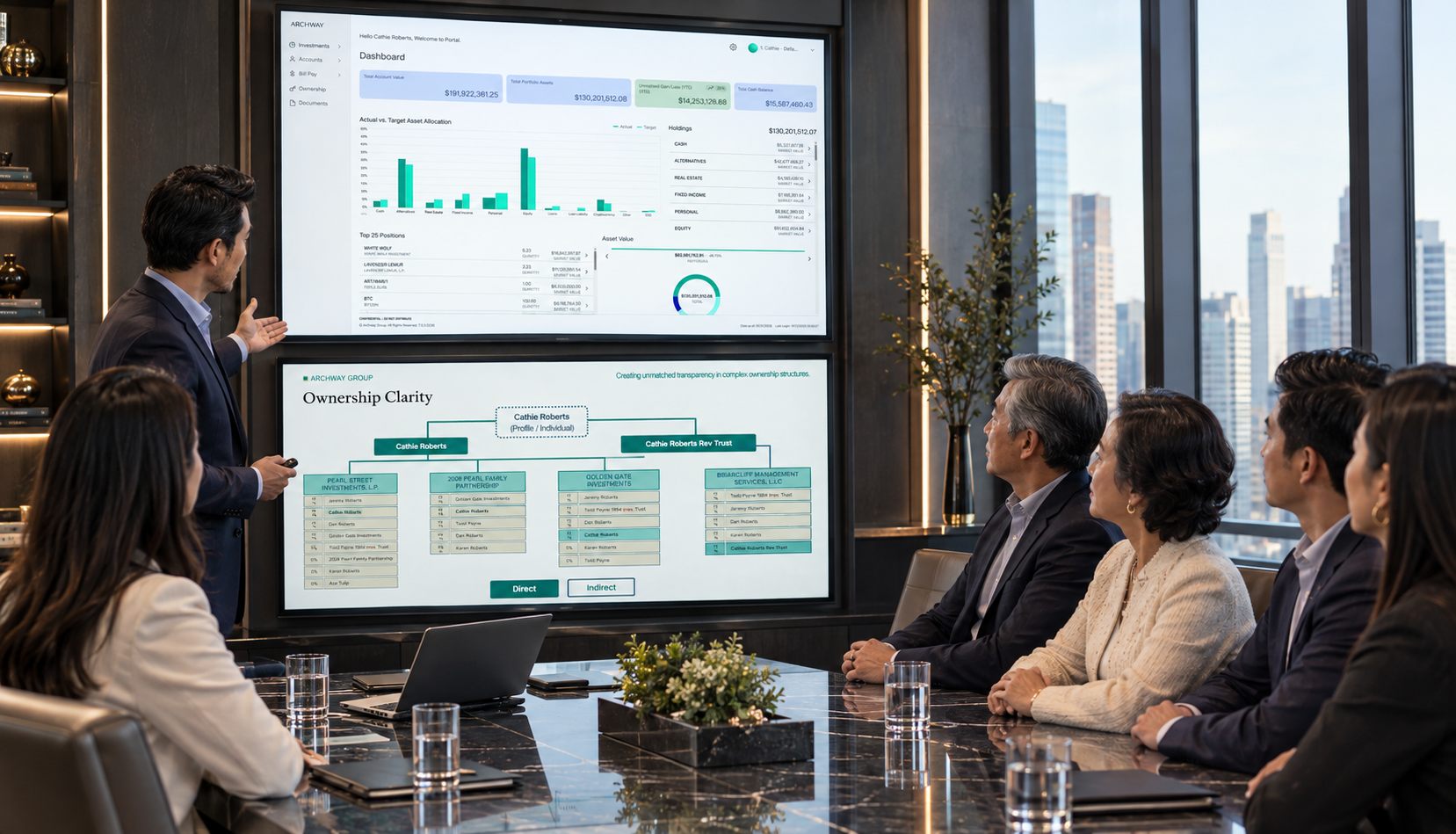
Ownership structures are layered and bespoke. A single investment may sit inside a holding LLC, which feeds a family partnership, which distributes to individual family members through trusts established at different times for different purposes. Each layer needs its own set of books. Getting consolidated reporting right means looking through every layer, eliminating intercompany balances so the same asset is not counted twice, and showing each beneficial owner their true economic exposure across the full structure. Most of these structures were built for estate planning or tax efficiency, not operational simplicity, and few follow a standard template.
We start with the governing documents which define preferred interests, profit interests held by family members, stuffing and other special allocations that split income, and gains differently across branches of the family. The accounting follows the governing documents precisely, and general-purpose platforms were not built for that level of complexity and layering.
Book to tax is an annual scramble. Most family offices run on a cash or accrual basis all year, then hand everything to an external tax advisor to convert to tax basis and prepare Form 1065s and K-1s. That process is only as good as the records underneath it. In a layered structure, one entity's K-1 feeds the next entity's return before that return can be completed, so the reconstruction starts from the bottom up, one layer at a time. In a structure with nested trusts, holding LLCs, and family partnerships, that can mean dozens of entities and weeks of professional time before a single K-1 is produced.
The increase in illiquid asset investments increases the long tail in valuations further complicating the matter. Private equity, real estate, hedge funds, direct investments: most do not price daily, and some have no formal valuation cadence at all. Without a policy for carrying values between valuation dates, the family office waits on every manager and appraiser before it can close the books. Many do exactly that. Consolidated reporting arrives 90 or more days after quarter end, well after it could have informed the decision it was meant to support.
Capital accounts require daily reconciliation. Every contribution, distribution, allocation, and transfer between entities, including in-kind transfers of real estate or private securities must be captured and posted accurately, or the account quickly stops reflecting reality. Left unaddressed, small discrepancies compound until reconciling them becomes a project rather than a routine.
Amid the myriad functions that are already stretching small finance teams, communication becomes its own layer of complexity. Why one branch of the family received a different allocation than another is not always self-evident, even when it is entirely correct under the partnership agreement. Those nuances are easily resolved through proactive communication, adding yet another step that needs to be thoughtfully managed by the same small team.
Where Most Family Offices Fall Short
The common failure is not a single mistake. It is an accumulation of workarounds that made sense at a time. A spreadsheet built to handle one partnership becomes the model for five. The one accountant who understands the allocation logic never writes it down. K-1 season is an annual scramble because partnership accounting and investment reporting live in two systems that were never built to agree.
Family offices are also investing more in formal governance: investment committees, valuation policies, approval matrices. J.P. Morgan's 2026 Global Family Office Report found that 48% of business-owning families have established formal governance bodies, compared with 40% of non-business-owning families. But governance defines control and accountability. Operations determine whether the controls are actually followed. Knowing where decisions are made means little if the numbers they need are being assembled by hand.
The result is not necessarily wrong numbers. It is a fragile operation: accuracy depends on specific people staying in their seats, reporting always runs a quarter behind, and the governing documents, investment reporting, and accounting records have quietly drifted apart in ways nobody has fully mapped. When a key person leaves, or the family's complexity outgrows the infrastructure supporting it, the cost of reconstruction is always higher than the cost of building it right would have been.
How Archway Can Help
Archway's platform maintains multi-entity ownership structures, parallel capital account bases, and allocation logic configured to the terms of each governing document. Investment reporting and partnership accounting run on the same general ledger, so the number in the report and the number in the books are the same number.
For family offices that also need accounting support, Archway’s Family Office Accounting team works as an extension of the family office’s own staff. The staffing challenges that make partnership accounting fragile in most family offices (attrition, coverage during leave, demand spikes at audit season and tax time) become Archway's to manage, not the family office's. The family gets consistent, high-quality accounting that does not depend on one person staying in their seat.



November 4, 2021
Article
·
Single Family Offices
·
time
-min
read
Family Office Software
Technology Due Diligence
Family Office Outsourcing
Family Office Trends
How to Choose the Right Technology Model for Your Family Office
Compares in-house, outsourced, and hybrid family office technology models, including the operational tradeoffs of each approach.

Chelsea Francis
·
Head of Strategy
Understanding the Pros and Cons of In-House Technology, Outsourced Services, or Hybrid Models
Today’s family offices have more options than ever when it comes to selecting a technology solution. From integrated wealth management technology that comprehensively handles accounting, investment data aggregation and client reporting to best of breed family office tools that provide specialized, hyper-focused capabilities, private wealth management organizations are inundated with choices.
Now, we have all heard that your technology is only as good as the data going into it, but we seldom talk about how the data is being entered, managed and reported on in the first place.
So before you choose a technology solution, it’s important to consider your overarching technology strategy. It’s worth noting that your technology strategy will cover a variety of requirements, like technology infrastructure, capabilities and reporting expectations.
But another important consideration to keep in mind is your resourcing capacity. Specifically, do you plan to run the technology internally or partner with a third-party organization to run the technology on your behalf?
To help you choose the right technology model for your family office, we’ve put together a brief description of these models alongside some thoughts on what makes them great and what makes them challenging.
In-House Family Office Technology
A far cry from on premise servers, local hard drive installations and CD-ROMs, today’s in-house technology is typically web-based software applications that are run by the family office staff. This model requires family offices to have sufficient staffing—and sufficient staffing capacity—to effectively use the software.
Pros:
- Provides greater flexibility in dictating how the data is managed
Since you and your team will be responsible for validating and reconciling the financial data piped into the technology, as well as the ultimate reporting output, in-house technology offers maximum flexibility in how the data is managed and conveyed to your end-clients.
- Gives family offices the ability to create a custom technology ecosystem
Many family offices choose to bolt multiple tools together. For instance, some family offices elect to take an integrated solution like the Archway Platform and leverage APIs to funnel data into their own data warehouse or other complementary systems like alternative investment data extraction technology, tax preparation tools and trust administration software.
Cons:
- Requires dedicated family office staff to run the technology
While some family office software solutions can easily be managed by an individual or a small group of individuals, more sophisticated technology stacks comprised of multiple systems may require additional volume and expertise.
Helpful Tip: While you can’t magically conjure more staff, you can help mitigate this drawback by thoroughly evaluating your technology strategy from the start so that you understand capacity limitations and resource availability within your family office to avoid overextending your team. Additionally, be sure to review your technology vendor’s product documentation to ensure that your team will have access to the right educational and training materials as they begin leveraging the platform more fully.
Family Office Accounting
Although more commonly seen amongst private banks aiming to enhance their HNW client service quality and establish greater scalability across their solutions, outsourcing is becoming increasingly popular amongst single family offices.
In this model, family offices partner with teams of highly-specialized accounting, investment and operations professionals to provide a full suite of family office administration services like portfolio reconciliation, bill payment, partnership accounting and client investment reporting.
Pros:
- Creates scalability and extensibility in your offering
It’s a bit of a misnomer that outsourcing is purely a means of replacing headcount. The reality is, single family offices choose to partner with trusted outsourced service providers so that they can focus on things like estate planning, investment strategies and financial literacy amongst the family members, while their outsourcing partner performs monotonous, data-focused tasks.
Additionally, as rising generations become more active in the family’s wealth story, family offices can quickly expand their services to include additional family members and households with little to no disruption amongst their internal staff.
- Provides business continuity in the event of unexpected conditions
Propelled by the winds of a global pandemic and the resulting disruption it caused to routine business processes, family offices are looking to outsourced service providers to help them uphold business-as-usual. Whether your family office faces employee departure, natural disaster or another scenario that puts your operations in limbo, an outsourced service partner can be a constant source of stability amid changing circumstances.
Cons:
- Makes changes to processes and reporting a bit more difficult
While any outsourced service provider worth its salt offers transparency into how they deliver their services, business process outsourcing (BPO) providers are successful because they create predictable, streamlined processes. After all, it’s how they maintain accuracy and efficiency in their service.
What may seem like a simple alteration in a procedure or a minor adjustment to your end-client reporting may actually turn out to be a material change to the original Service Level Agreement (SLA), which can subsequently introduce lengthy timelines and challenging change orders.
Helpful Tip: To ensure maximum satisfaction, be sure to carefully discuss SLAs with your outsourced service partner during your due diligence and re-contracting periods to ensure both sides are appropriately setting expectations that will meet—and hopefully exceed—your internal and end-client requirements.
Technology + Outsourcing Hybrid for Family Offices
Finally, a scenario where you can indeed have your cake and eat it too. For many family offices, technology is core to their operations. At Archway Family Office Services, we see hundreds of family offices whose accountants, A/P managers, investment professionals and reporting analysts rely on our technology to perform their daily objectives. We also see family offices that need an elevated level of support to make sure that their daily objectives can be met, both on an intermittent and permanent basis.
In the instance of the latter, this model allows the family office to perform a selected set of operations, while leveraging an outsourced service partner, like the Archway Family Office Services team, to perform other tasks.
Pros:
- Offers a wide variety of technology and service combinations
The hybrid model comes in all shapes and sizes, allowing family offices to create an ideal cocktail of in-house technology utilization and outsourced services. For example, if accounting is an area of inefficiency, family offices can choose to perform the bookkeeping for a subset of entities, while offloading the accounting work for more complex entities, like multi-owner family limited partnerships, private funds and other pooled investment vehicles. Or maybe accounting isn’t the issue at all.
Perhaps the volume of work needed to reconcile accounts or prepare client reports is beyond the family office staff’s capacity. Either way, a hybrid approach lets family offices take the most strenuous, time-consuming or just plain mundane tasks and hand them off to a team of capable, trustworthy subject matter experts.
- Provides a stopgap during short-term absences or times of transition
Hybrid approaches don’t have to be forever. In fact, many family offices employ these types of relationships on an as-needed basis. Should your family office find itself in a period of flux, whether it be due to parental leave, retirement or the pending appointment of a new staff member, the right outsourced service provider can quickly step in to fill the void.
This becomes even more prolific if your primary technology provider also offers outsourced services, as the delivery teams are already well-versed in the technology and likely have insight into your ongoing operations.
Cons:
- Requires flexible technology and a nimble set of operations
While some solutions are more intuitive than others, all technology is nuanced. For instance, if your technology provider charges per user, you may find it cost-prohibitive to grant access to additional third-party service providers. Similarly, if the technology solution is not equipped with APIs or data extract tools, you may find it unmanageable to share data between your platform and your service provider’s platform. And technology isn’t the only hitch.
If your operations require technology workarounds, are overly complex or lack documentation, you may find it challenging to bring outsiders up-to-speed, rendering your process transition ineffective.
Helpful Tip: When selecting a technology vendor, be sure to vet out their ability to provide supplementary services. If they are unable to offer outsourcing alternatives, request recommendations for endorsed outsourcing partners or industry consultants that have knowledge of the solution and can be relied upon to perform service contracts should the need arise.
Choosing the right technology model for your family office is key to building efficiency and enhancing the way you and your clients interact with their financial data. Whether you’re exploring family office solutions for the first time, or simply trying to understand what’s new in the market, take some time to evaluate your family office technology strategy to make sure you understand which approach will satisfy your internal staff and end-client needs in a manageable, sustainable fashion.
Originally authored by Archway for publication on Family Office Exchange.

October 25, 2021
Article
·
Multi-Family Offices
·
time
-min
read
Family Office Software
Technology Due Diligence
Family Office Outsourcing
Virtual Family Office
Family Office Technology: In-House, Outsourced or Both?
Uses three client examples to show how family offices can operate technology in-house, outsource operations, or combine both models.

Natalie Peters
·
Relationship Manager
How 3 Family Offices Are Using Different Technology Models to Operate the Archway Platform℠
Selecting a family office software solution can be an exciting opportunity. Manual processes can be completed with the click of a button and routine workflows can be streamlined and buttoned up.
With the prospect of more automation, greater efficiency and new capabilities on the horizon, it can be easy to overlook one of the most important questions: how will you manage the technology?
For family offices with dedicated resources that are prepared to manage the technology implementation and run the software in-house, the answer is easy.
But for family offices with staffing constraints or capacity limitations, failing to address this critical resourcing question can kneecap an entire technology investment.
Despite its importance, many family offices and financial institutions serving high-net-worth individuals aren’t even aware of which technology models are available—or which is right for their organization.
To help private wealth management firms understand how to choose the right technology model, Archway Family Office Services authored a guest blog for Family Office Exchange that defines and compares three primary family office technology models: in-house, outsourced or hybrid.
Here, we’ll provide three corresponding examples of how those technology models are actively being used by Archway’s family office clients to operate the Archway Platform.
In-House Family Office Technology
What You Need to Know:
After spending more than 18 years juggling two separate accounting systems and a troubling number of spreadsheets, a $1B+ single family office invested in the Archway Platform to better manage its accounting operations, aggregate assets and produce consolidated financial reporting for more than a dozen individual family members across the family’s 2nd and 3rd generations.
How is the 10-person family office staff using the Archway Platform?
Family Office Entity Consolidation: The family office uses a custom, multi-currency Chart of Accounts to perform bookkeeping for approximately 150 entities including individuals, trusts, foundations, LLCs and limited partnerships.
Brokerage and Bank Account Data Aggregation: The family office leverages automated data feeds with nearly 20 financial institutions to aggregate 250+ brokerage accounts and 100+ bank accounts.
Bill Payment and Vendor Management: Using custom check stock, the family office cuts an average of 60 checks per month across 500+ vendors.
Partnership Accounting: The Archway Platform’s sophisticated partnership accounting tools help the family office manage and report on several highly complex, multi-owner pooled investment structures.
Management and Client Reporting: Prior to beginning their implementation of the Archway Platform, the family office had a largely disjointed, inconsistent reporting process. Using the platform’s automated tools, the family office can now streamline their reporting operations to produce financial statements and gather deeper insights into the family’s financial picture including asset allocation, exposure, holdings, performance and net worth reporting.
Outsourced Family Office Services
What You Need to Know:
With a desire to minimize overhead expenses, reduce internal headcount and run a lean financial management operation, a single family office representing three households, and three generations, partners with Archway Family Office Services to administer the books and records for all of the family’s legal entities, which span 20+ individuals, trusts and partnerships, as well as a foundation.
What operations is Archway Family Office Services performing for the family office?
Portfolio Aggregation and Reconciliation: Archway’s accounting administration team consolidates and reconciles investment activity and transactions across 80 unique brokerage and custodial accounts including 125+ alternative and personal asset valuations.
Financial and Client Reporting: Archway Family Office Services prepares standard financial reports for the family office including balance sheets, income statements, cash flow forecasts and partnership-level reporting, as well as quarterly client reports which are delivered to family members online via the Archway Client Portal.
Performance Reporting: Archway Family Office Services provides quarterly NAV calculations and investment performance reporting for each individual family member.
Capital Movements: Due to the unique investment structure of the family office, Archway Family Office Services processes a significant amount of investor capital activity including commitments, calls and distributions into and out of the family’s limited partnership.
Cash and Expense Tracking: Archway Family Office Services works on behalf of the family office to facilitate cash movements to support charitable giving, as well as perform expense calculations and accruals.
Document Management: Using the Archway Platform, Archway Family Office Services stores and organizes financial documents for family office staff and family members to access and view.
Technology + Outsourcing Hybrid for Family Offices
What You Need to Know:
In the wake of unexpected staff turnover, a single family office that originally formed in the early 2010s partners with Archway Family Office Services to assist them with routine accounting administration functions for four of the family’s investment partnership entities, while their in-house staff continues to use the Archway Platform to manage 60+ additional entities.
What operations is Archway Family Office Services performing for the family office?
Complex Partnership Administration: Archway Family Office Services provides comprehensive oversight of the family’s complex investment partnerships, which are owned by underlying investor entities and contain a substantial number of side pockets.
Transaction Processing and Reconciliation: The Archway Family Office Services team processes transactions and completes portfolio- and fund-level reconciliations.
Software Management: The service team maintains and updates accounting records within the Archway Platform including adding new accounts, portfolios and securities for the investment entities.
Alternative Investment Tracking: Archway Family Office Services collects data, organizes documents and inputs alternative investment activity into the Archway Platform including calls, distributions, subscriptions, redemptions and valuations.
Monthly Financial Statements: Archway completes quarterly accounting period closes and conducts preparatory reviews ahead of producing financial statements including balance sheets, income statements, period balances, portfolio profit comparisons, open position summaries and private equity analysis.
How is the family office client using the Archway Platform?
Investor Entity Administration: The family office manages and maintains all family-level investor entities that feed into the investment partnership entities managed by Archway Family Office Services.
Cash Management: The family office’s accounting team executes all cash movements between bank accounts, including to/from family members and to/from investment entities.
Budgeting and Cash Flow Management: The family office maintains family and household budgets to manage expenses, monitor spending and measure cash flows against total assets.
Family Member Reporting: The family office staff prepares, produces and delivers quarterly reporting to family members including net worth, asset allocation history and comparison, performance against benchmarks and traditional financial statements.
At Archway Family Office Services, we understand that technology is not a one-size-fits-all endeavor and we’re prepared to help you think through important questions like:
- Which technology model is right for my family office?
- Who will be responsible for running the technology platform?
- Should I outsource some or all of my family office functions?
Schedule a call with the Archway Family Office Services team to discuss the Archway Platform’s accounting, investment data aggregation and reporting capabilities, and determine whether your family office should run the platform in-house, partner with our team of accounting and operations professionals to do the work for you or some combination of both.
DISCLAIMER: These case studies describe the attributes of a specific Archway Family Office Services client based on objective criteria, including organizational goals, product offering and asset size. Discussion of results is intended to help clients understand Archway’s customized approach and capabilities and should not be regarded as representative of the experience of other clients nor indicative of future results.

September 15, 2021
Article
·
Single Family Offices
·
time
-min
read
Family Office Technology Implementation
Family Office Software
Technology Due Diligence
Family Office Trends
Building a Family Office Technology Stack [Tips + Evaluation]
Offers practical considerations for family offices building a modern wealth technology stack, from requirements gathering to phased implementation and vendor evaluation.

Archway Family Office Services
Key Considerations for Your Family Office Technology Strategy
In the early 90s, legitimate family office software was, by all accounts, a unicorn.
At the time, there were only a handful of software platforms even partially suitable for family offices. The number of software platforms actually equipped to handle the complexities of managing and reporting on significant wealth was even fewer. Not surprisingly, family offices had limited potential when it came to digitizing and streamlining routine operations.
So for years, family offices and financial institutions serving high-net-worth clients had two options: buy ill-fitting technology for a makeshift solution or build a proprietary technology network for the sole use of their own family office.
The problem with both options was that neither offered a sound, long-term solution.
As wealthtech advanced and high-net-worth individuals began demanding access to modern family office reporting, the age-old debate of buy versus build shifted. Then, in the 2010s, the debate took on a wholly new form: buy an integrated family office platform or build a technology stack that utilized multiple best of breed family office solutions.
Fast forward to today, family offices of all sizes are actively scrutinizing their technology strategies and weighing the benefits of implementing comprehensive technology stacks that replace legacy systems with purpose-built family office technology solutions.
While some of the largest family offices have opted to engage consultants or deploy teams of resources to construct a long-term, multi-faceted solution, others have found it difficult to know where to start.
To help you get your footing, here are a few tips to consider as you jump into this lengthy, but ultimately rewarding, process:
1. Know the requirements of your family office staff and end-clients
You wouldn’t build a house without a blueprint, so why would you build a technology stack without a requirements assessment?
Before you start snapping up a platform—or multiple platforms—you should have pointed conversations with your internal accountants, investment professionals, reporting analysts and family members to understand what they hope to accomplish with modern wealthtech. Equally important, you should take time to understand your team’s capacity and expertise to manage and maintain a technology solution, particularly if you plan to interlink multiple systems.
To help begin this assessment, we’ve put together a list of 50+ evaluation criteria focusing on key decision points related to technology and staffing infrastructure, data collection, functionality and reporting to help you think through your wealthtech strategy.
2. Ask other family office professionals what tools they’re using
The wealthtech landscape has grown rapidly in recent years, but not all family office technology is created equally. Take the time to reach out to your peers in the family office community, attend conferences with other wealth management professionals and chat with industry consultants to learn not only what solutions are out there, but which ones can deliver on their promises and be a trusted, reliable resource for your organization for years to come.
If you’re interested in joining a family office network, check out our blog containing a short list of family office networking and educational resources.
3. Don’t be afraid to implement your family office’s technology strategy in phases
It can be tempting to try to solve all of your problems at once, but we recommend prioritizing the most pressing issues and building out from there.
Think about it this way: if you’re primary goal is to replace your accounting software and automate investment data aggregation, it probably doesn’t make sense to prioritize implementing a client portal, particularly if there’s no data to feed it. Instead, focus on finding a solution—or a combination of solutions—that can meet your accounting, investment and client reporting demands over time.
For instance, when implementing the Archway Platform℠, we suggest that our clients configure their chart of accounts first. From there, we can work alongside the family office to set account balances, build out entity structures, activate automated data feeds and begin the process of creating internal and external reports.
Once the family office staff has met their accounting and investment data requirements, and has established consistency in their daily processes, we can revisit how to set up the Archway Client Portal so that they can begin sharing digital reporting with their end-clients.
By phasing the implementation across multiple stages, we are able to help clients focus on maintaining the integrity of the data and provide proper training on how to use the solution for existing and future needs.
4. Create an evaluation process and follow it
Whether you plan to partner with a technology consultant, create an internal task force or perform your due diligence independently, it’s important to have a process. Establish priorities, curate a list of questions to help you compare potential vendors, create technology proofs of concepts and set realistic timelines for implementing new tools in your family office or financial institution.
By understanding your organization’s requirements and how to properly vet viable solutions, you can better manage expectations around the selection process, technology implementation and the long-term vision for your wealthtech strategy.
Ready to begin strategizing and planning your family office’s wealthtech stack?
Download our short wealthtech strategy evaluation to begin assessing feasibility, needs and outputs to help you add efficiency to your internal family office operations and deliver a more insightful client reporting experience.

August 31, 2021
Article
·
Multi-Family Offices
·
time
-min
read
Family Office Outsourcing
Family Office Trends
Virtual Family Office
Top 10 Reasons Private Wealth Managers Choose an Outsourcing Partner
Explains ten reasons private wealth managers use outsourced accounting and reporting partners to improve service, continuity, scalability, and operational efficiency.

Steven Edelman
·
Managing Director, Institutional Relationships
Why Financial Institutions & Family Offices Are Adopting Outsourced Accounting & Investment Reporting Solutions to Serve Their High-Net-Worth Clients
In some corners of the private wealth management world, the word outsourcing, sometimes referred to as business process outsourcing (BPO), has become taboo. Oftentimes considered synonymous with offshoring, outsourcing has erroneously been painted as cheap work performed by unskilled labor.
But it only takes a bit of due diligence to find that these negative connotations are often an inaccurate portrayal of the true value of an outsourced service offering.
To that end, like other outsourced service providers to family offices and financial institutions, the Archway Family Office Services team is frequently faced with questions about our people, our processes and our technology—and, ultimately, why outsourcing may be the right solution.
To help answer this question, here are 10 reasons private wealth managers are leaning into outsourced services.
1. They can enhance your service quality
Enhanced service quality tops the list and it’s quite a simple notion.
Instead of spending time normalizing data, performing consolidations, paying bills or preparing and reviewing report packages, private wealth managers can do the thing they’re passionate about doing: serving their clients and delivering results that build client wealth.
2. They enable you to grow, quickly
A new advisor joins your firm and brings a dozen new clients with him. Is your team prepared to absorb the account aggregation and report preparation responsibilities that will soon follow?
When you’re in high growth mode, the last thing you want to do is realize your team is not equipped to scale. An outsourced service provider like Archway Family Office Services can help financial institutions and family offices smoothly onboard new clients or households, so that wealth managers can focus on helping their clients achieve their wealth goals.
3. They provide business continuity in the event of disaster or significant change
We’ve learned a lot of tough lessons throughout the pandemic, but one that stands out for businesses is strengthening their ability to overcome disruption.
Whether you’re trying to minimize the effects of a health crisis, employee departures or just a simple power outage, having a dependable outsourced service partner helps ensure that you can continue to meet the demands and expectations of your clients despite forces beyond your control.
4. They offer workforce stability in the face of employee turnover
Key man risk is one of the chief concerns amongst family offices and financial institutions. If an employee departs or a position needs to be eliminated, how do you ensure that your operations don’t falter?
From our vantage point, outsourced service providers should operate as a seamless extension of your internal team. Using operational documentation, thorough communication and repeatable processes, an outsourced service team can quickly take on additional responsibilities in the absence of key personnel.
5. They are built on operational expertise
There’s an old adage that says you can be great at one thing or good at a lot of things. We believe that you should always strive for greatness, which may mean leveraging third-party resources to perform key tasks that sit outside of your expertise or aren’t a valuable use of your time.
By partnering with an experienced BPO team, you have the opportunity to work with subject matter experts and highly-skilled operations professionals that are solely focused on a single function. Examples of commonly outsourced activities include:
- Portfolio reconciliation & consolidated investment reporting
- Personal expense management
- Tax preparation
- Partnership administration
- Legal services
- Trust administration
6. They help you manage risk
In some cases, particularly amongst private banks and other financial institutions, there may be compliance requirements related to particular service offerings that necessitate the need for third-party oversight. This oftentimes translates to creating a business relationship with an outsourced service provider.
Financial institutions and family offices can further manage their risk exposure by establishing service-level agreements (SLAs) with outsourced service providers that help define the who, what and when of service delivery.
7. They allow you to customize your solutions offering
We’ve all watched this scene play out before: you’re courting a new client who presents a unique set of wealth management demands and you need to spin up a new solution offering quickly. It can be an anxiety-inducing situation if you don’t already know what’s out there.
On the other hand, if your financial institution or family office has a pre-established relationship with an outsourced service partner, it’s much easier to explore other available services and expand your relationship on an as-needed basis. Additionally, you can craft tiered service offerings that span the range of your clientele—ensuring you’re delivering the right solutions to the right clients.
8. They provide efficiencies in your back-office
Most outsourced services focus on one of two areas: highly repetitive processes or highly specialized processes. The common thread between these two areas is that they both require a significant amount of time to complete.
By allowing an outsourced service team to absorb click-heavy, recurring operations like portfolio reconciliation, or time-consuming, tedious operations like family office partnership accounting, your staff can focus on doing what they do best and not worry about the monotony of data.
9. They can offer access to purpose-built technology
While some people may envision BPO firms as shops filled with endless rows of desks and people, the reality is that most outsourced service organizations rely on a key tool to help drive efficiency: specialized technology.
At Archway Family Office Services, our BPO teams use our proprietary family office software, the Archway Platform℠, to perform the nuanced operations that exist within family offices and financial institutions serving high-net-worth clients.
Then, using the Archway Client Portal, we can securely deliver the processed and formatted data to family office professionals, advisors and their end-clients in an intuitive, easy-to-use platform. This gives them the opportunity to engage with their financial information in an interactive, tech-forward way that may not exist if the family office was exclusively responsible for designing and developing the end-client reporting experience.
10. They can reduce your firm’s overhead costs
Maintaining technology can be expensive, especially if you are the designer, developer, quality assurer and information systems architect.
An outsourced service partner alleviates the need to maintain the technology—and the servers that run it—which can ultimately reduce your overhead IT costs. As both an experienced technology firm and an award-winning outsourcing provider, we can offer:
- Hosting and server maintenance
- Data backup and disaster recovery
- Ongoing technology enhancements via product upgrades and feature releases
- Software quality assurance
- Data collection and normalization
- System connectivity troubleshooting
- Product documentation and training
We know that outsourcing doesn’t always receive the recognition—and appreciation—it deserves, but the benefits of partnering with an outsourced service provider are demonstrated to be plentiful for private wealth management firms.
Whether you are seeking to ease the burden of client reporting, add new concierge services like client bill payment or offload the complex process of private fund bookkeeping and reporting, Archway Family Office Services is prepared to work and grow alongside your firm.
Check out our full suite of technology and outsourced service solutions for family offices and financial institutions to find out how we can help you better serve your high-net-worth clients.

July 27, 2021
Article
·
Multi-Family Offices
·
time
-min
read
Family Office Software
Family Office Reporting
Family Office Outsourcing
Family Office Trends
Client Portal
4 Pandemic-Fueled Family Office Solutions That Help Provide Future-Proof Business Continuity
Identifies four pandemic-era changes likely to remain in family office operations: technology investment, process digitization, digital reporting, and outsourcing.
Chelsea Francis
·
Head of Strategy
How Operational Survival Tactics Will Translate In Newly Redefined Work Environments
In the first quarter of 2020, the world saw seismic shifts in the way businesses operated. Employees left their offices, receding into their private residences where the only means of connection was via email, video, phone or online chat.
Without a centralized office, there weren’t any drop-ins or quick sign-offs. Swivel chair processes as we knew them ceased to exist. And, in the thick of it—across geographies, industries and markets—we saw entire operations upended and antiquated workflows grind to a halt.
Much like the rest of the world, many family offices and financial institutions serving wealthy families scrambled to create continuity in the absence of the in-person processes they relied on to serve their clients.
And then we saw something extraordinary.
Wealth management firms became scrappy. Determined to make it to the other side, they mended broken processes with new technology and they invested in teams of people that provided scalability and extensibility in a totally digital world.
Now, as businesses begin to reopen, doors are unlocked and lights begin to flicker back on, the question has become: what will remain? What pieces of remote work will stick as employees find themselves back inside of the physical family office?
Based on our experience working with hundreds of wealth management organizations, here are four pandemic-fueled trends we believe will continue to be front and center for family offices and financial institutions as they balance managing a decentralized staff with providing meaningful client interactions across in-person, remote and hybrid work environments.
Technology Investment
According to Family Office Exchange’s 2021 State of the Ultra-Wealth Business report, an overwhelming percentage of family offices invested in new technology during the pandemic.
Ranging from integrated family office software solutions like the Archway Platform℠ to best of breed and purpose-built solutions like Canoe’s AI-based data extraction technology for alternative assets, family offices are ditching spreadsheets and industry-agnostic data management tools in pursuit of technology designed specifically for private wealth management firms.
Why It Sticks:
We are in the throes of a technological revolution. And while COVID-19 may have throttled the adoption of technology forward amongst wealth managers, we have seen new technology entering into our personal and work peripherals for several years now. Disrupting the status quo and ushering the wealth management industry into a new era of digital engagement, technology is—and has been—changing the way we manage, interact with and exchange wealth information.
As the next generation of wealth owners takes asset control, there will be a greater demand for modernization of all kinds. From tools that facilitate digital touchpoints with wealth managers to technology that offers a better way to track and report on future-facing asset classes like cryptocurrencies, NFTs, SPACs and other types of alternative assets, wealth managers should be prepared for rapid changes in technology expectations amongst younger clients.
At Archway Family Office Services, we believe that family offices and wealth management firms that choose to embrace the abundance of technology at their disposal in pursuit of innovative client experiences will be better able to attract, engage and retain clients moving forward.
Digitization of Routine Processes
It goes without saying that the global COVID-19 pandemic—and the transition from office parks to home offices—exposed critical holes in the operational processes of many family offices and other wealth management firms. Traditionally beset with manual touchpoints and face-to-face interactions, processes like bill payment and client reporting were at risk of failure when social distancing became the norm.
But over the course of roughly 16 months, these organizations were pushed to review their operating procedures. As they identified areas of inefficiency, they were able to utilize new and existing technology solutions to help them remotely complete these historically manual tasks.
Why It Sticks:
Between Q1 2020 and Q2 2021, Archway Family Office Services saw a drastic increase in the number of report packages automatically generated using the Archway Platform’s reporting tools. In June 2021, numbers continued to surge, with over 14,000 unique report sets created in a single month.
Using the platform's tools, clients can virtually collaborate on client reporting by sharing report packages across groups of approved users. The added efficiency of pre-configured, pre-scheduled reporting coupled with the ability to work together regardless of physical location has our clients well positioned to run a largely automated reporting process.
As some employees head back to the office and others continue to work from home, a digitized reporting process helps wealth management organizations effortlessly deliver timely, accurate client reporting.
And reporting isn’t the only process worth automating. Family offices are actively implementing automation when it comes to workflow processes, bill payment approvals, cash movements and financial data collection.
Digital Client Reporting Enablement
Twenty years ago, reporting was a one-dimensional output. Family offices would create basic financial reports using spreadsheets and PowerPoint presentations based on hand-consolidated data from accounting files, custodial statements and bank account summaries.
As time went on, technology companies found ways to pipe data between fintech systems, banks, custodians and asset managers. But reporting remained largely unaffected. PDF and Excel-based reports continued to be the predominant reporting mechanism despite the advancement in technology.
Then, COVID-19 hit. For 12+ months, we were asked to stay home. To avoid close contact with our family, friends and neighbors—and our clients. As in-person meetings fell off of calendars, family offices and financial institutions sought out other means of distributing client reports.
So, rather than sitting down at a desk to discuss quarterly or annual report findings, family offices took to digital tools to share financial insights with their clients.
Why It Sticks:
Tools like the Archway Client Portal became high in demand in as wealth management professionals sought out new ways to connect with their clients. While some family offices opted to only leverage the technology’s document sharing capabilities as a short-term holdover until in-person meetings could resume, others elected to share the technology with their clients in full.
With a bit of configuration and a touch of client service wizardry, family members gained on-demand, secure access to a brand new selection of interactive charts, graphs and tables. They were able to customize their portfolio views using self-defined sorting and grouping options.
And directly from their phones and tablets, they were able to dive deeper into their financial insights—from aggregated holdings, expense summaries, cash balances and net worth calculations to performance, risk and model-to-actual reporting.
Much like Pandora’s Box, once a client portal—and all of its bells and whistles—is open, there’s no dialing it back.
Family Office Outsourcing
Over-extended networks. Natural disasters. Power outages. Illness. Turnover.
Financial services firms across the globe have felt the fallout of the COVID-19 pandemic. Lessons have been learned—and continue to be learned—as we navigate our way back to the office. But amidst it all, one recurring theme has emerged: everyone needs a contingency plan.
In the family office world, that plan has been a resounding need for expanded service relationships, specifically through outsourcing. Necessitated by emergency situations, loss of employees pursuing new opportunities and a desire for continuity, family offices and financial institutions are eager to partner with versatile, client-centric firms.
Why It Sticks:
Life happens. And while we all collectively hope to put COVID-19 behind us, there will most certainly be another scenario that will have us dusting off our business continuity plans. Whether it’s the retirement of your family office controller, the departure of an investment reporting analyst or just a jammed MICR printer that puts you on your heels, it’s imperative to have a solution at the ready.
With more than 50 years of experience partnering with wealth management firms, Archway has had the unique opportunity to curate a powerful combination of technology, process and, most importantly, people—all of which is designed to be tailored to your firm’s specific needs so that you can operate under the most stringent circumstances and continue delivering a seamless, dependable client experience.
If you are interested in discussing how our award-winning technology and outsourced services can help you enhance and fortify your family office operations, schedule a call with a member of the Archway Family Office Services team.
Together, we can identify ways that we can help you:
- Upgrade your family office technology stack and enhance the speed and efficiency of your wealth management operations
- Centralize and automate your core accounting, investment data aggregation and reporting processes
- Introduce an engaging client experience using enriched financial insights and tech-forward digital reporting tools
- Reduce the key-man risk by partnering with a trusted team of accounting and operations professionals to perform certain tasks or functions in conjunction with—or on behalf of—your own family office team

June 29, 2021
Article
·
Single Family Offices
·
time
-min
read
Family Office Software
Family Office Reporting
Integrated Financial Tools
Alternative Investments
How to Evaluate Your Family Office’s Alternative Asset Reporting Process
Provides a checklist-driven way to evaluate alternative asset reporting workflows and identify opportunities for automation across collection, transfer, reporting, and analysis.
Archway Family Office Services
A Short Checklist to Help Family Offices Identify Alternative Investment Reporting Inefficiencies
Over the past decade, alternative assets have become a mainstay in the portfolios of high-net-worth (HNW) families. According to the 2020 UBS Global Family Office Report, alternative assets—which include private equity, hedge funds and real estate—make up 35% of family office portfolios.
While these investments represent a significant portion of HNW assets, they’re seldom easy to track and report on as a component of the family’s larger wealth picture. Unlike traditional investments like equities and fixed income, alternatives lack concrete public reporting requirements. As a result, investors are dependent on third-party managers to receive timely, accurate data regarding their investments.
Over time, it seems that this dependency has morphed into complacency, where delayed access to alternative asset data is an expectation and manual transcription of hard-copy documents into digital formats is a given. The reality is that the process of tracking and reporting on alternative investments has remained steadily challenging.
But as new solutions emerge and the integration between family office software platforms grows stronger, the boundaries of efficiency are being redrawn.
Still, it can be difficult to pinpoint inefficiencies within a process that has remained largely unaffected for the past decade—and not for lack of want, but for lack of available solutions.
To help family offices identify inefficient processes and manual tasks ripe for automation, Archway Family Office Services partnered with Canoe Intelligence to put together an evaluation checklist featuring questions focused on five key areas of the alternative investment reporting process.
Five Core Family Office Reporting Operations for Alternative Assets:
- Document collection
- Data access
- Data transfer and delivery
- Report creation
- Report analysis
Post-evaluation, if you’ve found that your family office—like many others—is expending too much time and too many resources manually collecting, normalizing, consolidating and reporting on its alternative assets, it may be time to consider a purpose-built technology solution.
This is where Archway Family Office Services and our friends at Canoe can help.
Using modern, automated tools like Canoe Intelligence and the Archway Platform, family offices can relieve bottlenecks and bridge gaps commonly associated with aggregating and reporting on alternative assets.
Designed to be tightly integrated, Canoe’s automated approach to digitizing printed copies of alternative investment documents helps family office professionals streamline extraction, validation and delivery of alternative asset data into the Archway Platform.
By leveraging the two systems together, users can eliminate manual data entry and automatically incorporate alternative asset data into the Archway Platform’s specialized suite of family office reporting.
Interested in diving into the benefits of Archway’s strategic partnership with Canoe?
Schedule a call with a member of the Archway Family Office Services team to learn more about how the integration between the Archway Platform and Canoe can help your family office streamline its alternative investment reporting process.


