







September 30, 2026
Article
·
Single Family Offices
·
time
-min
read
Family Office Trends
Your Investment Reporting Is Excellent. Your Partnership Accounting Is Probably a Liability.
Why family office partnership accounting is harder than it looks.

Megan Greer
The Distinction That Gets Overlooked
Most family offices have built serious investment and portfolio reporting. They know what the family holds, what it is worth, and how it has performed. That visibility is necessary. It is not sufficient.
Investment reporting tells you the family holdings and their value. Partnership accounting tells you who owns what, on what basis, under what agreement, and what the accounting, tax and legal consequences are of every allocation, distribution, and transfer. A family office with one but not the other is making decisions on incomplete information and creating liabilities it will not recognize until they surface in an audit, a family dispute, or a K-1 that does not match what someone was told to expect.
Partnership accounting sits at the intersection of investment operations, tax, and estate planning. It is one of the most technically demanding functions inside a family office, and one of the most consequential when it goes wrong. Here is why it is harder than it looks, and where most family offices fall short.
Why Partnership Accounting Is Uniquely Complex
Family offices use partnership and LLC structures extensively: investment holding, estate planning, liability isolation, generational wealth transfer, governance. While the structures themselves are not unusual, the combination of competing demands makes administering them so challenging.
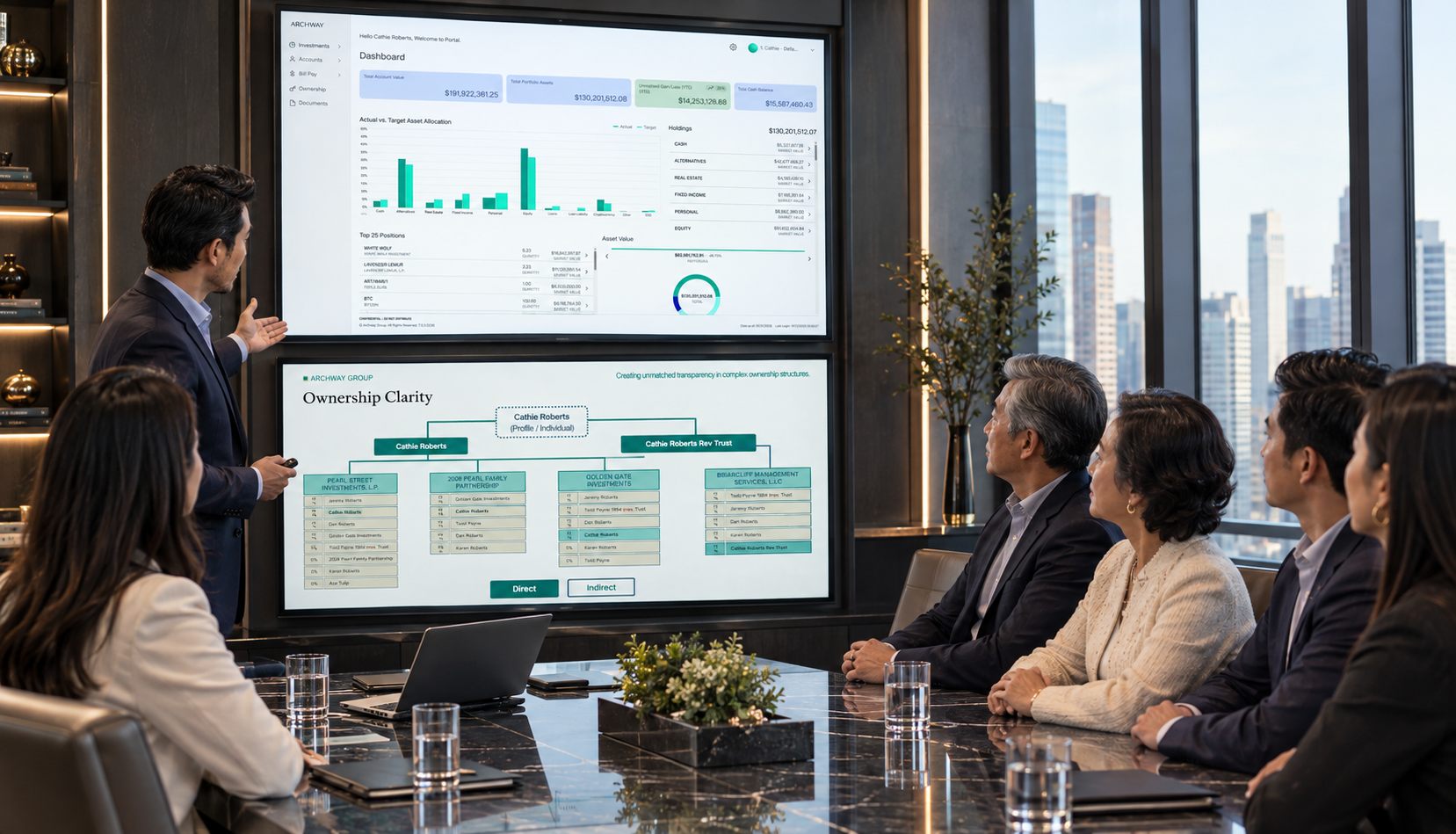
Ownership structures are layered and bespoke. A single investment may sit inside a holding LLC, which feeds a family partnership, which distributes to individual family members through trusts established at different times for different purposes. Each layer needs its own set of books. Getting consolidated reporting right means looking through every layer, eliminating intercompany balances so the same asset is not counted twice, and showing each beneficial owner their true economic exposure across the full structure. Most of these structures were built for estate planning or tax efficiency, not operational simplicity, and few follow a standard template.
We start with the governing documents which define preferred interests, profit interests held by family members, stuffing and other special allocations that split income, and gains differently across branches of the family. The accounting follows the governing documents precisely, and general-purpose platforms were not built for that level of complexity and layering.
Book to tax is an annual scramble. Most family offices run on a cash or accrual basis all year, then hand everything to an external tax advisor to convert to tax basis and prepare Form 1065s and K-1s. That process is only as good as the records underneath it. In a layered structure, one entity's K-1 feeds the next entity's return before that return can be completed, so the reconstruction starts from the bottom up, one layer at a time. In a structure with nested trusts, holding LLCs, and family partnerships, that can mean dozens of entities and weeks of professional time before a single K-1 is produced.
The increase in illiquid asset investments increases the long tail in valuations further complicating the matter. Private equity, real estate, hedge funds, direct investments: most do not price daily, and some have no formal valuation cadence at all. Without a policy for carrying values between valuation dates, the family office waits on every manager and appraiser before it can close the books. Many do exactly that. Consolidated reporting arrives 90 or more days after quarter end, well after it could have informed the decision it was meant to support.
Capital accounts require daily reconciliation. Every contribution, distribution, allocation, and transfer between entities, including in-kind transfers of real estate or private securities must be captured and posted accurately, or the account quickly stops reflecting reality. Left unaddressed, small discrepancies compound until reconciling them becomes a project rather than a routine.
Amid the myriad functions that are already stretching small finance teams, communication becomes its own layer of complexity. Why one branch of the family received a different allocation than another is not always self-evident, even when it is entirely correct under the partnership agreement. Those nuances are easily resolved through proactive communication, adding yet another step that needs to be thoughtfully managed by the same small team.
Where Most Family Offices Fall Short
The common failure is not a single mistake. It is an accumulation of workarounds that made sense at a time. A spreadsheet built to handle one partnership becomes the model for five. The one accountant who understands the allocation logic never writes it down. K-1 season is an annual scramble because partnership accounting and investment reporting live in two systems that were never built to agree.
Family offices are also investing more in formal governance: investment committees, valuation policies, approval matrices. J.P. Morgan's 2026 Global Family Office Report found that 48% of business-owning families have established formal governance bodies, compared with 40% of non-business-owning families. But governance defines control and accountability. Operations determine whether the controls are actually followed. Knowing where decisions are made means little if the numbers they need are being assembled by hand.
The result is not necessarily wrong numbers. It is a fragile operation: accuracy depends on specific people staying in their seats, reporting always runs a quarter behind, and the governing documents, investment reporting, and accounting records have quietly drifted apart in ways nobody has fully mapped. When a key person leaves, or the family's complexity outgrows the infrastructure supporting it, the cost of reconstruction is always higher than the cost of building it right would have been.
How Archway Can Help
Archway's platform maintains multi-entity ownership structures, parallel capital account bases, and allocation logic configured to the terms of each governing document. Investment reporting and partnership accounting run on the same general ledger, so the number in the report and the number in the books are the same number.
For family offices that also need accounting support, Archway’s Family Office Accounting team works as an extension of the family office’s own staff. The staffing challenges that make partnership accounting fragile in most family offices (attrition, coverage during leave, demand spikes at audit season and tax time) become Archway's to manage, not the family office's. The family gets consistent, high-quality accounting that does not depend on one person staying in their seat.


November 24, 2020
Article
·
Private Banks
·
time
-min
read
Family Office Software
Client Service
5 Questions to Help You Evaluate Your Technology Firm’s Client Service Team
Provides five questions to assess a technology provider’s client service team, including structure, location, support channels, training, and user communities.

Michael Hansford
·
Director of Client Relations
Why Client Service is a Differentiator among Family Office Software Solutions
When assessing financial technology solutions, it’s easy to focus solely on functionality. After all, a thorough technology evaluation involves several rounds of system-specific questions and detailed technology proofs-of-concept, making it easy for the ongoing service function to drift out of focus.
But when you exclusively assess features and capabilities, you miss the opportunity to evaluate the long-term service component of your relationship with your new fintech partner.
Even if you were to find the ideal family office software solution, if the client service doesn’t match the quality of the technology platform, the long-term viability of the solution becomes murky.
So, ask yourself, when the software is implemented, and you’re off and running on your own, who will support you? Can you rely on them to help you work through complex financial scenarios using the technology? To respond quickly to your important questions? To be knowledgeable on both the software and your unique usage of the system?
To help you avoid a preventable client service mishap down the road, we recommend evaluating the competency and reliability of the client services teams with as much vigor as you use to evaluate the solution’s capabilities.
As a firm that has built an elite client service team to support hundreds of family offices and high-net-worth families, we’ve identified five starter questions to help you navigate the client service evaluation and set the stage for a more detailed assessment.
How is your customer support organization structured?
Your client service team should be able to do more than just reset your password. They should be able to problem solve on the fly and lead you through nuanced scenarios – like entering data or running a report – as well as less common scenarios – like how to perform equity transfers or validate performance calculations using the technology.
The composition and experience of your support team are important factors as you evaluate the client service team.
Is customer support performed in-house or does the technology firm outsource this business function? Will you have a dedicated support staff or will you be funneled into a large-scale call center? What are the client service specialists’ qualifications? Are they accounting and finance professionals? Do they have a background in service operations? Is there a manager or team lead that is responsible for inquiries that require escalation? Are there designated subject matter experts (SMEs) for specific topics or functions within the technology?
Digging into these questions helps you assess the value your technology firm places on client service, and can create an image of how you might interact with the customer service team as a client.
Where are the client service operations located?
Although not necessarily a deal breaker, geographic location can affect the quality of your service. Depending on where your family office is located and where your technology vendor houses its client service operations, you may experience impacts to availability and turnaround time for support cases and client service inquiries due to differences in time zones.
Furthermore, if the client service operations are based offshore, you may need to review your risk compliance policies and perform additional due diligence related to data security to confirm that your data can be accessed from other countries.
What communication channels and tools are available for customer support?
A good client service organization will utilize an omni-channel service model that allows clients to engage with the client service team in multiple ways. In a best case scenario, you should be able to reach a client service representative via phone, email, or online client support portal depending on the urgency of your request.
It’s worth noting that some technology providers use a tiered support system, so it’s important to understand what type of support is available at each level. For example, certain channels like phone or direct email may only be available to customers paying for the top tier of support.
We also recommend asking about the technology provider’s support case system. Is it automated and easy to use? Does it offer templates or pre-defined issues to expedite the ticket submission process? Does the system log your inquiry directly to a client service representative? What happens if your case requires involvement from additional teams like product development? What is the typical turnaround time for requests submitted through the system?
Internally, you should consider the volume of anticipated requests, the size of your organization and the amount of product knowledge your team possesses to help you determine whether or not the available communication channels will be suitable for your family office.
Do you offer ongoing training?
Family office fintech providers regularly introduce new versions of their products and services. Finding a technology firm that offers educational resources, online training courses and live user conferences helps your family office stay in-tune with updates to the solution.
Simply put, ongoing training is core to excellent client service and is crucial for family offices that want to make the most out of their technology investment.
Do you facilitate user groups or peer networks?
Your client service experience isn’t limited to the interactions between you and the technology provider. In fact, there are some questions that can be better answered by those who are in the daily throes of the system: other platform users. A technology firm that recognizes this opportunity and facilitates secure client exchanges clearly has their clients’ success at the top of the list.
By posing questions to other users, you have the benefit of learning from system power users who have likely dealt with similar situations in the past.
These peer-to-peer interactions help you brainstorm creative solutions for complex problems, establish best practices for common family office accounting and reporting scenarios, hear different perspectives on the effects of industry trends and regulations, and develop a sense of community among other family offices – all of which should be equally important factors when selecting a technology vendor.
Interested in learning about Archway’s customer-first approach to client service?
Download our mini ebook Our Commitment to Exceptional Client Service to find out how Archway Family Office Services has devised an approach to customer support that is valued and trusted by hundreds of family offices and financial institutions.
October 15, 2020
Article
·
Multi-Family Offices
·
time
-min
read
Family Office Software
Technology Due Diligence
A Simple Guide to Family Office Software Pricing
Breaks down common family office software pricing models, including flat-rate, per-user, feature-based, account-based, transaction, tiered, AUM, and entity pricing.

Dennis Mangalindan
·
Vice President, Business Development
What You Should Know About Common Costs Associated with Family Office Fintech
“How much does your solution cost?”
This is typically one of the first questions we get asked by family offices and investment advisors evaluating family office accounting and reporting solutions.
When it comes down to it, pricing can be one of the most influential factors in choosing a family office fintech solution. And while most technology vendors wish that value alone dictated buying decisions, we’d be naïve to believe that budget constraints don’t play a role when it comes to selecting a technology solution.
But technology costs can be tricky. There’s certainly no industry standard and, in many cases, family office software providers may price their solution differently depending on what combination of technology and services you choose from their menu of offerings.
To help you prepare for family office software pricing discussions, we put together a crash course of sorts in family office software pricing. To do this, we identified several pricing structures that are common amongst family office fintech and service providers. Our goal is to help you understand the basic premise of each pricing model so that you can better anticipate costs based on your unique family office structure.
Types of Pricing Models
Flat Rate
One of the simplest pricing models is a flat rate fee. In this structure, the solution is sold at a predetermined price and offers a fixed set of features. Using a flat rate fee, the software provider does not take into account any additional information or detail about your family office like the number of users, entity count, investment types or add-on functionality. This type of pricing structure is typically employed by off-the-shelf software, meaning there’s limited room for customizations.
In short, what you see is what you get.
Per User
Largely self-explanatory, a per user fee is dependent on the number of users that will receive login credentials for the technology platform. This pricing structure is simple and enables your family office or advisory firm to control costs since you ultimately dictate how many users need access to the solution. This pricing structure is often incorporated into the tiered pricing structure described below.
Feature-based
Feature-based pricing allows firms to pick and choose pieces of software functionality to create a unique suite of capabilities. In this model, you have greater control over costs by only paying for what you need while retaining the ability to scale the product by adding additional functionality as your team’s bandwidth grows.
Per Account
Most family offices need to collect vast amounts of financial information – from portfolio transactions, cash movements and account balances to alternative investment activity and valuations. The per account pricing structure charges based on the number of accounts or portfolios within your investment profile. This fee is particularly common across data aggregation and reconciliation services, and can fluctuate depending on the type of asset and whether data is retrieved automatically or manually.
Similar to a per user fee, the per account fee typically fits into a tiered, or escalator, fee structure.
Per Transaction
Although a per transaction fee is a less common pricing model for family office software providers, it will occasionally enter the equation with transaction-based services. For instance, if you leverage ancillary services like cash management processing, bill payment or trade execution, you may see it as a line item in your pricing proposal. These costs are typically framed as processing fees for any cash movements between accounts or invoice payments.
More often than not, this type of fee is in addition to other software-based fees, like per user or per entity subscription fees.
Tiered
A tiered pricing model is fairly common amongst family office financial solutions. This pricing structure offers firms economies of scale. The tiers represent scalability and are designed to provide per unit cost savings as you increase your usage of the solution. Tiers might be based on the number of users, number of entities, number of accounts or assets under management. In a tiered pricing model, you can incrementally increase your subscription as your organization or assets grow.
Assets under Management (AUM)
AUM-based pricing can be one of the more volatile pricing models. Similar to AUM pricing models typically employed by investment advisors, this structure charges basis points, or a percentage of assets, based on the amount of money that’s being aggregated and reported on by your fintech solution. Since market conditions directly impact asset valuations, the amount you are charged on a monthly basis may change drastically.
For this reason, most AUM-based pricing structures also include minimums, or floors, that require a minimum amount to be paid should asset valuations drop noticeably.
Per Entity
No two family offices have the same infrastructure and their unique ownership structures can become very complex – from nested entities and family partnerships to creative investment strategies and esoteric holdings. To handle this degree of complexity and the associated system configuration, some family office fintech companies use the number and type of entities – among other relevant data points – to determine pricing of their solutions.
This type of fee is common amongst tailored family office solutions that require substantial solution configuration to meet the specific needs of each client.
More often than not, fintech providers will use a blend of the aforementioned fees to create their own proprietary pricing model. It’s also common for vendors to package pricing into phases. For instance, they may charge a per account fee for upfront implementation – or setup – costs, while using a flat subscription fee for ongoing usage of the platform or service.
Keep in mind that you can control costs by changing variables and inputs within the cost models to help you ultimately find a solution that meets both your capability and budget requirements.
Although fintech software prices can vary dramatically, understanding the different family office software fee structures can help you anticipate the size of the investment and the degree of scalability in a family office software solution.
Interested in learning about how we price our technology and service solutions for family offices and financial institutions?
Connect with a member of our team to learn more about our award-winning accounting, investment data aggregation and client reporting tools.
September 30, 2020
Article
·
Single Family Offices
·
time
-min
read
Family Office Software
Product Development Strategy
How Well Do You Know Your Fintech Vendor's Strategic Direction?
Explains Archway’s product development philosophy and why family offices should understand a fintech vendor’s roadmap, upgrade cadence, and innovation approach.

Chelsea Francis
·
Head of Strategy
An Inside Look into the Relentless Development Philosophy at Archway Family Office Services
This isn’t surprising: long-lasting technology companies, those that thrive amid changes and challenges, are the ones that meet the demands of their clients over and over again without disrupting the way they operate.
This obviously implies ongoing accessibility to the technology as changes take place, but it also alludes to the intentional design and development of features and functionality that build efficiencies and make a user’s job easier. Where’s the value in a change that doesn’t align with — or unnecessarily distracts from — the solution’s core mission?
As advocates of transparency, especially when it comes to product development, we know how compelling a unique and forward-looking strategic vision can be for family offices and financial institutions. But we also strongly believe that an organization’s strategic vision should seek to enhance, not clutter, the capabilities of a platform.
At Archway Family Office Services, our commitment to intentional innovation is embodied by our Relentless Development Philosophy. When you look back on the past two decades of the Archway PlatformSM, the evolution of the product has always been channeled through a long-term vision.
Our resolve to adhere to this vision and to avoid diversions along the way ultimately afforded us the staying power that we have today as an award-winning family office solution within the broader Archway solution suite.
As a part of this ongoing process, there are a few guiding principles that help us deliver meaningful, if not incremental, improvements to our clients.
User Feedback
Technology companies don’t withstand the test of time by making assumptions. Period. They use data, analytics and tangible user insights to establish and prioritize critical enhancements. Through focus groups, enhancement requests and everyday client service interactions, Archway Family Office Service has amassed a wealth of enhancement requests and leverages these requests internally to help drive our strategic roadmap for the Archway Platform.
Peer Dialogue
Many organizations believe that internal disagreements negatively impact a business. But we think a dose of healthy opposition leads to some of the greatest product outcomes.
We engage with internal stakeholders across the entire lifecycle of a client — from the sales and marketing teams that help them begin their buying journey to the client service personnel that deliver ongoing product and service support — to ultimately derive the right balance of function and flair when it comes to product enhancements. This is evident in our current effort to redesign the Archway Platform’s user interface scheduled to be released in December 2020.
The interplay of these dynamics puts our internal release committee in a position to design a product roadmap with input from advocates of system power users with complex problems as well as proponents of simple, easy-to-understand solutions. The result is well-rounded innovation.
Frequent Upgrades
Firms that can successfully combine constructive user feedback and the internal exchange of ideas are more likely to deliver effective product enhancements and upgrades that align with the solution’s core mission. And the frequency at which firms release these product upgrades is a key driver in letting users know the value their fintech provider places in product development.
At Archway Family Office Services, we upgrade the Archway Platform on a regular basis through both minor and major releases throughout the year, amounting to hundreds of enhancements on an annual basis. By delivering incremental enhancements seamlessly and often, clients gain access to better tools while not missing a beat in executing their daily operations.
To ensure our clients are aware and up-to-date on these major improvements, we provide complete release notes and documentation through our client support portal. By being transparent and thorough in explaining our upgrades, our clients are able to trust that each change is an intentional improvement to the solution.
So how does this all play out in real life?
Download our latest mini ebook, Our Perspectives: A Relentless Development Philosophy, to learn more about our future of innovation.
August 27, 2020
Article
·
Single Family Offices
·
time
-min
read
Family Office Software
Integrated Financial Tools
8 Must-Have Accounts Payable Technology Features for Family Offices
Lists eight accounts payable technology capabilities family offices should evaluate, including workflow, client portal approvals, e-signatures, audit trails, and cash reporting.
Dennis Mangalindan
·
Vice President, Business Development
A List of Capabilities to Look for in an Accounts Payable Solution
In a different blog post, we highlighted five reasons to use an outsourced bill pay provider. But what about the family offices and financial institutions that prefer to use internal staff to manage their client bill pay operations?
For those managing this function internally, it typically requires you to maintain lengthy vendor lists, process large numbers of transactions and produce time-consuming expense reports. Even with dedicated staff, these operations can be a huge drain on your team.
So with other tasks at hand, how do you save time and resources?
Accounts payable technology.
There are plenty of accounts payable solutions available to family offices, ranging from comprehensive software suites to function-specific online tools. In an ideal world, your accounts payable functions like cash management, bill payment, approval workflow and reporting should reside within your broader family office accounting software package. But, sometimes there are operational reasons why these functions are kept separate.
In these situations, your AP solution should, at the very least, integrate with your family office accounting and reporting platforms.
Whether you are evaluating a comprehensive family office fintech platform or a best-of-breed accounts payable tool, consider the following capabilities to help you create efficiencies and automate manual bill payment processes.
8 Must-Have Accounts Payable Features
1. Automated workflow
Paying bills on behalf of high-net-worth families and individuals requires rigorous controls and processes. Automated workflow around common AP tasks like invoice review, accounts payable data entry, invoice approval, payment settlement and cash flow reporting allows you to define complex processes and multi-level approval hierarchies to ensure that no review is overlooked.
2. Client portal with digital payment approval
Client portals are gaining popularity among family offices and advisors working with HNW clients. While they are primarily used for reporting purposes, some client portals also feature tools that allow end-clients to interact with their advisors. For example, the Archway PlatformSM features a client portal that allows family members to view invoices, approve vendor payments and monitor their expenses.
Users can also configure pre-approval rules or set dollar limit thresholds for specific vendors or recurring payments. Using these tools, you can digitize manual processes, like phone calls and signatures, and smooth otherwise clunky AP procedures.
3. E-signatures
The COVID-19 pandemic and ensuing physical distance has shed new light on the need for digital tools that allow family offices to ensure continuity across business processes, especially essential functions like bill payment. Leveraging an AP solution that securely stores e-signatures enables permissioned system users to immediately apply signatures to checks once approval criteria is met.
This creates a fluid digital process, and eliminates the need for family members or account holders to be physically present for check signing.
4. Audit trail
An audit trail offers a complete history of any system transaction, including bill payments. Since family offices and financial institutions have a legal and fiduciary obligation to protect client assets, audit trails help ensure that they are tracking who, when and where a payment was issued.
5. Document manager
For wealthy families, there is usually a high volume of vendor invoices and bank statements related to various accounts, credit cards, properties and assets. Combined with weekly expense reports and other AP documents, files accumulate quickly and risk getting misplaced in convoluted file structures. Through a centralized document vault, users can securely upload, categorize and share relevant AP-related documents.
6. Various payment methods
Depending on how your firm pays bills or moves cash on behalf of individual family members, finding an accounts payable solution that offers various payment methods is key. Whether you use paper checks or electronic payments like ACH files and wires, your solution should offer the right method for your bill payment process.
7. Accounts payable and cash flow reporting
Fintech platforms with integrated accounts payable tools tend to offer a greater selection of internal and end-client reporting options — from AP-specific reports to a broader suite of family office financial reporting.
Using the Archway Platform, you are able to produce investment and net worth reporting alongside expense reports by bill type or vendor, invoice aging and consolidated cash summaries to determine when payments are due, which accounts are affected and how it impacts your client’s expense trends for the reporting period. Meanwhile, end-clients can access a complete analysis of their financial health including their cash balances, expenses and spending habits.
8. Cash management straight-through-processing (STP)
Every family office has a different process for moving cash, whether it’s between internal accounts or to outside parties. Depending on your own process, it’s worth considering whether your AP solution offers straight-through-processing for seamless cash movements. If your firm deals with a high volume of transactions or a substantial number of international payments, the STP approach can eliminate several manual touchpoints throughout the payment process and speed up the delivery of cash.
By finding an accounts payable solution that checks the appropriate boxes for your firm’s unique bill payment and cash management processes, you can spend less time on manual AP processes while ensuring secure, timely management of the family’s bill payment needs.
Interested in finding a family office software solution with integrated accounts payable capabilities? Learn more about the Archway Platform and its purpose-built accounts payable tools.
July 29, 2020
Article
·
Single Family Offices
·
time
-min
read
Family Office Software
Integrated Financial Tools
5 Capabilities to Look For in a Partnership Accounting Solution
Outlines five capabilities to look for in partnership accounting solutions, including flexible allocations, ownership calculations, nesting, reporting, and outsourced support.
Dennis Mangalindan
·
Vice President, Business Development
Useful Tools to Help Simplify Partnership Accounting for Wealthy Families
Family limited partnerships are one of the most common organizational structures among family offices and wealthy families. Unlike trusts which are managed by outside trustees and fiduciaries, they allow the family to retain control over their investments, while reducing tax impacts, protecting assets and streamlining the transition of wealth.
Despite their appeal, the accounting behind family partnerships poses distinct challenges for family offices and advisors to high-net-worth families, especially when it comes to partner allocations, capital activity, changes in ownership and nested relationships.
Without the right partnership accounting solution in place, partnership accounting operations become increasingly manual, time-consuming and overwhelming.
As a family office fintech provider, we understand the common challenges associated with partnership accounting and have spent the past two decades refining the Archway PlatformSM to adeptly handle the most complex partnership accounting scenarios — from side pockets and sleeves to multi-layered ownership and sophisticated allocation structures.
Based on our experience delivering partnership accounting technology and outsourced partnership accounting solutions, we put together a short list of capabilities to be on the lookout for as you evaluate potential partnership accounting solutions for your family office or high-net-worth client.
1. Flexible Allocation Methods
Allocation methodologies can depend based on internal business rules and partnership agreements. Choose a partnership accounting solution that gives you a variety of options for income and gain allocations to accommodate your specific requirements.
For instance, Archway Platform users can choose from four unique income allocation methods including by capital account, by committed capital, by called capital and by units, and four unique gain allocation methods including the option to mirror the income allocation method, by full or partial netting and by tax layering.
2. Automated Ownership Calculations
Ownership oftentimes changes throughout the lifecycle of a partnership through investor contributions, withdrawals or holdings transfers. Rather than having to manually calculate and track changes in spreadsheets, a sophisticated partnership accounting solution will automatically calculate the changes in ownership based on activity entered into the system.
As a result, your family office can deliver reporting across the partnership and the underlying partners that accurately depicts each partner’s pro rata ownership of the partnership’s assets as of a point in time.
3. Multi-Layer Relationships
Keeping track of the relationships between partnerships and their owners can be a complex process, particularly when entities own other entities within master-feeder or partnership-investor structures. At Archway, we refer to these multi-layer relationships as nesting. Advanced partnership accounting technology like the Archway Platform helps you untangle the web of nested relationships, and all other ownership structures within the family office.
This functionality helps family offices allocate profit and loss from the top-level entities down to the individual partners and ultimately deliver clear, concise reporting for the partnerships and the underlying partners.
4. Advanced Partnership Reporting
Reporting on investment partnerships is a complicated task that is only compounded by a lack of advanced partnership accounting technology. As you evaluate partnership accounting solutions, look for a solution with integrated reporting tools that give you on-demand access to consolidated partnership and individual partner reporting.
We recommend asking for report samples to confirm the availability of financial statements, general ledger reports, investment performance analyses, partner statements and tax detail reports.
5. Outsourced Partnership Accounting Service
Family office partnership accounting solutions can be delivered in a variety of formats — from partnership accounting software to specialized outsourced service offerings. Even if you plan to implement an in-house partnership accounting software for your family office staff, ask if the provider offers an outsourced partnership accounting service option as well.
Outsourced partnership accounting services help provide accounting and reporting continuity in the event of a sudden or unplanned loss of staff, reassigned job responsibilities or simply not enough bandwidth across the family office. By selecting a provider that can deliver both technology and service solutions, you can ensure your partnership accounting needs will always be met.
Within Archway Family Office Services, we offer both. Our team of accounting and tax professionals are trained to serve as a seamless extension of our clients’ in-house staff to provide assistance with partnership accounting operations like capital activity processing, book and tax allocation management, tax reporting and 704(c) tracking.
While investment partnerships and the supporting partnership accounting operations vary from firm to firm, leveraging a purpose-built partnership accounting software or service can help you flexibly handle a wide variety of partnership accounting scenarios within a single, dedicated solution.
Interested in learning more about the Archway Platform's integrated partnership accounting capabilities?
Discover the platform's purpose-built partnership accounting tools.
June 26, 2020
Article
·
Single Family Offices
·
time
-min
read
Family Office Software
Integrated Technology Platform
How the Archway Platform Helped One Family Office Tackle Operational Inefficiencies and Prepare for Change
Shares four mini case studies showing how Archway Platform helped one family office improve data aggregation, tax workflows, reporting, and remote access.
Chelsea Francis
·
Head of Strategy
4 Mini Case Studies Highlighting the Benefits of an Integrated Accounting and Investment Platform
Beginning in March 2020, tens of millions of American workers migrated to remote work environments as a result of the global pandemic. Several months later, as the country reopens and employers begin executing their back-to-office strategies, the idea of remote work is gaining traction as a part of a long-term strategy for employers who are acknowledging the benefits of working from home.
But operating in a remote work environment has its own set of challenges and requires, among many things, technology and systems that help employees perform their daily tasks.
For some family offices, the transition has exposed inefficiencies in their accounting, investment data aggregation and reporting processes as they’ve been forced to use read-only spreadsheets and found themselves locked out of accounting files in single-user accounting systems.
For other family offices — those with a fluid technology stack — the past few months have reinforced the importance of flexible, web-based technology platforms. Among these modern family offices, the accounting and investment teams have been able to seamlessly collaborate and deliver uninterrupted financial reporting to the family members and family office leaders.
At Archway Family Office Services, we felt that it was important to understand and demonstrate the value of an integrated family office software platform — both in the remote work environment of today and in its more general purpose of helping family offices become more efficient.
But we didn’t want this to be from our perspective. Rather, we wanted to present the value of the Archway PlatformSM from the perspective of one of our family office clients.
So we reached out to a prominent family office client located in Houston, TX to understand how the Archway Platform has helped them address key pain points and, more recently, helped them smooth their transition into a remote work environment.
Below, we outline four mini case studies based on their experience.
An Introduction to the Family Office
Archway Family Office Services is dedicated to the confidentiality and privacy of our clients. To ensure anonymity, we will refer to the client as Family Office, the Family Office Controller as Carrie and the Family Office Tax Manager as Elizabeth.
The client is a single family office providing investment, tax, financial reporting, estate planning and financial planning services to three generations consisting of 20 family members. The family office manages more than $400M in assets including equities, fixed income, private equity, hedge funds, real estate and personal assets.
Prior to running the Archway Platform in-house, the Family Office partnered with Archway Family Office Services to receive monthly financial reporting through our outsourced consolidated reporting service. As they added new resources to the internal Family Office team, they looked to expand their use of Archway’s family office solution.
They ultimately elected to license the Archway Platform for in-house use of its integrated general ledger, automated data feeds, investment data aggregation and reconciliation tools, partnership accounting and financial reporting functionality.
The Family Office has been successfully operating the Archway Platform for three years and its in-house team is currently comprised of five staff members, four of which use the system.
Mini Case Study #1: Automated Investment Data Aggregation
Problem: Prior to partnering with Archway Family Office Services, the Family Office staff was responsible for manually aggregating financial data. This required logging into each of the family member’s accounts to retrieve bank and brokerage statements, and manually preparing valuation statements for the Family Office’s tax manager, Elizabeth.
This process was time-consuming and required both the aggregated investment data and copies of the account statements to be stored on a shared network, which posed accessibility issues and limited the number of users that could modify the data at any one point in time.
Solution: The Archway Platform automatically receives position, trade and cash detail from custodians and banks on a nightly basis. The Archway Family Office Services team, not the client, is responsible for monitoring system integrations, ensuring that data is received on time and acting as an intermediary between the client and the data provider to address any errors or exceptions.
The platform also generates the underlying journal entries associated with each transaction type, which are automatically booked to the general ledger. As a result, Carrie and Elizabeth have immediate access to updated and complete financial information — aggregated across all of the family members and family office entities, including family limited partnerships, investment partnerships, trusts and the family foundation — every morning.
And since the Archway Platform allows multiple users to work within the system at the same time, Carrie and Elizabeth are able to perform their job functions within the platform simultaneously.
Mini Case Study #2: Integrated Investment and Tax Data
Problem: Though Carrie and Elizabeth have unique roles within the Family Office, they both contribute to three primary family office functions: income tax compliance, financial management and reporting across all of the family’s legal entities. With a less sophisticated solution in place, the team was forced to plan and communicate who would be working inside each of the entities at any given time to avoid overlap and potential loss of data.
Further compounding the situation, the Family Office lacked integrated systems, making the process of capturing investment detail, including gains/losses, dividend and interest income and alternative investment cash flows, problematic. Carrie was spending time manually collecting and updating investment activity and market values in one place before feeding it to Elizabeth, who was manually recording and reconciling income statement and nested ownership activity in another place.
At some point, all of this information had to be shared and consolidated for compliance and reporting purposes — a tall order if Carrie and Elizabeth operated in the same office, but even more challenging when one or both worked remotely. All in all, it was a lackluster solution for fusing the investment and tax sides of the Family Office together.
Solution: Functioning as a single system of record for accounting and investment detail, the Archway Platform inherently allows multiple users to work in the software and use the same tools simultaneously without impeding other users’ activity in the system. More importantly, the prior day’s investment activity is available in the morning alongside the system-generated journal entries.
From there, the Family Office is able to seamlessly collaborate through a tag team approach of inputting and interpreting information in the system — whether through the searchable and filterable GL and portfolio transaction databases or through formatted reports. The family office is able to limit the number of back and forth exchanges related to sensitive financial information and, instead, focus on fulfilling their financial management, tax compliance and client reporting functions.
Mini Case Study #3: Comprehensive Financial and Net Worth Reporting
Problem: Consolidated financial reporting is one of the core — and most challenging — functions of the Family Office. With the family’s investments spanning multiple asset classes and three generations of deeply nested ownership, reporting was complex. Factor in manual investment tracking, clunky data input methods and convoluted Excel spreadsheets, and you’re looking at a burdensome — and largely inflexible — reporting process.
A process that could be unhinged if someone was out of the office, a file was corrupted or a step in any part of the procedure was missed. As reporting expectations among family members began to shift — specifically towards digital reporting tools — it became clear that the Family Office’s legacy reporting process would not be sustainable much longer.
Solution: The Archway Platform’s powerful reporting engine is designed to ease the burden of financial and net worth reporting for family offices. Using the platform’s database of accounting and investment detail, Carrie can produce net worth, holdings and asset allocation reporting for individual family members and households, while Elizabeth can produce financial statements, gain/loss reporting and partnership capital and tax account detail.
Since reporting can be generated at various levels, including position, individual and user-defined group, Carrie and Elizabeth are able to perform multi-level analysis. The Family Office has access to 200+ configurable parameter screens to customize reporting, making it easier to fulfill the requests of different households and generations.
The platform’s reporting tools also enable the Family Office to configure recurring monthly, quarterly or annual report packages that can be scheduled and delivered automatically. Given the web-based nature of the application, users with the proper permissions can access shared reports to avoid lapses in reporting that may occur in remote or out-of-office scenarios.
In short, using the Archway Platform, the Family Office was able to eliminate manual data collection, simplify the report creation process and establish uniform data access for the Family Office staff.
Mini Case Study #4: Web-Based Access to Consolidated Financial Information
Problem: The Family Office staff was located in multiple physical locations requiring secure access to the firm’s network files. Without an online solution, important financial documents were stored in file folders and aggregated financial data was stored in spreadsheets and shared via email. The Family Office recognized the need for a more secure solution that took advantage of the modern technologies available to family offices and other private wealth management firms.
Solution: The Archway Platform’s web-based delivery model ensures that Elizabeth and Carrie can access the platform from anywhere, regardless of their physical location. Available via any web browser, the Archway Platform satisfies a need for a digital tool that can be accessed on-demand. In the wake of the COVID-19 crisis, this became more important than ever as the entire Family Office team transitioned to remote work environments.
Carrie, Elizabeth and the broader Family Office team are able to securely share documents and financial data via the system and, more importantly, perform their day-to-day operations in tandem with one another. Both Carrie and Elizabeth agree that the Family Office’s financial data aggregation and reporting operations were unaffected throughout the transition because of their prior implementation of the Archway Platform.
Watch a demo of the Archway Platform to find out how the technology can help you integrate your accounting, investment data aggregation and financial reporting operations to establish efficiency and flexibility in an ever-changing family office environment.
DISCLAIMER: These case studies describe the attributes of a specific Archway Group client based on objective criteria, including organizational goals, product offering and asset size. Discussion of results is intended to help clients understand Archway Group’s customized approach and capabilities and should not be regarded as representative of the experience of other clients nor indicative of future results.


