







September 30, 2026
Article
·
Single Family Offices
·
time
-min
read
Family Office Trends
Your Investment Reporting Is Excellent. Your Partnership Accounting Is Probably a Liability.
Why family office partnership accounting is harder than it looks.

Megan Greer
The Distinction That Gets Overlooked
Most family offices have built serious investment and portfolio reporting. They know what the family holds, what it is worth, and how it has performed. That visibility is necessary. It is not sufficient.
Investment reporting tells you the family holdings and their value. Partnership accounting tells you who owns what, on what basis, under what agreement, and what the accounting, tax and legal consequences are of every allocation, distribution, and transfer. A family office with one but not the other is making decisions on incomplete information and creating liabilities it will not recognize until they surface in an audit, a family dispute, or a K-1 that does not match what someone was told to expect.
Partnership accounting sits at the intersection of investment operations, tax, and estate planning. It is one of the most technically demanding functions inside a family office, and one of the most consequential when it goes wrong. Here is why it is harder than it looks, and where most family offices fall short.
Why Partnership Accounting Is Uniquely Complex
Family offices use partnership and LLC structures extensively: investment holding, estate planning, liability isolation, generational wealth transfer, governance. While the structures themselves are not unusual, the combination of competing demands makes administering them so challenging.
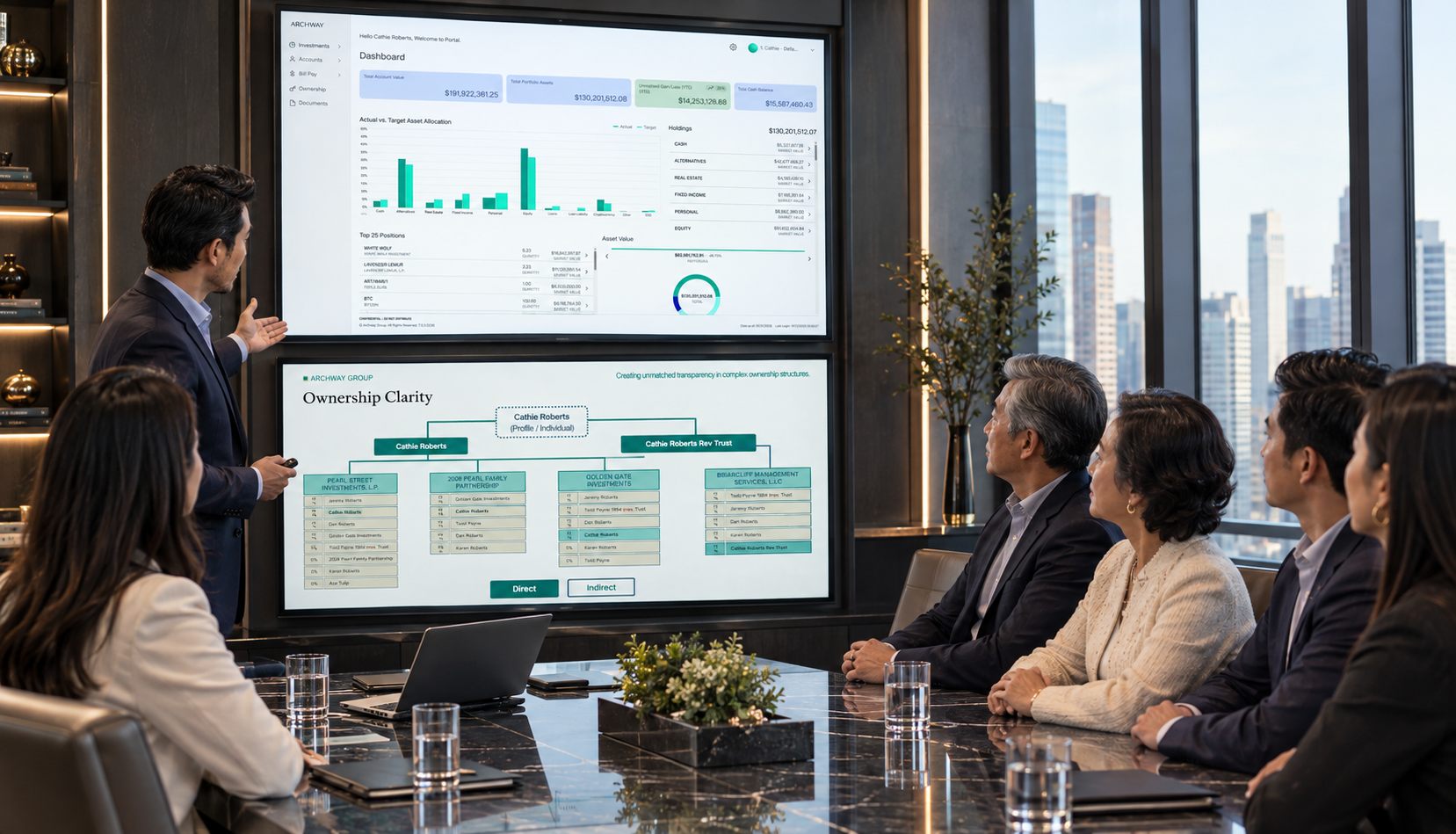
Ownership structures are layered and bespoke. A single investment may sit inside a holding LLC, which feeds a family partnership, which distributes to individual family members through trusts established at different times for different purposes. Each layer needs its own set of books. Getting consolidated reporting right means looking through every layer, eliminating intercompany balances so the same asset is not counted twice, and showing each beneficial owner their true economic exposure across the full structure. Most of these structures were built for estate planning or tax efficiency, not operational simplicity, and few follow a standard template.
We start with the governing documents which define preferred interests, profit interests held by family members, stuffing and other special allocations that split income, and gains differently across branches of the family. The accounting follows the governing documents precisely, and general-purpose platforms were not built for that level of complexity and layering.
Book to tax is an annual scramble. Most family offices run on a cash or accrual basis all year, then hand everything to an external tax advisor to convert to tax basis and prepare Form 1065s and K-1s. That process is only as good as the records underneath it. In a layered structure, one entity's K-1 feeds the next entity's return before that return can be completed, so the reconstruction starts from the bottom up, one layer at a time. In a structure with nested trusts, holding LLCs, and family partnerships, that can mean dozens of entities and weeks of professional time before a single K-1 is produced.
The increase in illiquid asset investments increases the long tail in valuations further complicating the matter. Private equity, real estate, hedge funds, direct investments: most do not price daily, and some have no formal valuation cadence at all. Without a policy for carrying values between valuation dates, the family office waits on every manager and appraiser before it can close the books. Many do exactly that. Consolidated reporting arrives 90 or more days after quarter end, well after it could have informed the decision it was meant to support.
Capital accounts require daily reconciliation. Every contribution, distribution, allocation, and transfer between entities, including in-kind transfers of real estate or private securities must be captured and posted accurately, or the account quickly stops reflecting reality. Left unaddressed, small discrepancies compound until reconciling them becomes a project rather than a routine.
Amid the myriad functions that are already stretching small finance teams, communication becomes its own layer of complexity. Why one branch of the family received a different allocation than another is not always self-evident, even when it is entirely correct under the partnership agreement. Those nuances are easily resolved through proactive communication, adding yet another step that needs to be thoughtfully managed by the same small team.
Where Most Family Offices Fall Short
The common failure is not a single mistake. It is an accumulation of workarounds that made sense at a time. A spreadsheet built to handle one partnership becomes the model for five. The one accountant who understands the allocation logic never writes it down. K-1 season is an annual scramble because partnership accounting and investment reporting live in two systems that were never built to agree.
Family offices are also investing more in formal governance: investment committees, valuation policies, approval matrices. J.P. Morgan's 2026 Global Family Office Report found that 48% of business-owning families have established formal governance bodies, compared with 40% of non-business-owning families. But governance defines control and accountability. Operations determine whether the controls are actually followed. Knowing where decisions are made means little if the numbers they need are being assembled by hand.
The result is not necessarily wrong numbers. It is a fragile operation: accuracy depends on specific people staying in their seats, reporting always runs a quarter behind, and the governing documents, investment reporting, and accounting records have quietly drifted apart in ways nobody has fully mapped. When a key person leaves, or the family's complexity outgrows the infrastructure supporting it, the cost of reconstruction is always higher than the cost of building it right would have been.
How Archway Can Help
Archway's platform maintains multi-entity ownership structures, parallel capital account bases, and allocation logic configured to the terms of each governing document. Investment reporting and partnership accounting run on the same general ledger, so the number in the report and the number in the books are the same number.
For family offices that also need accounting support, Archway’s Family Office Accounting team works as an extension of the family office’s own staff. The staffing challenges that make partnership accounting fragile in most family offices (attrition, coverage during leave, demand spikes at audit season and tax time) become Archway's to manage, not the family office's. The family gets consistent, high-quality accounting that does not depend on one person staying in their seat.



October 3, 2025
Article
·
Private Funds
·
time
-min
read
Family Office Outsourcing
Top 10 Reasons to Choose an Outsourcing Partner
Explains why family offices and private wealth firms use outsourced service partners to scale operations, strengthen continuity, reduce risk, and access specialized technology.

Archway Family Office Services
Why Financial Institutions and Family Offices Are Adopting Outsourced Accounting and Investment Reporting Solutions to Serve Their Ultra High-Net-Worth Clients.
In some corners of the private wealth management world, the word outsourcing, sometimes referred to as business process outsourcing (BPO), has become taboo. Oftentimes considered synonymous with offshoring, outsourcing has erroneously been painted as cheap work performed by unskilled labor.
But it only takes a bit of due diligence to find that these negative connotations are often an inaccurate portrayal of the true value of an outsourced service offering.
To that end, like other outsourced service providers to family offices and financial institutions, Archway is frequently faced with questions about our people, our processes and our technology and, ultimately, why outsourcing may be the right solution.
To help answer this question, here are 10 reasons private wealth managers are leaning into outsourced services.
1. They enable you to grow, quickly.
A new advisor joins your firm and brings a dozen new clients into the firm. Is your team prepared to absorb the account aggregation and report preparation responsibilities that will soon follow?
When you’re in high growth mode, the last thing you want to do is realize your team is not equipped to scale. An outsourced service provider like Archway can help financial institutions and family offices smoothly onboard new clients or households, so that wealth managers can focus on helping their clients achieve their wealth goals.
2. They can enhance your quality of service.
Enhanced service quality tops the list and it’s quite a simple notion.
Instead of spending time normalizing data, performing consolidations, paying bills or preparing and reviewing report packages, private wealth managers can focus on their passion: serving their clients and delivering results that build client wealth.
3. They provide business continuity in the event of disaster or significant change.
We’ve learned some tough lessons throughout the pandemic, but one that stands out for businesses is strengthening their ability to overcome disruption. Whether you’re trying to minimize the effects of a health crisis, employee departures or just a simple power outage, having a dependable outsourced service partner helps ensure that you can continue to meet the demands and expectations of your clients despite forces beyond your control.
4. They offer workforce stability in the face of employee turnover.
Key person risk is one of the chief concerns amongst family offices and financial institutions. If an employee departs or a position needs to be eliminated, how do you ensure that your operations don’t falter?
From our vantage point, outsourced service providers should operate as a seamless extension of your internal team. Using operational documentation, thorough communication and repeatable processes, an outsourced service team can quickly take on additional responsibilities in the absence of key personnel.
5. They are built on operational expertise.
There’s an adage that says, “You can be great at one thing or good at many.” We believe that you should always strive for greatness, which may mean leveraging third-party resources to perform key tasks that sit outside of your expertise or aren’t a valuable use of your time.
By partnering with an experienced BPO team, you will be able to work with subject matter experts and highly-skilled operations professionals that are solely focused on a single function. Examples of commonly outsourced activities include portfolio reconciliation and consolidated investment reporting, personal expense management, tax preparation, partnership administration, legal services, and trust administration.
6. They help you manage risk.
In some cases, particularly amongst private banks and other financial institutions, there may be compliance requirements related to particular service offerings that necessitate the need for third-party oversight. This oftentimes translates to creating a business relationship with an outsourced service provider.
Financial institutions and family offices can further manage their risk exposure by establishing service-level agreements (SLAs) with outsourced service providers that help define the who, what and when of service delivery.
7. They allow you to customize your solutions offering.
We’ve all watched this scene play out before: you’re courting a new client who presents a unique set of wealth management demands and you need to spin up a new solution offering quickly. It can be an anxiety-inducing situation if you don’t already know what’s out there.
On the other hand, if your financial institution or family office has a pre-established relationship with an outsourced service partner, it’s much easier to explore other available services and expand your relationship on an as-needed basis. Additionally, you can craft tiered service offerings that span the range of your clientele to ensure you’re delivering the right solutions to the right clients.
8. They provide efficiencies in your back office.
Most outsourced services focus on one of two areas: highly repetitive processes or highly specialized processes. The common thread between these two areas is that they both require a significant amount of time to complete.
By allowing an outsourced service team to absorb click-heavy, recurring operations like portfolio reconciliation, or time-consuming, tedious operations like family office partnership accounting, your staff can focus on doing what they do best and not worry about the monotony of data.
9. They can offer access to purpose-built technology.
While some envision BPO firms as shops filled with endless rows of desks and people, the reality is that most outsourced service organizations rely on a key tool to help drive efficiency: specialized technology.
At Archway, our BPO teams use our proprietary family office software, the Archway Platform℠, to perform the nuanced operations that exist within family offices and financial institutions serving high-net-worth clients.
Then, using the Archway Client Portal, we can securely deliver the processed and formatted data to family office professionals, advisors and their end-clients in an intuitive, easy-to-use platform. This gives them the opportunity to engage with their financial information in an interactive, tech-forward way that may not exist if the family office was exclusively responsible for designing and developing the end-client reporting experience.
10. They can reduce your firm’s overhead costs.
Maintaining technology can be expensive, especially if you are the designer, developer, quality assurer and information systems architect.
An outsourced service partner alleviates the need to maintain the technology and the servers that run it, which can ultimately reduce your overhead IT costs. As both an experienced technology firm and an award-winning outsourcing provider, our services include hosting and server maintenance, data backup and disaster recovery, ongoing technology enhancements, software quality assurance, data collection and normalization, system connectivity troubleshooting, and product documentation and training.
We know that outsourcing doesn’t always receive the recognition and appreciation it deserves, but the benefits of partnering with an outsourced service provider are demonstrated to be plentiful for private wealth management firms.
Whether you are seeking to ease the burden of client reporting, add new concierge services like client bill payment or offload the complex process of private fund bookkeeping and reporting, Archway is prepared to work and grow alongside your firm.
Check out our full suite of technology and outsourced service solutions for family offices and financial institutions to find out how we can help you better serve your high-net-worth clients.

June 4, 2024
Article
·
Single Family Offices
·
time
-min
read
Family Office Software
Data Feeds and System Connectivity
Alternative Investments
Strategic Partnership Highlight: Archway's Platform℠ x Canoe Intelligence
Highlights Archway and Canoe Intelligence’s integration for alternative investment data, including automated fund data extraction, pricing updates, and capital call workflows.
Archway Family Office Services
Archway and Canoe Forge Path to Further Advance Alts Data Management for Family Offices Using the Archway Platform
Since 2020, collaboration and a desire to solve complex financial problems have been at the core of Archway and Canoe Intelligence’s strategic partnership. Throughout the years, Archway’s experience working with nearly 600 ultra-high-net-worth families through the Archway Platform has made them acutely familiar with the challenges family offices face when it comes to collecting and reporting on alternative investment data.
Coupled with Canoe’s innovation and vision in the alts technology space, where the Canoe platform covers 42,000 active funds across $8T in Assets Under Management or Advisement for its 325 alternative investor clients, our teams knew early on there was an immense opportunity to streamline alternative investment data management within the family office space.
Recently, the two teams have been working on the next iteration of our partnership as we develop a more robust integration between the Canoe and Archway platforms.
This integration between Canoe and Archway automates the transmission of private equity and hedge fund valuations, as well as Private Equity Call and Distribution data. Moreover, Hedge Fund subscriptions and redemptions extracted from Canoe can be effortlessly imported into Archway.
In this article, we share how the two technologies are teaming up to test and build this expanded integration—and how we believe it can level up the operational efficiency for our mutual family office clients.
Common Challenges in Alts Data Management
Alternative investors, particularly family offices, navigate a complex landscape fraught with challenges when it comes to managing alts data. Among these challenges are data silos, where crucial information is scattered across multiple systems and platforms, making it difficult to obtain a comprehensive view of investments. Additionally, the reliance on manual data entry introduces a significant risk of human error and inefficiency, consuming valuable time and resources.
Compounding these issues is the lack of standardized data formats, further complicating the integration and analysis of disparate data sources.
In response to these challenges, Archway Family Office Services and Canoe Intelligence are expanding their strategic partnership and integration methods. By automating data transmission and ensuring data consistency, the integration streamlines the process of accessing and integrating alts data. This not only enhances operational efficiency but also mitigates the risk of errors, empowering family offices to make informed decisions with confidence.
How Canoe Enhances Archway’s Platform
- Automated Fund and Allocation-Level Data Extraction: Canoe's integration with the Archway Platform facilitates automated extraction, validation, and delivery of fund and allocation-level data.
- Pricing Updates: Canoe seamlessly updates pricing information in Archway, providing alternative investment valuation data extracted as soon as received and processed.
- Effortless Management of Capital Calls and Distributions: Canoe automates the process of updating Archway with capital call and distribution transactions.
- Streamlined Subscription and Redemption Transactions: Canoe generates extracts of subscription or redemption transactions, which can be uploaded directly to Archway.
Archway’s Platform at a Glance
Archway's Platform serves as a comprehensive wealth management technology solution tailored specifically for family offices. With Archway, family offices gain access to a wide range of benefits, including a 360-degree view of clients' wealth, enhanced operational efficiency, improved data accuracy and reliability, and robust operational and client reporting.
Bringing the Integration to Life
Prior to launching beta testing for the integration in late 2023, the Archway and Canoe teams worked in concert to automate data flows, normalize values, and define accounting rules and transaction mapping across systems.
The teams collaborated on extensive internal testing to validate the effectiveness and reliability of the integration, with the intent to not only automate the transmission of alternative asset data between platforms, but to simplify the complex nature of accounting for alternative investment transactions.
Through rigorous analysis and learning, the team identified and addressed potential challenges, fine-tuning the integration to meet the unique needs and requirements of family offices.
Now in its beta testing phase, the team continues to collect invaluable real-world perspectives, helping to guide iterative improvements and ensuring alignment with client expectations.
To date, Canoe has processed 150,000+ documents on behalf of Archway’s clients. Additionally, this collaborative effort has positioned two dozen mutual clients to automate the transmission of data across 3,400+ alternative investments, underscoring the substantial impact of the integration on operational efficiency and data management accuracy.
What's Coming Next
Looking ahead, Archway and Canoe are finalizing the initial integration offering with plans to expand the universe of data available to mutual clients seeking to automate the transmission of their alternative asset data. This next phase promises to unlock new levels of efficiency and value for family offices leveraging the combined power of the Archway’s Platform and Canoe Intelligence.
As Archway continues to leverage Canoe's capabilities, clients can expect further enhancements that drive continued scale and elevate client satisfaction. With a commitment to innovation and excellence, Archway and Canoe are poised to shape the future of alts data management. Stay tuned for more updates as the integration nears launch later this year.
Disclaimer: All statistics as of March 31, 2024.
Originally published by Canoe Intelligence.

March 30, 2023
Article
·
Single Family Offices
·
time
-min
read
Family Office Software
Family Office Reporting
Financial Reporting
Family Office Trends
Introducing the Archway Platform℠ Report Composer Tool
Introduces Archway Platform’s report composer tool and explains how self-service reporting helps family offices analyze, visualize, and synthesize enterprise data.

Michael Hansford
·
Director of Client Relations
A New Way to Synthesize, Visualize, and Analyze Family Office Data
With reporting at the center of nearly every family office software buying decision, the Archway Platform has offered a robust suite of reporting tools since its earliest days.
Launching with a raw database export capability, a handful of in-app performance visualizations, and roughly two dozen statement-style reports, the Archway Platform’s reporting foundation was set out of the gates.
Within the first five years of being on the market, the solution’s feature set quickly grew to include over 40 distinct reporting options.
By 2009, the Archway Platform featured more than 90 reports within its standard report library and users were first introduced to the concept of dynamic dashboards for quick, on-screen consumption of data. In 2012, the platform’s first standalone client portal application, dubbed FOIL, was released.
Over the course of the next decade, the standard report library ballooned to more than 200 parameter-driven reports, thousands of queries were built, dozens of dashboard inserts were rolled out, data grid customization was implemented throughout the application, and the Archway Client Portal was further enhanced to be an on-demand, mobile reporting tool for end-clients and family members.
Together, the Archway Platform’s standard report library, data queries, dashboards, custom data grids, and client portal served as a powerful, multi-faceted reporting engine.
But with an eye towards innovation, it was always clear that reporting is a function of our solution that can constantly be built upon: More metrics, more insights, more flexibility.
And so, in 2023, we introduced the Archway Platform’s report composer tool.
A unique, interactive reporting experience, the report composer functionality allows family offices to comprehensively analyze their enterprise data in a user-driven, self-service manner. Both elegant and powerful, the latest tool in the Archway Platform’s reporting suite grants nontechnical users the ability to create bespoke data views that deliver better insights and better reporting outputs for their needs.
Pulling from the Archway Platform’s vast database, family offices can assemble custom reports using raw data related to accounts payable, general ledger detail, investor activity, transactions, open positions, alternative assets, and other financial information.
But perhaps most important: The tool is inherently designed with versatility in mind. Featuring a drag-and-drop interface that enables users to build and edit custom reports in real-time, the report composer allows users to add, remove, and reorder data points—all without coding or custom development. And since the tool is embedded directly within the Archway Platform, users can dynamically group, sort, and filter their data based on their existing user-defined data classifications.
Using visualizations and charting tools like pie, bar, and line charts, users can further transform their data into meaningful analytics that help tell a story of trends, comparisons, and measurements.
Although a sophisticated reporting tool by nature, the Archway Platform’s report composer capability offers family offices yet another reporting mechanism built on the principle of simplexity: A simple interface that allows users to access and synthesize complex financial data on demand.
The report composer tool serves an important role in how family offices and advisors to high-net-worth families compile, communicate, and analyze their clients’ financial information, and seamlessly complements the existing suite of Archway Platform reporting capabilities.
Interested in seeing the report composer in action? Request a call with a member of the Archway Family Office Services team to schedule your live tour of the Archway Platform.

February 28, 2023
Article
·
Single Family Offices
·
time
-min
read
Family Office Software
Family Office Reporting
5 Family Office Reporting Examples to Inspire You
Shares five bespoke family office reporting examples, from artwork and property expenses to rental income and impact reporting.

Chris Rose
·
Sales Director
How Family Offices Use the Archway Platform℠ to Create Bespoke Client Reports
Every family office professional understands the necessity of balance sheets and income statements: They serve a fundamental purpose in understanding an individual’s financial position. And, fortunately, there are many family office software and service providers that can produce them.
But conventional financial statements rarely provide the level of insight needed to fully satisfy bespoke client requests.
As you’ve likely encountered, assembling non-traditional reports often requires unique attributes or classifications, custom data groupings, and client-specific data points. Moreover, if the request involves uncommon assets or personalized investment frameworks, compiling the data can require a heavy lift.
In our 20+ years working with family offices and advisors to high-net-worth families, we’ve received plenty of unique reporting requests, and we know how important it is to present complex—sometimes irregular—investment data in a simple, yet meaningful report.
Combining the robustness of the Archway Platform’s reporting engine with the flexibility of its user-defined data attributes and classifications, we’ve had the opportunity to help our clients harness the power of the platform to craft creative, tailored reporting outputs for their end-clients.
Whether you’re interested in building a report that compares household expenses across multiple properties, analyzes clean energy investments, or summarizes artwork valuations, the Archway Platform’s 200+ standard reports and multi-pronged reporting capabilities can help you quickly produce an easy-to-consume report.
Here are five unique reports, built using the Archway Platform, that break the boundaries of traditional family office reporting and deliver creative, tailored financial insights.
Inspiration #1. Paintings by historical era.
While it’s well known that artwork is a commonly held asset amongst family offices, the asset type tends to lack influence and inclusion in the development of family office technology and reporting standards. But given its prominence in high-net-worth investment portfolios, artwork—like any other asset—deserves specialized reporting.
Using the Archway Platform’s flexible, parameter-driven reporting templates, users can customize the view to see purchase price, change in market value, and unrealized gains / losses across the owner’s fine art collection. Perhaps more importantly, they can create custom attributes such as artist, historical era, region of origin, or art consultant—ultimately, allowing family offices to create a wholly unique way to consume artwork-related financial insights.
Inspiration #2. Profit comparison by horse.
Perhaps not as widely held as fine art, thoroughbred racing talent still requires an impressive amount of asset management. Leveraging the Archway Platform’s ability to create a fully customized general ledger, family offices can categorize and group expenses, measure their costs against equestrian-generated income, and compare profits across horses with simplicity and ease.
Inspiration #3. Primary residence expenses.
When you operate multiple households or properties, it can be difficult to compile the various expenses associated with each location. Spanning across utility and tax bills to insurance, property upkeep, and household staff payroll costs, it’s critical to know how much money is being spent on each property.
Using custom general ledger accounts and flexible reporting templates, family offices can succinctly compare property ownership costs across multi-level, user-defined expense categories.
Inspiration #4. Rental property income.
Like personal properties, many family offices hold a variety of rental properties. As a result, from time to time, you may be asked how much rental income is being generated—and which property is earning the most.
Using a combination of customized general ledger accounts and property-based portfolios, the Archway Platform’s reporting suite allows users to quickly produce a consolidated net income report that displays revenue and general operating expenses by individual rental property.
Inspiration #5. Impact report.
New investment frameworks—whether generally accepted or internally developed—are routinely popping up in the family office arena. Having the flexibility to infinitely tag assets with unique attributes gives family office professionals the opportunity to slice-and-dice data in line with the overarching investment strategy.
Using the Archway Platform’s multi-level grouping mechanisms, you can take multiple frameworks, such as foreign investment allocation laid over the United Nations’ Sustainable Development Goals, to present a unique view of investment impact across regions, areas of development, and environmental, social, and governance initiatives.
To learn more about how the Archway Platform’s powerful reporting engine can help your family office deliver tailored financial insights, check out a demo or schedule a call with a member of the Archway Family Office Services team.

January 31, 2023
Article
·
Private Funds
·
time
-min
read
Family Office Software
Technology Due Diligence
Data Feeds and System Connectivity
Family Office Trends
3 Signs You Should Revisit Your Family Office Tech Strategy
Outlines three signals that a family office should reassess its technology strategy: lack of specialization, manual workarounds, and weak system connectivity.

Dennis Mangalindan
·
Vice President, Business Development
Evaluating Family Office Platforms for Specialty, Efficiency, and Connectivity
As a family office software provider, we talk about technology evaluations, well, a lot.
And when we talk about technology evaluations, it’s important to note that the conversation isn’t limited to prospective users and industry consultants trying to better understand our offering.
In fact, the most constant tech evaluation the team here at Archway Family Office Services participates in is the one we conduct ourselves: an ongoing assessment of how we can improve the Archway Platform and the private wealth management operations it supports.
But if you aren’t a technology provider to hundreds of family offices and financial institutions, this may not be a routine activity for you, which likely has you asking the question, “When should I reevaluate my family office technology?”
Here are three signs that it may be time to revisit your family office tech strategy.
Your technology is designed for the masses, but not for family offices.
Out-of-the-box general ledger, portfolio management, and performance reporting solutions work extremely well for out-of-the-box scenarios—scenarios of which family offices rarely encounter.
Common pain points family offices may experience with non-specialized technology include:
- Entity consolidations
- Partnership accounting
- Nested ownership calculations
- Centralized disbursements and bill payment
- Enhanced investment analytics
- Complex, multi-pronged transactions
- Net worth and financial report creation
If your family office has found itself experiencing one of the above challenges, it may be a good time to research purpose-built family office solutions—or, at the very least, engage with a consultant that can point you in the right direction.
If your family office has found itself experiencing many of the above challenges, it’s an even better time.
Despite having a technology solution in place, you still predominately rely on manual processes.
Ideally, when you implement a technology platform, your family office will see a negative correlation in manual work: More automation, less human intervention.
But when the solution in place is non-specialized, or simply ill equipped to handle the nuances of ultra-high-net-worth wealth, family office professionals may find themselves doing a significant portion of work outside of the system.
A few manual tasks here and there certainly isn’t enough to move the needle, but if you find that you are routinely performing manual rework in other applications, moving data to spreadsheets, writing physical checks, or building financial reports using presentation slides, it may be time to ask yourself if your current technology solution is serving its intended purpose—or if it’s just collecting digital dust.
Your current technology platform doesn’t connect with outside data providers or third-party systems.
Across industries, it’s generally accepted that technology silos can cause a variety of problems. Aside from clouding transparency and stunting collaboration, technology silos can prove to be a massive drain on efficiency. Often requiring duplicative data entry, technology silos at best waste resources, and at worst open the door to data discrepancies and risk across systems.
But technology silos and multiple systems don’t need to be synonymous. There can be immense value in selecting modern family office platforms that are able to communicate by securely passing relevant data to and from one another—whether through automated data feeds, APIs, or customizable data extracts and queries.
To that end, if your current family office tech stack lacks the ability to automatically collect data from multiple sources, integrate data across multiple systems, or produce comprehensive reporting, it may be worth reviewing the technology solutions that are preventing your family office from breaking down those verticals.
If your family office has seen the signs and is interested in revisiting your current tech stack, check out our simple wealthtech strategy evaluation to help you think through and build your organization’s long-term technology strategy.

December 20, 2022
Article
·
Single Family Offices
·
time
-min
read
Family Office Software
Family Office Outsourcing
Family Office Trends
Family Office Outlook: Planning for the Future
Highlights four strategic focus areas for family offices, including outsourcing, automation, enhanced analytics, and entity or tax restructuring.

Chelsea Francis
·
Head of Strategy
A Look at 4 Key Areas of Strategic Focus Expected in 2023
As the end of the year looms near, so do project deadlines, final data reviews, and annual reporting deliverables. With family offices bogged down by the mechanics of reconciliations and closing the year-end books, strategic planning can unintentionally get pushed to the bottom of the pile.
But whether strategy is top of mind or not, the family office space is in flux—changing now more than ever—which warrants consideration of several key focus areas.
Outsourcing
Continuing a multi-year conversation, outsourcing has been a trending topic in the market for some time now. With more family offices reviewing internal operations and a growing appetite amongst financial institutions to offer a more holistic set of services to its ultra-high-net-worth clients, we at Archway Family Office Services believe outsourcing will continue to be the centerfold in the ongoing assessment of operations and resources.
Employed as a long-term strategy or as a trusted stopgap during unanticipated events, outsourced services can create meaningful capacity within family offices. Although family office outsourcing is often synonymous with professional services like tax and regulatory compliance or cybersecurity, it can also be impactful in core operational areas like data aggregation and reconciliation, partnership administration, and routine reporting.
Process automation
When the Archway Platform℠ was introduced in the early 2000s, it offered family offices the opportunity to automate the manual ticking and tying of prior decades. It offered automated data aggregation and the creation of financial statements and client reports. It offered automated partnership allocations, investment performance calculations, bill payment, and more. And all of this automation offered family offices something they’d long been after: Time.
Now 20 years later, countless technology solutions have been introduced to automate family office functions from A to Z, each offering a new layer of efficiency—and potentially adding hours back into the work week for family office professionals.
Enhanced analytics
Ultra-high-net-worth investors and next gen wealth owners are clamoring for data. They want more transparency, deeper insights, and a higher probability of success. For family office professionals, this translates into looking beyond traditional performance measurements and delivering enhanced analysis across a variety of metrics and results like attribution, benchmarking, value-at-risk, stress testing, exposure mapping, and what-if scenarios.
Entity and tax restructuring
While most family offices don’t endeavor to restructure every single year, certain events can lead to this conversation taking a front row seat during annual strategic planning. Impending tax laws, new regulations, and political posturing can all lead to an evaluation of a family office’s structure. But so can major changes to the nuclear family like deaths, births, divorces, or marriages.
As family offices and their tax attorneys consider tax advantages and implications, entity restructuring can help families weather the changes—political, social, environmental, or personal.
At Archway Family Office Services, we can’t overstate the importance of having the right family office software in place to manage the restructure, automate asset transfers, define new ownership, and validate the changes through reporting. With the help of the right tools, family offices can make the restructuring process feel nearly seamless—or at least as seamless as restructuring goes.
While it’s likely that your to-do list is long and the countdown to the New Year is short, we encourage family offices and advisors to high-net-worth clients to spend some time reviewing the outcomes of the past year and strategizing for the next.


