







September 30, 2026
Article
·
Single Family Offices
·
time
-min
read
Family Office Trends
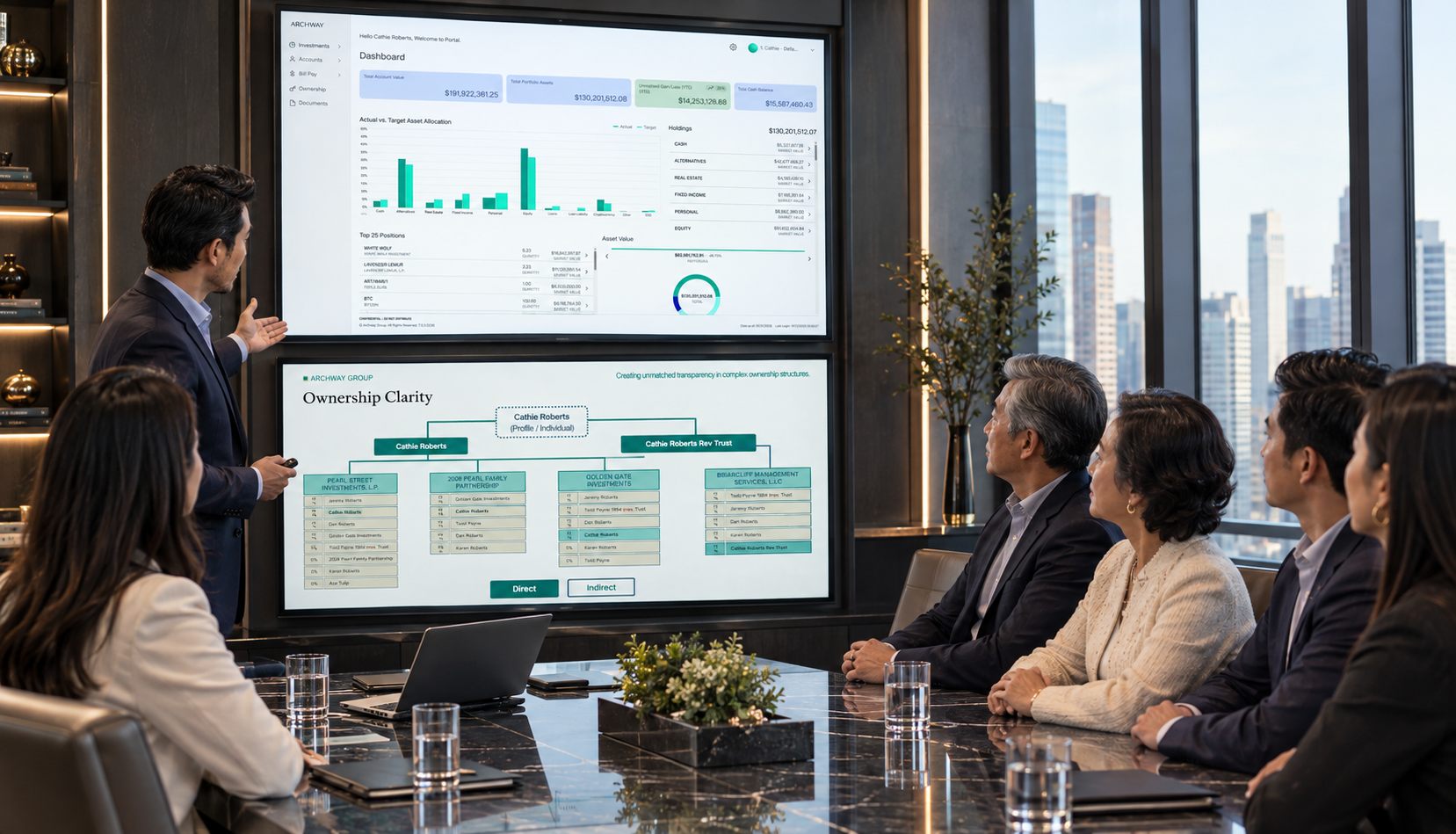
Your Investment Reporting Is Excellent. Your Partnership Accounting Is Probably a Liability.
Why family office partnership accounting is harder than it looks.

Megan Greer
The Distinction That Gets Overlooked
Most family offices have built serious investment and portfolio reporting. They know what the family holds, what it is worth, and how it has performed. That visibility is necessary. It is not sufficient.
Investment reporting tells you the family holdings and their value. Partnership accounting tells you who owns what, on what basis, under what agreement, and what the accounting, tax and legal consequences are of every allocation, distribution, and transfer. A family office with one but not the other is making decisions on incomplete information and creating liabilities it will not recognize until they surface in an audit, a family dispute, or a K-1 that does not match what someone was told to expect.
Partnership accounting sits at the intersection of investment operations, tax, and estate planning. It is one of the most technically demanding functions inside a family office, and one of the most consequential when it goes wrong. Here is why it is harder than it looks, and where most family offices fall short.
Why Partnership Accounting Is Uniquely Complex
Family offices use partnership and LLC structures extensively: investment holding, estate planning, liability isolation, generational wealth transfer, governance. While the structures themselves are not unusual, the combination of competing demands makes administering them so challenging.
Ownership structures are layered and bespoke. A single investment may sit inside a holding LLC, which feeds a family partnership, which distributes to individual family members through trusts established at different times for different purposes. Each layer needs its own set of books. Getting consolidated reporting right means looking through every layer, eliminating intercompany balances so the same asset is not counted twice, and showing each beneficial owner their true economic exposure across the full structure. Most of these structures were built for estate planning or tax efficiency, not operational simplicity, and few follow a standard template.
We start with the governing documents which define preferred interests, profit interests held by family members, stuffing and other special allocations that split income, and gains differently across branches of the family. The accounting follows the governing documents precisely, and general-purpose platforms were not built for that level of complexity and layering.
Book to tax is an annual scramble. Most family offices run on a cash or accrual basis all year, then hand everything to an external tax advisor to convert to tax basis and prepare Form 1065s and K-1s. That process is only as good as the records underneath it. In a layered structure, one entity's K-1 feeds the next entity's return before that return can be completed, so the reconstruction starts from the bottom up, one layer at a time. In a structure with nested trusts, holding LLCs, and family partnerships, that can mean dozens of entities and weeks of professional time before a single K-1 is produced.
The increase in illiquid asset investments increases the long tail in valuations further complicating the matter. Private equity, real estate, hedge funds, direct investments: most do not price daily, and some have no formal valuation cadence at all. Without a policy for carrying values between valuation dates, the family office waits on every manager and appraiser before it can close the books. Many do exactly that. Consolidated reporting arrives 90 or more days after quarter end, well after it could have informed the decision it was meant to support.
Capital accounts require daily reconciliation. Every contribution, distribution, allocation, and transfer between entities, including in-kind transfers of real estate or private securities must be captured and posted accurately, or the account quickly stops reflecting reality. Left unaddressed, small discrepancies compound until reconciling them becomes a project rather than a routine.
Amid the myriad functions that are already stretching small finance teams, communication becomes its own layer of complexity. Why one branch of the family received a different allocation than another is not always self-evident, even when it is entirely correct under the partnership agreement. Those nuances are easily resolved through proactive communication, adding yet another step that needs to be thoughtfully managed by the same small team.
Where Most Family Offices Fall Short
The common failure is not a single mistake. It is an accumulation of workarounds that made sense at a time. A spreadsheet built to handle one partnership becomes the model for five. The one accountant who understands the allocation logic never writes it down. K-1 season is an annual scramble because partnership accounting and investment reporting live in two systems that were never built to agree.
Family offices are also investing more in formal governance: investment committees, valuation policies, approval matrices. J.P. Morgan's 2026 Global Family Office Report found that 48% of business-owning families have established formal governance bodies, compared with 40% of non-business-owning families. But governance defines control and accountability. Operations determine whether the controls are actually followed. Knowing where decisions are made means little if the numbers they need are being assembled by hand.
The result is not necessarily wrong numbers. It is a fragile operation: accuracy depends on specific people staying in their seats, reporting always runs a quarter behind, and the governing documents, investment reporting, and accounting records have quietly drifted apart in ways nobody has fully mapped. When a key person leaves, or the family's complexity outgrows the infrastructure supporting it, the cost of reconstruction is always higher than the cost of building it right would have been.
How Archway Can Help
Archway's platform maintains multi-entity ownership structures, parallel capital account bases, and allocation logic configured to the terms of each governing document. Investment reporting and partnership accounting run on the same general ledger, so the number in the report and the number in the books are the same number.
For family offices that also need accounting support, Archway’s Family Office Accounting team works as an extension of the family office’s own staff. The staffing challenges that make partnership accounting fragile in most family offices (attrition, coverage during leave, demand spikes at audit season and tax time) become Archway's to manage, not the family office's. The family gets consistent, high-quality accounting that does not depend on one person staying in their seat.


December 5, 2022
Article
·
Private Funds
·
time
-min
read
Family Office Software
Family Office Trends
3 Common Family Office Technology Myths [And What to Expect Instead]
Debunks three common myths about family office technology, including going it alone, siloed systems, and viewing technology only as an expense.

Chelsea Francis
·
Head of Strategy
Debunking common family office software misconceptions
There are plenty of opinions when it comes to family office technology: Integrated versus best of breed, non-specialized versus purpose-built, in-house versus outsourced, IBOR (Investment Book or Records) versus ABOR (Accounting Book of Records). The list goes on.
And given the sheer number of opinions out there, occasionally a mistruth is bound to emerge. To help separate fact from fiction, here are three well-circulated myths about family office technology, and what you can expect instead.
Myth #1: You have to go it alone.
Selecting, implementing, and operating a technology platform can feel like an oversized task for family offices with limited staffing and capacity. Fearing that more sophisticated, purpose-built family office tools will compound resource constraints, it’s not uncommon for family offices to stick with non-specialized, seemingly low-maintenance software.
From their vantage point, without the internal infrastructure or headcount to support the ongoing maintenance of a new system, the likelihood of adoption is low.
Here’s the truth:
Utilizing generic software packages for general ledger, investment data aggregation, partnership accounting, bill payment, and client reporting can actually hinder efficiency. Burdened with manual processes and disconnected technologies that beckon duplicative work, this approach can ultimately require more time to manage than enterprise-level family office software.
On the other hand, it is true that dedicated family office tools are often accompanied by a bit of a learning curve, but the long-term gains in efficiency, dependability, and accuracy can be tremendous.
Technology doesn’t need to be exclusively managed by an organization’s in-house staff.
In many cases, technology vendors offer outsourced services that family offices can leverage to supplement their own staffing. Similarly, family offices can partner with consultants and contractors to assist with upfront technology implementations and offload recurring, resource-heavy operations, like portfolio reconciliation, partnership accounting, and monthly reporting.
By working alongside external teams with operational or technology-specific expertise, family offices can reap the benefits of dedicated family office technology, while lightening the operational load associated with day-to-day data management.
Myth #2: Siloed technology and specialized technology are one in the same.
The wealthtech boom over the past decade introduced a variety of solutions that are hyper focused on specific family office functions—areas like alternative assets, portfolio intelligence, risk analysis, manager due diligence, bill payment, data aggregation, and benchmarking.
With so many options, family offices may find themselves leveraging two, three, five, and sometimes more disparate solutions. Hence the myth that these solutions must live in mutually exclusive silos.
Here’s the truth:
Today’s family office tech stacks are indeed more sophisticated than ever. But family office technology is also displaying unprecedented levels of interconnectivity. From strategic partnerships across firms, like the recently expanded relationship between Archway’s Archway Platform℠ and Canoe Intelligence, to the widespread adoption of APIs, file exchanges, and data warehouses, family offices have an increasingly wide array of options when it comes to integrating their financial data hub.
Myth #3: Technology is an expense, not an investment.
Family office or not, industry-specific technology rarely comes cheap. Built according to the nuanced operations and unique data structures of its user base, purpose-built family office technology comes with a commensurate price tag. But simply because modern wealthtech costs more than legacy systems and spreadsheets, doesn’t mean it’s not worth the price.
Here’s the truth:
Like most things in business, you get what you pay for. And while adopting family office-specific tools comes with a cost, using non-specialized software does too.
Oftentimes undetected, these costs may not come in the form of a price tag on a license agreement, but make no mistake, your family office could be paying in manual rework, duplicative efforts, multi-step data entry, time-consuming consolidations, and labor-intensive reporting.
Meanwhile, investing in purpose-built, process-driven family office solutions can introduce automation, native workflows, validation systems, increased data accuracy, and enhanced reporting, all of which can pay dividends in terms of time and resources.
Which begs the question: What’s that worth to your family office?
Originally authored by Archway for publication on Family Office Exchange.

November 30, 2022
Article
·
Single Family Offices
·
time
-min
read
Family Office Software
Client Service
Family Office Trends
4 Things Archway Platform℠ Users Can Learn from One Another
Explains how Archway Platform users learn from one another through shared use cases, underused tools, reporting ideas, and peer community discussions.

Natalie Peters
·
Relationship Manager
The Importance of a Family Office Software User Community
At Archway Family Office Services, we have always prided ourselves on our ability to understand the nuances of our ultra-high-net-worth clients. Our teams have extensive experience working through complex issues and one-off scenarios that are unique to family offices and private wealth management organizations. We are, by all accounts, well suited for the job.
We’ve helped hundreds of family offices leverage the Archway Platform to support critical facets of their operations like central disbursement entities, multi-layered ownership structures, complex equity transfers, and family member-specific reporting requirements.
But even our most tenured team members will tell you: There is no substitute for the opportunity to problem solve amongst your peers.
As mentioned in our blog discussing the what, where, who, and why of Archway’s exclusive Archway Platform User Conference, IMMERSION, the leading request from our clients is access to other members of our family office user community.
So what exactly can family offices who share a common wealthtech solution—say, the Archway Platform—learn from one another?
1. How family offices are using the Archway Platform to solve complex issues.
The evolution of family offices and the development of family office software are undeniably intertwined. As the needs of family offices have shifted over the years, so has the Archway Platform’s suite of tools.
With each product upgrade, we’ve introduced new functionality, built efficiencies and automation into the application, and enhanced the capabilities of our existing tools. As a result, our users have found that there’s often more than one way to do the same thing in the system.
And while we offer release notes, product documentation, and system training, sometimes the easiest way to learn something is to hear from someone else that’s already using it.
Common in-app operations that our clients discuss with one another include:
- How to transfer ownership based on different scenarios, and which Archway Platform tool is most suitable for the desired outcome
- Best practices when using the Archway Platform’s reconciliation tools
- Usage of alternative asset-specific tools to track activity and report on investments
- Accounts payable processes best practices
- Creating ad hoc reports and recurring family member report packages
- Archway Client Portal use cases and adoption strategies for family members and outside stakeholders
2. What Archway Platform tools they could be utilizing, but aren’t today.
When a client begins discussing how they’re using the Archway Platform to solve complex issues, this often leads to another user saying, “We hadn’t thought of doing it that way!”
The fact of the matter is, it’s our human nature to create routines and processes. If a process works, we don’t necessarily go out looking for another way to do it. But, when a step in the process changes, it presents an inflection point: Is there a better way to do this?
And when it’s time for our clients to find that answer, Archway Family Office Services offers multiple channels:
- Reach out to the Archway Family Office Services Client Relations team for product support
- Engage with the Archway Platform Training team for consulting on a new process
- Pose that exact question to other Archway Platform users through a variety of forums and idea exchanges in our secure, online client support portal
Although it’s widely accepted that each family office has its own unique way of operating, we frequently find that there are common threads that tie them together. While our clients’ experiences may not be identical, users may have experienced similar scenarios that can nonetheless lead to the adoption of new tools and the implementation of new processes.
3. Which reports they can use to answer challenging financial questions.
Reporting is the pinnacle of family office wealthtech. It is, after all, how family offices and the family members they advise render and make sense of the data that’s been collected, entered, and validated in the technology. So it’s no surprise that reporting is one of the most comprehensive functions that exists in the Archway Platform.
With a suite of tools consisting of an extensive report library, raw data queries, dashboards, and a client reporting portal, users of the Archway Platform have a variety of options when it comes to reporting on their financial data.
That said, in a perfect world, family office professionals would have plenty of free time to explore the report library, try out new queries, and customize reporting dashboards. But day-to-day responsibilities often prevent that.
So what’s a quick and easy way to discover new reporting ideas? Clever report configurations? Unique data classifications and groupings?
Enter: The Archway Platform user community.
By inquiring with other users to learn what reports they’re using, which metrics they’re leveraging, and how they’re applying parameters and data groupings, family offices can quickly identify the right combination of reports, data points, and formats to get the output they desire—straight from the individuals that have walked the same path.
4. How family offices are handling situations that have nothing to do with the software.
Perhaps the most important thing family offices can learn from one another has nothing to do with technology or operations at all.
As anyone who works in the family office arena knows, it can be excruciatingly difficult for family offices to connect with other family offices. And while there are a variety of family office membership organizations and events that can help, family offices are, generally speaking, incredibly private and confidential, making networking and communicating with one another challenging.
Understanding that gap and recognizing the commonality of our client base, we created a trusted community in which all of the members share a unifying theme: Usage of the Archway Platform.
Sustained through national and regional user conferences, virtual peer dialogues, online user forums, and brokered introductions, our family office software user community presents our clients with the unique opportunity to connect and build relationships with other family office professionals.
Through their expanded network, our clients have gone on to create a variety of breakout peer groups that frequently get together to discuss the issues they face as family offices—whether it pertains to the Archway Platform or not.
These peer groups, though born out of their common usage of the Archway Platform, have grown across a much wider spectrum, where family office professionals can discuss trust law, tax planning, family office restructuring, burgeoning investment strategies, talent acquisition, process documentation and new hire training, and so much more. The community has flourished.
To learn more about joining the Archway Platform user community, schedule a call with a member of our team to discover how other family offices and private wealth management firms are using Archway’s purpose-built wealth management solutions.

October 18, 2022
Article
·
Single Family Offices
·
time
-min
read
Family Office Software
Client Service
Family Office Trends
How Archway Family Office Services Built an Exclusive Family Office Event Rooted in Connection and Collaboration
Explains the history and purpose of IMMERSION, Archway’s exclusive family office user conference for client training, networking, and peer collaboration.

Eric Sampson
·
Relationship Manager
Everything you need to know about IMMERSION: Archway’s PlatformSM User Conference
When we ask our clients what would help them become even more successful, we get plenty of answers: Specialized functionality, new reports, more hours in the day. But time and time again, the answer that we hear most often—the one that is echoed over and over by family offices, regardless of location, size, or tenure—is the opportunity to connect with other family offices.
And so, nearly a decade ago, the IMMERSION User Conference was born.
Let’s take a look at the history of IMMERSION: What it is, where it happens, who attends, and why it’s become a mainstay in the Archway Family Office Services training program.
What is IMMERSION?
The IMMERSION User Conference is a multi-day training and networking event hosted by Archway Family Office Services. We invite our family clients from across the globe to join us for a three day immersive experience (see what we did there?), where they’re given the opportunity to:
- Receive firsthand training from our team of experts
- Preview new Archway Platform enhancements
- Join roundtables discussing family office best practices
- Hear from strategic partners about additional family office solutions
- Build their network of family office professionals
While at IMMERSION, attendees can choose from a menu of expertly curated, CPE-accredited sessions. Focusing on key functional areas of our family office software platform, these sessions deliver best practices, tips, and tricks in areas like troubleshooting system issues, completing reconciliations, managing accounts payable, tracking alternative investments, measuring performance, and producing family office reporting.
In 2016, we introduced our first-ever New User Workshop, giving new clients the opportunity to get up to speed prior to the more advanced sessions at the main conference. Not surprisingly, the New User Workshop has become a cornerstone of our event and has expanded to include not only new users, but existing users simply looking for a refresher on Archway Platform blocking and tackling.
Where does IMMERSION take place?
Since the inaugural IMMERSION was hosted in our hometown of Indianapolis, IN, in 2014, we’ve had the chance to collect plenty of feedback over the course of several events, allowing us to evolve the format of the event, the topics we cover, how we deliver the content, and even where we host the conference.
Following our first IMMERSION User Conference, we decided that we would alternate between the large global conference in even-numbered years and smaller, regional user conferences in odd-numbered years.
We followed this cadence through 2019, hosting two additional IMMERSION User Conferences in Indianapolis and a dozen regional user conferences across the country, from New York to Dallas to San Francisco—and many more in between.
But like most firms, Archway Family Office Services took IMMERSION virtual in 2020 and 2021 as we adjusted to the world around us. Broadcasting live from a pop-up studio in our Indianapolis office and powered by a newsroom-worthy studio crew, we were able to carry on the IMMERSION tradition despite the obstacles that inherently come with transitioning a typically in-person event to being fully online.
And now, in October 2022, we are back in-person and we’ve moved. This year, our global conference is being hosted in Austin, TX.
Who goes to IMMERSION?
IMMERSION is an exclusive, invitation-only event for our family office and private wealth clients. By bringing together a group of family office professional that all share a common usage of the Archway Platform, we create an intimate, secure environment where users can connect, share ideas, collaborate, and learn together.
Today, IMMERSION has become a core tenant of the Archway Family Office Services training program. Outside of its discernible popularity amongst clients, the event has grown be so much more than a training exercise for users.
IMMERSION is an opportunity for our team to connect with one another, to put faces to names, and build lasting relationships with our clients. Sure, we spend a lot of time talking about partnership accounting, performance validation, and data management.
But we spend an equal amount of time talking about the things that happen in our lives outside of the four walls we work within. IMMERSION is about discovery and learning and bringing people together: Some of the most human elements we all possess.
After 20 years working with family offices, the team at Archway Family Office Services understands how critical your technology partner—and the people who comprise it—is to your success. Which is why we invite our clients to come together for a day—or three—every year so that we can continue to grow together.
Discover the many ways Archway Family Office Services connects with our family office clients through education, support, and training in our mini ebook, Our Commitment to Exceptional Client Service.

September 30, 2022
Article
·
Single Family Offices
·
time
-min
read
Family Office Software
Family Office Outsourcing
Family Office Trends
3 All-Purpose Strategies to Overcome Common Family Office Challenges
Presents three broad strategies for family offices facing operational complexity: education and networking, outsourcing underserved functions, and working with consultants.
Chelsea Francis
·
Head of Strategy
Leveraging Family Office Software and Outsourced Services to Help Your Operations Stay Balanced
The very nature of a family office is to provide multiple services, across multiple households, across multiple generations. To that end, it goes without saying that family offices are rarely, if ever, afforded a singular operational focus.
The ubiquity of daily, multi-entity data management, routine monitoring of inflows and outflows, evolving investment strategies, shifting ownership structures, and seemingly always-on-the-horizon tax and reporting deadlines can make running a family office inherently challenging. Compounded by social, economic, and political influences, running a family office can truly become a balancing act.
And when you’re juggling that many balls at the same time, it can be difficult to know which ones to keep in the air and which to hand off to someone else.
Luckily, growth and innovation in the family office space have created a host of options to help lighten the operational burden.
Struggling with your family office’s financial data management? Evaluating or implementing a new technology solution? Wanting to connect with other family office professionals to talk shop? From purpose-built family office technology to exclusive family office communities, dedicated family office service providers, and experienced consultants, the answers are out there. You just need to know where to look.
Here are three universal strategies that can help your family office identify solutions and overcome its unique challenges—big or small.
Pursue all of the training, education, and networking opportunities.
You’ve probably said it, we’ve definitely said it, and you’ve surely heard it: We don’t know what we don’t know. But more often than not, someone is willing and able to help you learn—and what better way to connect and share experiences than through training, education, and networking events?
Nevertheless, even on our best days, when your capacity is already hitting the limiter, it can be hard to look at a new opportunity and say, “Yes, I want to add more to my plate.”
We get it: It’s hard to make time. We’ve all felt the pinch, but when it comes to training, education, and networking, we at Archway Family Office Services firmly believe it’s worth the reward.
Let’s look at a few examples:
Scheduling one-on-one or team training with your technology provider
Pros: Expand your knowledge of the application; Explore new tools and functionality; Smooth out workflows; Discover ways to automate processes and reduce clicks
Cons: Requires time out of your schedule; May incur a financial cost
Attending a family office conference
Pros: Connect with other family office professionals; Discuss alternative solutions to shared operational challenges; Learn about new technology and service providers; Gain insight into regulatory changes, investment trends, and other strategic topics
Cons: Requires time out of your schedule; May incur a financial cost
Among the weary, the busy, and the cost-conscious, a natural response is to say “I don’t have the time” or “It’s not in the budget.” But a shift in mindset to say “It is worth my time” or “It is worth the cost” can pave the way to new connections, elevated conversations, and creative ideas that just may hold the solution to your most stubborn challenges.
Don’t be afraid to outsource underserved operations.
Sometimes it’s not a matter of training, education, or networking—after all, even a creative solution can’t add hours to the day. And if you’re not in a position to hire additional staff, capacity challenges can quickly become overwhelming.
But the situation doesn’t have to be dire. The industry is laced with experienced, trusted service providers that specialize in family office operations.
Take Archway Family Office Services for example. Given our deep roots in family office software, it’s only natural that we offer outsourced services to our clients that either augment or replace their in-house usage of the Archway PlatformSM.
Ranging from portfolio reconciliation and consolidated client reporting to personal expense management and partnership administration, our menu of solutions helps our clients create a bespoke combination of technology and services that is right-sized for their family office or financial institution.
Still on the fence? Check out the Top 10 Reasons Private Wealth Managers Choose an Outsourcing Partner.
So, whether you’re looking for expertise in broader areas like financial data management and tax planning, or more niche areas like private foundation management and family governance, there’s a good chance you can find a service provider that specializes in it.
Which brings us to the world of consultants.
Partner with an experienced consultant.
When in doubt, reach out to a consultant.
Oftentimes leveraging in-depth assessments and contextual reviews, consultants are equipped to help make recommendations that are appropriately suited for your family office. Their range of expertise and their unbiased opinion can help your family office identify key pain points, evaluate viable solutions, partner with experienced technology and service providers, and implement long-term strategies.
Read How Consultants Can Help Family Offices to get a deeper understanding of the three primary roles of family office consultants: Administrative consulting, technology consulting, and operational consulting.
Contact Archway Family Office Services to find out how our suite of technology and service solutions helps our clients overcome their accounting, investment data aggregation, and reporting challenges.
Just need a suggestion for a family office consultant or conference? We can do that too.

August 29, 2022
Article
·
Single Family Offices
·
time
-min
read
Family Office Software
Technology Due Diligence
Client Service
The Client Service Trifecta: Family Office Software Client Support, Education, and Training
Explains why client support, education, and training should be evaluated alongside functionality when selecting family office software.
Natalie Peters
·
Relationship Manager
Using Client Service as a Mechanism to Qualify Family Office Technology Providers
Capabilities and tools, code and databases, reports and more reports.
When it comes to family office technology evaluations, these tend to be the topics that dominate most conversations. And for good reason: These topics are, no doubt, core to selecting a solution that will work for your family office.
But a technology solution that merely works for your family office is a far cry from a technology solution that enhances your family office. Your family office software should extend beyond functionality and reporting. Ideally, an investment of this magnitude should support the growth and strategy of the family, generation over generation.
In our experience, the key to finding a dependable technology partner with a staying power equal to the family wealth itself is to look beyond the product or service and evaluate the whole of the firm’s client service approach.
It’s no secret that at Archway Family Office Services, we routinely cite the importance of client service as a key consideration when choosing a family office software provider.
Client Support
Oftentimes, the most common face of client service is client support. In the traditional sense of client support, this is the real human answering the phone, replying to your email, or triaging your support ticket. In a more modern sense, it could equate to chatbots, automated voice systems, or robotic process automation (RPA).
When evaluating your technology provider’s client support capabilities, consider the following:
- Support hours and availability
- Location of support staff
- Types of support channels (i.e. phone, email, online support portal, etc.)
- Experience and/or qualifications of support staff
- Self-service support capabilities
Client Education
Client education can come in a variety of forms, from knowledge bases, setup guides, and product release notes to step-by-step process and policy documentation. A key pillar in any client service model, education is fundamental to giving clients the tools they need to successfully operate a wealthtech solution.
But perhaps more notably, this facet of client service puts clients in the driver’s seat, allowing them to acquire the knowledge and skills they need so that they can become self-sufficient within the application.
When evaluating your technology provider’s client education capabilities, consider the following:
- Availability of online, self-service product documentation
- Communication strategy related to product enhancements, upgrades, and announcements
- Creation of thorough process documentation and/or best practices for critical operations
- Access to how-to guides, tutorials, and setup manuals
- Opportunity to join peer networks and/or forums for best practices, tips, and tricks
Client Training
Ongoing client training is critical to maximizing your family office’s technology investment. Training represents the tipping point from becoming self-sufficient to proficient in an application and often covers more advanced features and functions of the technology.
At Archway Family Office Services, we offer a variety of training opportunities including ad hoc client-specific trainings, recorded tutorials, live group trainings, and our pinnacle training event exclusively for our family office clients: Archway’s IMMERSION User Conference.
When evaluating your technology provider’s client training capabilities, consider the following:
- Availability of dedicated, in-house training staff
- In-person and/or virtual group training opportunities
- One-on-one custom training opportunities
- Access to user conferences, regional user groups, or client communities
- Accreditation of training content
By checking the boxes in these three areas of client service, your family office can feel more confident in not only the technology you’ve selected, but the people, processes, and documentation that will support you going forward. More importantly, these areas—even more so than the software itself—will define how you engage, connect, and grow with your technology partner for years to come.
Learn more about how Archway Family Office Services builds lasting relationships and connects with our family office and financial institution clients through education, support, and training in our mini ebook, Our Commitment to Exceptional Client Service.

July 28, 2022
Article
·
Single Family Offices
·
time
-min
read
Family Office Software
Family Office Reporting
Family Office Trends
Client Portal
Family Office Client Portals: 5 Vital Financial Insights + Examples
Explains five key financial insights family office client portals should provide, including net worth, holdings, performance, cash, and expense detail.

Chris Rose
·
Sales Director
What to Look for When Selecting Client Portal Technology for Your Family Office
Client portals have taken many shapes throughout the years. With nearly every modern financial institution offering clients some form of digital access to their financial information, online portal technology is a far cry from its infancy.
The same can be said for family office client portals.
To paint the picture, let's take a look at the evolution of the Archway PlatformSM and its portal technology.
Originally introduced in the early 2000s, our initial portal concept was referred to simply as Investor Login. Limited to a handful of configuration options, the Archway Platform's Investor Login served as an online access point for individual users to view performance returns, capital activity, fees, and a select number of reports.
Since those early days, we have rolled out several iterations of the portal using a combination of client requests, internal feedback, and a healthy dose of innovative thinking.
Which brings us to today, where the Archway Client Portal gives end-clients on-demand access to an interactive, mobile financial reporting tool.
Based on our experience developing and enhancing our own family office software and client portal, here are several key financial insights you should consider looking for when selecting client portal technology for your family office or financial institution.
1. Consolidated net worth
This seemingly simple request can actually be one of the most difficult to questions to answer, especially when it comes to high-net-worth (HNW) individuals.
Your family office’s client portal should be able to—at a minimum—tell your end-client exactly how much they are worth, inclusive of cash, investments, property, and indirect exposure to additional holdings, at the click of a button.
We recommend looking for family office portal technology that can:
- Consolidate net worth across entities, portfolios, and assets
- Compute net worth based on direct and indirect holdings
- Show net worth changes over time based on investment performance, purchases, sales, contributions, withdrawals, accruals, and other types of activity
2. Aggregated holdings
Having the means to answer the question “How much am I worth?” is powerful, but being able to show the assets that make up your client’s net worth can have an even greater appeal.
A standard family office client portal should allow your end-clients to view individual holdings. An elite family office client portal should allow your end-clients to consolidate, group, filter, and categorize their holdings in ways that are meaningful to their understanding.
We recommend looking for family office portal technology that can:
- Aggregate holdings data across all types of assets such as equities, bonds, cash, real estate, personal assets, and alternative investments like private equity, hedge funds, and cryptocurrency
- Assess changes in market values over time
- Maintain user-defined asset categories or groupings
3. Investment performance
Being able to analyze investment performance falls into family office reporting 101—and serves as a key capability of any financial reporting tool. But to really hit the mark, a family office client portal should feature the ability to attribute performance to factors like asset type, portfolio manager, strategy, or region.
We recommend looking for family office portal technology that can:
- Render performance data in both graphic and tabular formats
- Compare performance against benchmarks
- Measure performance over time, across multiple periods
- Use multiple performance calculations such as time-weighted and money-weighted returns
4. Cash balances
Understanding how much cash is available at any point in time is vital to a client’s financial health, particularly amongst individuals that have high transaction volumes or large purchase amounts.
Even for clients whose bills are paid by family office staff or an outsourced bill payment service, it’s always helpful to know how much money is available for day-to-day expenses.
We recommend looking for family office portal technology that can:
- Pull in daily cash activity from banks, custodians, and brokerage firms
- Provide on-demand cash balances as of a point in time
- Display cash flows and changes in cash balances over time
5. Expense and spending detail
Speaking of expenses, it can be easy for a family office or HNW advisor to focus their client portal search on tools that primarily show investment-related detail. But there can be tremendous value in being able to share accounting and investment data within a single portal.
By selecting a tool that can summarize expenses, identify spending habits, and even compare outflow detail against budgets and cash inflows, end-clients are able to be more in control of their recurring cash flow.
We recommend looking for family office portal technology that can:
- Categorize expenses based on user-defined expense categories
- Display summary-level expense data as well as underlying detail such as vendors, payment terms, and invoices
Beyond financial analytics and insights, we recommend assessing for other features as well, including things like bill payment approval functionality, document management, and customizable reporting dashboards.
To find tips, tricks, and best practices for adopting a client portal in your family office, check out Best Practices to Transition Your Family Office into the Age of Digital Reporting.
A family office client portal featuring valuable financial insights can introduce a new approach to traditional family office reporting.
Better yet, when offered as an interactive, user-controlled reporting experience, family offices can engage end-clients in ways that far surpass anything paper reports provide to create contemporary, meaningful connections with current and future wealth owners.
But if you’re still debating the merits of a client portal for your family office, start by checking out the Archway Client Portal’s flexible reporting dashboards, comprehensive financial insights, and easy-to-use tools. Operating as a seamless extension of the Archway Platform, our client portal can serve as the link you need between your family office staff and the family members they serve.


