







September 30, 2026
Article
·
Single Family Offices
·
time
-min
read
Family Office Trends
Your Investment Reporting Is Excellent. Your Partnership Accounting Is Probably a Liability.
Why family office partnership accounting is harder than it looks.

Megan Greer
The Distinction That Gets Overlooked
Most family offices have built serious investment and portfolio reporting. They know what the family holds, what it is worth, and how it has performed. That visibility is necessary. It is not sufficient.
Investment reporting tells you the family holdings and their value. Partnership accounting tells you who owns what, on what basis, under what agreement, and what the accounting, tax and legal consequences are of every allocation, distribution, and transfer. A family office with one but not the other is making decisions on incomplete information and creating liabilities it will not recognize until they surface in an audit, a family dispute, or a K-1 that does not match what someone was told to expect.
Partnership accounting sits at the intersection of investment operations, tax, and estate planning. It is one of the most technically demanding functions inside a family office, and one of the most consequential when it goes wrong. Here is why it is harder than it looks, and where most family offices fall short.
Why Partnership Accounting Is Uniquely Complex
Family offices use partnership and LLC structures extensively: investment holding, estate planning, liability isolation, generational wealth transfer, governance. While the structures themselves are not unusual, the combination of competing demands makes administering them so challenging.
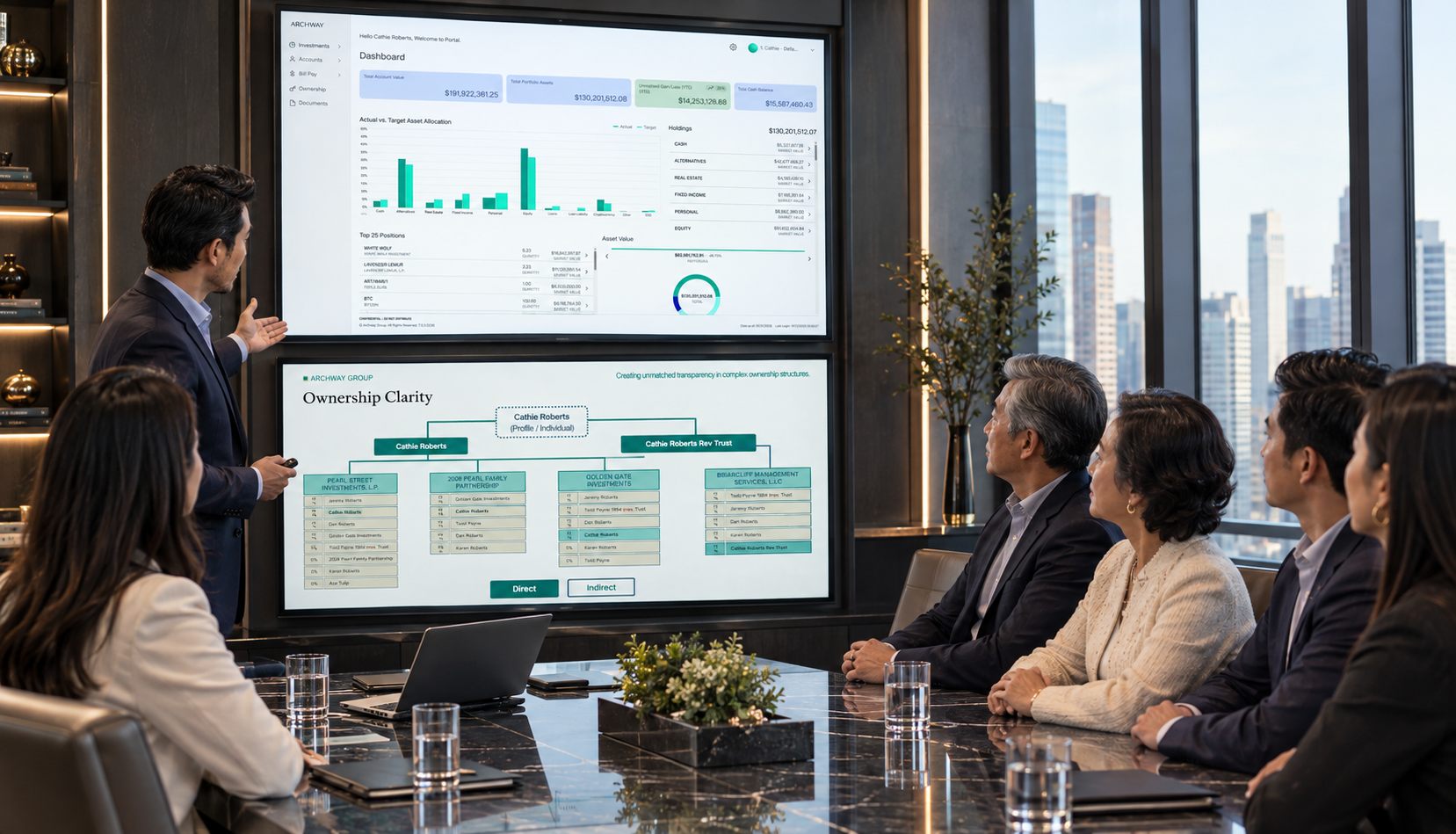
Ownership structures are layered and bespoke. A single investment may sit inside a holding LLC, which feeds a family partnership, which distributes to individual family members through trusts established at different times for different purposes. Each layer needs its own set of books. Getting consolidated reporting right means looking through every layer, eliminating intercompany balances so the same asset is not counted twice, and showing each beneficial owner their true economic exposure across the full structure. Most of these structures were built for estate planning or tax efficiency, not operational simplicity, and few follow a standard template.
We start with the governing documents which define preferred interests, profit interests held by family members, stuffing and other special allocations that split income, and gains differently across branches of the family. The accounting follows the governing documents precisely, and general-purpose platforms were not built for that level of complexity and layering.
Book to tax is an annual scramble. Most family offices run on a cash or accrual basis all year, then hand everything to an external tax advisor to convert to tax basis and prepare Form 1065s and K-1s. That process is only as good as the records underneath it. In a layered structure, one entity's K-1 feeds the next entity's return before that return can be completed, so the reconstruction starts from the bottom up, one layer at a time. In a structure with nested trusts, holding LLCs, and family partnerships, that can mean dozens of entities and weeks of professional time before a single K-1 is produced.
The increase in illiquid asset investments increases the long tail in valuations further complicating the matter. Private equity, real estate, hedge funds, direct investments: most do not price daily, and some have no formal valuation cadence at all. Without a policy for carrying values between valuation dates, the family office waits on every manager and appraiser before it can close the books. Many do exactly that. Consolidated reporting arrives 90 or more days after quarter end, well after it could have informed the decision it was meant to support.
Capital accounts require daily reconciliation. Every contribution, distribution, allocation, and transfer between entities, including in-kind transfers of real estate or private securities must be captured and posted accurately, or the account quickly stops reflecting reality. Left unaddressed, small discrepancies compound until reconciling them becomes a project rather than a routine.
Amid the myriad functions that are already stretching small finance teams, communication becomes its own layer of complexity. Why one branch of the family received a different allocation than another is not always self-evident, even when it is entirely correct under the partnership agreement. Those nuances are easily resolved through proactive communication, adding yet another step that needs to be thoughtfully managed by the same small team.
Where Most Family Offices Fall Short
The common failure is not a single mistake. It is an accumulation of workarounds that made sense at a time. A spreadsheet built to handle one partnership becomes the model for five. The one accountant who understands the allocation logic never writes it down. K-1 season is an annual scramble because partnership accounting and investment reporting live in two systems that were never built to agree.
Family offices are also investing more in formal governance: investment committees, valuation policies, approval matrices. J.P. Morgan's 2026 Global Family Office Report found that 48% of business-owning families have established formal governance bodies, compared with 40% of non-business-owning families. But governance defines control and accountability. Operations determine whether the controls are actually followed. Knowing where decisions are made means little if the numbers they need are being assembled by hand.
The result is not necessarily wrong numbers. It is a fragile operation: accuracy depends on specific people staying in their seats, reporting always runs a quarter behind, and the governing documents, investment reporting, and accounting records have quietly drifted apart in ways nobody has fully mapped. When a key person leaves, or the family's complexity outgrows the infrastructure supporting it, the cost of reconstruction is always higher than the cost of building it right would have been.
How Archway Can Help
Archway's platform maintains multi-entity ownership structures, parallel capital account bases, and allocation logic configured to the terms of each governing document. Investment reporting and partnership accounting run on the same general ledger, so the number in the report and the number in the books are the same number.
For family offices that also need accounting support, Archway’s Family Office Accounting team works as an extension of the family office’s own staff. The staffing challenges that make partnership accounting fragile in most family offices (attrition, coverage during leave, demand spikes at audit season and tax time) become Archway's to manage, not the family office's. The family gets consistent, high-quality accounting that does not depend on one person staying in their seat.


March 29, 2022
Article
·
Single Family Offices
·
time
-min
read
Family Office Technology Implementation
Technology Due Diligence
Family Office Trends
How Consultants Can Help Family Offices
Explains the administrative, technology, and operational roles family office consultants can play across strategy, implementation, and ongoing support.

Chelsea Francis
·
Head of Strategy
Explaining the Many Roles of Family Office Consultants
The role of family office consultants is far-reaching and the range and depth of the services they offer can vary significantly. From entity and organizational structuring to technology selections and operational support, consultants can wear quite a few hats throughout the lifecycle of a family office.
While Archway Family Office Services tends to interact with consultants most commonly during due diligence, selection, implementation and ongoing usage of the Archway PlatformSM, consultants can play a much larger role that expands well beyond family office software.
Broadly grouped into three primary areas of focus, here are a few examples of how family offices can work with consultants across their businesses.
Administrative Consulting
Largely focused on formative and strategic initiatives, family offices can partner with consultants to help with traditional administrative tasks such as:
- Family office creation
- Legal entity structuring
- Tax and estate planning
- Foundation and non-profit strategy
- Governance
- Next-gen and transition planning
Administrative consulting can also span to include niche consultancy like:
- Personal security and risk assessment
- Family education
- Legacy preservation
- Executive talent search
- Travel and household management
Administrative consulting can come in the form of a one-time project or as a recurring function as restructuring and intermittent evaluations are needed.
Technology Consulting
As a 20-year veteran in the family office software space, Archway Family Office Services has the most exposure in the technology-focused area of family office consulting. Over the years, we’ve worked with a number of consultants to help family offices on their technology journey.
Technology consulting projects can include:
- Technology needs and goals assessments
- Technology strategy planning
- Database infrastructure
- Family office technology selection
- Technology implementation project management
- Cybersecurity
- Client portal development and/or implementation
Though it’s common to associate technology consulting with the more familiar accounting and investment software solutions, it can also extend to the broader family office technology ecosystem, inclusive of hyper-targeted tools like digital family office communication apps, document managers, grant-making software, CRMs, dashboard-style portals and compliance platforms.
Consultants tend to have a large network of viable solutions that they are able to take to the table and recommend based on the unique needs of each family office. For this reason, technology consulting can be a very involved, but rewarding initiative for family offices.
Operational Consulting
This type of consulting lends itself more to ongoing service than one-off consulting efforts, but is nonetheless an important function of family office consultants.
Like administrative and technology consulting, operational consulting can include a variety of functions such as:
- Technology implementation project resourcing
- Software administration
- Accounting and investment data validation and reconciliation
- Monthly financial reporting
- Tax preparation
- Annual charitable gift planning
While not all consultants can perform the operational functions in-house, most are able to advise on a trusted service provider that will be a sound, long-term partner for the family office.
Archway Family Office Services has a long history of working with family office consultants across the globe. Schedule a call with a member of our team to learn more about our family office solutions and how we can work with your preferred consultant to support you from technology evaluation to ongoing usage of Archway's Platform.

February 28, 2022
Article
·
Single Family Offices
·
time
-min
read
Technology Due Diligence
Family Office Trends
20 Lessons Learned as a Family Office Solution Provider
Reflects on 20 years of family office solution delivery, covering technology specialization, reporting, implementation, scalability, outsourcing, and client community.

Archway Family Office Services
What 20 Years of Working with Family Offices Has Taught Archway Family Office Services
As the Archway PlatformSM celebrates its 20th year serving family offices, Archway Family Office Services is looking back on the lessons we’ve learned throughout two decades of client service interactions, thousands of product development hours and seemingly endless internal discussions.
Here is a list of 20 lessons we’ve learned since the Archway Platform got its launch in 2002:
- Family offices require purpose-built accounting and investment tools. Wrought with limitations around entity consolidation, complex transaction processing, investment data aggregation and end-client reporting, industry-agnostic software is simply not designed to handle the intricacies of ultra-high-net-worth (UHNW) wealth. As family offices have become increasingly sophisticated, so have our solutions, allowing our clients to handle their particular nuances like complex entity structures, multiple households, vast portfolios and diverse investments.
- …but there is no one-size-fits-all approach when it comes to family offices. Although it’s been said countless times before, each family office presents its own unique organizational structure, investment strategy and set of operational processes. Family office software should be flexible enough to adapt to each family office’s distinct needs.
- Financial reporting can only be as good as the underlying data. The only way to ensure reliable reporting is to input clean, accurate data into your system of record from the start. Period.
- We can all agree: Excel is not a long-term reporting solution. Spreadsheets permeate nearly every walk of life, but they are not sustainable when it comes to financial reporting for modern family offices. Whether the need arises out of a desire for greater automation, accuracy or security, family offices seek out applications that simplify and streamline complex reporting processes.
- Technology presents myriad opportunities to automate key family office operations. Family office technology, including the Archway Platform, has come a long way since the early 2000s. From accounting close processes and investor allocations to bill payment approvals and wealth reporting, workflows have been built to automate an incredible number of historically manual processes—and today’s family offices demand more automation than ever before.
- We know what we are—and what we aren’t. Archway Family Office Services delivers a comprehensive suite of accounting, investment data aggregation and reporting capabilities. We specialize in partnership, portfolio and corporate accounting alongside bill payment, investment management and multi-asset class data aggregation. We handle complex cash management, transfers and gifting and fee billing. We offer hundreds of financial statements, asset allocation overviews, performance analytics and holdings reports. But we know there’s more to a family office than what the Archway Platform can do, and we don’t strive to over-engineer our solution for a function it was never meant to perform.
- Best of breed and integrated family office software solutions have unique benefits. Fundamentally, the Archway Platform was built to replace multiple applications. But we also know there are a variety of reasons why a family office may continue to use ancillary systems for certain functions. To help family offices interconnect their ecosystem of technology and service providers, we’ve made a significant investment over the years to create integration points with a variety of third-party applications. We’ve learned to help family offices use the Archway Platform as a standalone family office solution, or as a hub of their broader technology ecosystem.
- Technology models should be tailored to the family office. Family offices need options when it comes to how they consume technology solutions. After all, not every family office is equipped—nor wants—to run an enterprise application. To that end, Archway Family Office Services has adapted how our clients are able to leverage the Archway Platform, allowing them to use the technology in-house, outsource the work to us or employ some combination of both in-house and outsourced resources to run the platform.
- Technology and service evaluations require structure. Selecting a technology or service provider is never a decision that should be made lightly. Over the years, we’ve completed countless use-cases, proofs-of-concepts, questionnaires and consultative discussions, making us keenly aware of the importance of those tasks in the decision-making process.
- Scalability is a leading consideration when making a wealthtech decision. A solution that can grow with a family office is far more viable in the long-term than a solution that meets singular needs right now. Throughout the years, we’ve implemented new tools that allow our clients to efficiently expand their usage of the Archway Platform—whether it’s the addition of entities, households, portfolios, assets, users or functionality.
- …and outsourced services can also serve as a mechanism to help family offices create efficiency. When capacity and bandwidth run short, family offices need a strategic partner that can serve as a seamless extension of their internal team. Whether it’s an unexpected short-term gap or a long-term strategic decision, Archway Family Office Services has built an offering that allows our team to work alongside our clients through tailorable partnership administration, personal expense management, portfolio reconciliation, consolidated reporting and family office outsourcing services.
- Technology plays a key role in business continuity—as underscored in 2020. Whether our clients were using the Archway Platform within their own four walls or working with our outsourced service teams, we found that they were well-equipped to handle the migration of their operations from in-person to remote work environments overnight. More notably, the shift reinforced the importance of a trusted, dependable technology provider that is prepared to evolve with you.
- A family office wealthtech strategy is more than functionality. Functionality should not be the sole set of criteria used to define a family office wealthtech strategy. Our experience has illuminated the value of a clearly defined, holistic strategy that takes into account the opinions of multiple stakeholders, technology and staffing infrastructure preferences and data availability.
- Change management is critical for a successful family office wealthtech implementation. Technology conversions require planning, resources and, most importantly, time. Ensuring that our family office clients are properly equipped to manage an implementation project is paramount to meeting deadlines and setting expectations.
- Clients are the greatest driver of product enhancements. The Archway Platform was born out of a need for a better fund accounting solution, but the evolving needs of our clients have shaped the platform into the award-winning family office solution it is today. Their requests, recommendations and feedback have paved our product roadmap throughout the years, and continue to do so today.
- Innovation is not a destination. Our desire to evolve and grow the Archway Platform has been omnipresent since we first entered the family office market in 2002. To this day, we continue to aggressively pursue strategic initiatives, introduce new functionality and evolve the way our clients interact with and consume our technology.
- Product training and education are evergreen. We cannot overstate the importance of our clients and how we interact with them. Over the years, we’ve grown our library of client service mediums to include comprehensive product documentation, self-service support tools, detailed how-to guides, client-specific instructional opportunities and user training conferences—all of which are designed to provide an optimal client experience.
- A strong family office network is priceless. The number of membership organizations, consultants and conference organizers geared towards family offices has soared, even in recent years. Creating a network of peers can be immensely helpful for family offices seeking recommendations, advice or new connections.
- …and our family office client community is one of our greatest successes. For 20 years, we have taken a customer-first approach to our client relationships—and it shows. The impact of our dedication to exceptional client service is evident in the engagement of our client community, their peer-to-peer interactions and our long-lasting relationships with our clients.
- Nothing compares to experience—or the relationships you build gaining it. Like most firms, we’ve felt our fair share of growing pains over the years. But with two decades of knowledge, lessons learned and success to tap into, Archway Family Office Services has developed a staying power few can afford. Our experience has taught us that nothing about family offices—or family office software—is standard, but we’ve built a reputation as a problem-solver, a frontier-leader and an esteemed strategic partner for hundreds of family offices and, in the process, we’ve reaffirmed time and time again that our connections with our clients are made to endure.
With 20 years behind us, and many more in front of us, we are excited for the next era of successes, lessons and innovations. To learn more about our experience working with family offices, schedule a call to connect with the Archway Family Office Services team.

February 16, 2022
Article
·
Single Family Offices
·
time
-min
read
Family Office Technology Implementation
Family Office Software
Data, People, and Process: Key Considerations for Family Offices Implementing a Wealthtech Solution
Breaks down how data readiness, people, and process planning affect family office technology implementation timelines and long-term adoption.

Chris Rose
·
Sales Director
How to Build a People-centric, Data-driven Implementation Process
At Archway Family Office Services, we often talk about the importance of data, people and process in overarching family office wealthtech strategies. But it bears repeating that this trio can—and should—be specifically applied to the implementation of family office technology solutions too.
Leveraging our extensive experience implementing the Archway Platform℠ for family offices and financial institutions serving ultra-high-net-worth families, Archway Family Office Services knows a thing or two about how the decisions related to these three core areas can impact your implementation timeline as well as the long-term viability of your chosen family office software solution.
To help your family office think through these inflection points, Archway Family Office Services has put together a short list of considerations associated with each theme: data, people and process.
Data. The foundation of your wealthtech solution.
Arguably one of the most challenging components of a wealthtech implementation project is collecting, validating and delivering data to your technology vendor. While tech shops can mitigate the impact of this step through automation, data feeds and intuitive data assembly tools, family offices can also take steps to help create a seamless conversion.
Here are a few data-focused considerations:
- Do you have a list of entities, accounts and ownership structures?
- Do you have a list of all custodial and bank accounts, including points-of-contact?
- Do you have a list of all managers for alternative investments?
- Do you know how to extract data out of legacy systems, including general ledgers, custodian portals and portfolio reporting platforms?
- Are you able to provide accurate, validated data to ensure a clean starting point in your new system?
- Do you have access to historical financial reports, including balance sheets, income statements, trial balances and custodial documents?
- Do you have records for all historical alternative investment cash flows?
- If migrating to a new accounting system, are you prepared to close out the last accounting period in your existing system?
- If migrating to a new reporting tool, is historical investment performance data readily available?
People. The engine that drives your success.
Implementing a new wealthtech solution takes equal parts skill, knowledge and resourcing. And while most people assume resourcing needs must be met internally, we’ve found that this isn’t always the case given the growing number of family office consultants that can offer capacity and expertise on an as-needed basis.
With that in mind, striking the right balance of internal and external resources is critical to ensuring that you have the right team in place to successfully complete the implementation project and perhaps, more importantly, operate the solution long-term.
Here are a few people-focused considerations:
- Who will be responsible for evaluating solutions?
- Will you engage a consultant during the technology selection?
- Who will be the ultimate decision-maker?
- Who will manage the implementation project?
- Who will support the collection, validation and delivery of data to your vendor?
- Who will oversee the successful completion of project milestones?
- Will you have a dedicated team to operate the technology post-conversion?
- Who will be responsible for communicating with the vendor, sharing product updates internally and training internal staff on how to use the solution?
- Will you outsource any components of your operations to your technology vendor or other third-party contractor?
Process. The nuances that define your operations.
If you have the data and you have the people, the final piece in the trifecta of implementation success is your process. Do you have a process defined that assembles the proper resources to collect, validate and deliver the data that is required to stand up to a new technology solution? While this may seem like overkill, keep in mind that in most cases, family office employees don’t simply abandon their day jobs during a technology implementation.
By planning a process ahead of time, and remaining flexible throughout the implementation project, you’ll be in a better position to set reasonable expectations that don’t over-burden your resources.
Here are a few process-focused considerations:
- What are the most important functions you need to perform in your new platform?
- Have you thought about how you would like to prioritize the adoption of these new functions?
- What reporting outputs do you hope to attain using your new platform?
- Have you communicated your goals to your preferred technology vendor?
- Have you worked with your internal stakeholders as well as your preferred technology vendor to set priorities and milestones?
- Have you begun change management discussions?
- Do you understand what data is required to reach project milestones?
- Is your anticipated milestone timeline achievable based on other, pre-existing responsibilities and priorities?
- How will you allocate resources to complete project milestones?
- Have you created a workflow for collecting, validating and delivering data to your preferred vendor?
- Who will sign off on the completion of project milestones?
- Have you established criteria to determine when you can effectively cut ties with your old systems and processes?
In our 20 years of implementing the Archway Platform, Archway Family Office Services has learned firsthand how impactful pre-work can be. We recognize that having data, people and processes aligned is the key to simplifying technology migrations.
By going through the exercises of organizing and preparing your data, planning resources and defining processes upfront, your family office will be better equipped to hit the ground running on your implementation project and successfully scale up your new solution.
Originally authored by Archway for publication on Family Office Exchange.

January 31, 2022
Article
·
Single Family Offices
·
time
-min
read
Family Office Technology Implementation
Family Office Software
Technology Due Diligence
Family Office Software Implementations: 5 Common Timeline Delays and How to Prevent Them
Identifies five common implementation timeline risks for family office software projects and outlines practical steps to reduce migration delays.

Michael Hansford
·
Director of Client Relations
Preparing Data, People and Processes before Implementing a Family Office Solution
As purveyors of financial technology and service for wealthy families, we at Archway Family Office Services are keenly aware of the important role data migration and setup plays in achieving long-term client success.
But the process of collecting, migrating, normalizing, testing and validating data is no simple task, especially when the number of data points soar.
Nonetheless, the Archway Family Office Services Implementation Consulting team has managed to deliver hundreds of successful implementations of our family office software solution, the Archway Platform℠.
If the proof is, as they say, in the pudding, our clients have certainly put our teams to the test.
Over the past two decades, we’ve implemented established, multi-generational families with hundreds of entities and complex ownership structures and first-generation wealth owners who are in the process of structuring their new family offices. We’ve implemented large financial institutions serving hundreds of high-net-worth families and wealth advisors in the early stages of rolling out their family office practices. We’ve even implemented hedge funds, private equity funds and fund of funds.
And while we can all agree that no two implementations are alike, there are certainly common threads that stretch between each of our onboarding projects.
Following these threads and using our collective experiences, we’ve identified five potential project snags to be aware of. And, more importantly, how you can prevent them from impacting your implementation timeline. After all, who wants to hear about a problem without a solution?
1. Incomplete or low quality data.
Clean, readily-available data is the single most important asset when it comes to keeping a project timeline on track. Setting a balance forward, entering performance history and producing reports all necessitate accurate data. To avoid the crunch of data collection, it’s important to establish a process for collecting data from legacy accounting systems, custodians and other relevant data sources—prior to selecting a new wealthtech solution.
Be prepared to supply lists of entities, accounts, ownership structures, designated signers or powers of attorney, account owners, relationship managers and points-of-contact at places like banks, custodians and funds. Lastly, we recommend taking time to proactively organize key financial reports like balance sheets and custodial statements as well as historical alternative asset cash flow detail.
2. Changing requirements and expectations.
Understanding requirements, setting expectations and establishing project milestones upfront creates structure and accountability for the duration of the process. But we also know that sometimes the scope of the project may change as other business projects take priority rank, entities are reorganized, new accounts are added or reporting requirements change. In these situations, we recommend communicating any new requirements as early as possible to avoid unnecessary rework and delays.
3. Delayed deliverables and milestone reviews.
If establishing project milestones is how you build a plan, then adhering to project milestones is how you measure progress against the plan. But anticipation and excitement of what’s waiting at the finish line can make it easy to overlook the necessary steps it takes to get there.
Compounded with the fact that most project participants on the client-side still have to perform their day-to-day tasks, it can be difficult to stay on top of the reviews and approvals that are required to move the project forward.
To keep checkpoints on track, ensure that your team has the proper allocation of time and resources to uphold milestone obligations and sign off on milestone achievements. Equally important is to ensure that your chosen vendor has—at a minimum—a set of guiding principles that will dictate your path forward.
As a firm believer in this approach, Archway Family Office Services leverages a repeatable, trusted implementation process that helps formalize deliverables and measure progress as data is collected, entered, tested and validated—all in pursuit of the client’s expected results.
4. Undefined roles and responsibilities.
Selecting a technology or service provider is a project in and of itself, but it is merely a precursor to the actual implementation of your chosen solution. Avoid the dissolution of project stakeholders by embedding their participation into your project plan.
Create clear outlines of who will be responsible for collecting which components of the data, who will review the data before it is shared with your vendor and who will perform the final validation check once it’s been entered into your new system.
Balance is also key when it comes to projects of this magnitude, so assigning a dedicated project manager and an underlying project team can help build momentum towards implementation success.
5. Lengthy data rebuilds.
Historical data is a hot topic when it comes to converting records from a legacy system to a modern application. It can also be quite nuanced depending on the type of historical data requested. For instance, five years of accounting activity versus five years of performance returns are very different requests. The easiest way to avoid project delays is to understand exactly how much and what type of history you desire before beginning your project.
While many things can delay your implementation project timeline, there are also many things that can keep you on track—or, in some cases, even expedite your progress:
- Define clear requirements and desired outcomes for the project, including expectations around historical data rebuilds
- Create lists of signers, powers-of-attorney, account owners, relationship managers and points-of-contact for banking and custodial relationships
- Create a plan for collecting data
- Review data for completeness and accuracy before delivering it to your vendor
- Encourage responsiveness and timeliness across your team
- Establish an organizational structure and assign roles and responsibilities once project deliverables and milestones have been defined
But perhaps our most salient advice is to choose a vendor with experience and expertise when it comes to converting data and implementing clients onto a new solution.
Schedule a call with a member of the Archway Family Office Services team to learn how successfully converting hundreds of family offices and financial institutions onto the Archway Platform has armed us with a wide range of best practices and practical advice to help our clients overcome the challenges of implementing a new wealthtech platform.

December 21, 2021
Article
·
Single Family Offices
·
time
-min
read
Technology Due Diligence
Client Service
Integrated Financial Tools
Family Office Trends
Five Ideas to Include on Your Family Office Solution Wish List
Outlines five non-functional factors family offices should consider when evaluating a long-term technology or service partner.
Chelsea Francis
·
Head of Strategy
Looking Beyond Functionality as You Evaluate Family Office Technology Providers
Around the holidays, lists of all kinds are plentiful. From gift ideas and holiday menus to New Year’s resolutions, it seems as though everyone is creating a list of some sort. And while these examples apply more to our personal lives than our professional careers, we can say nearly the same thing about businesses.
As we approach the end of this year and work through how we plan to execute our strategy in the coming year, nearly all of us are making our lists—and checking them twice.
For family offices and financial institutions that have set their sights on evaluating family office software and service solutions in the New Year, one of the most important lists they’ll make is their family office solution wish list.
More times than not, your list of family office solution requirements begins with the obvious: the features and functionality you hope to gain with a new solution.
But we also believe it’s important to weigh other—sometimes more intrinsic—benefits of your future long-term strategic partner.
Here are five additional ideas to add to your family office solution wish list:
1. An experienced family office solution provider that continues to innovate and grow
Whether you’re expanding your administration to include new households or family members, adjusting your investment strategy or adopting new allocation structures, your family office is constantly evolving. Your family office solution provider should too.
We recommend keeping innovation and growth near the top of your wish list to help you find a family office technology and service provider that has a clear strategic vision, a defined product roadmap and a track record of growing their family office community.
2. A trusted, reputable organization that understands the nuances of family offices and ultra-high-net-worth (UHNW) wealth
Family offices and advisors to UHNW individuals and families face a unique set of challenges when it comes to the accounting, investment data aggregation and reporting operations required to manage complex wealth. By checking this box on your wish list, you’ll feel more confident that your family office solution provider specializes in and understands these specific requirements and can offer flexible, purpose-built technology and outsourced services that simplify these complexities.
3. A reliable, time-tested client service approach
Client service is more than product support. This wish list item can help you discern which family office solution providers truly create a thoughtful and rich educational experience for their clients. Keep an eye out for things like user conferences, training events, comprehensive product documentation and self-service support portals, so that you and your team can extract the full value out of the solution.
4. A family office solution provider that offers flexible technology models
At Archway Family Office Services, the Archway Platform℠ was originally marketed and sold as software-as-a-service (SaaS), meaning family offices used the software in-house. But for some family offices, a technology strategy may not mean they have a desire to run a technology platform themselves. Instead, their wish list includes finding an outsourced service provider that can perform the work while offering a technology-driven reporting experience for their staff and their end-clients.
It can be incredibly beneficial to find a family office solution provider that can do both.
5. A wealthtech system that can integrate with your broader family office technology ecosystem
Technology is not a one-size-fits-all approach and where a single system may suffice for one family office, another family office may require multiple systems that integrate together to accomplish their goals. Adding this to your wish list will help you select a solution provider that can coexist in your family office ecosystem alongside other systems and tools in a seamless, interconnected fashion.
Whether you’re prepped to launch a technology evaluation or simply planning to evaluate your existing wealthtech strategy in the coming year, Archway Family Office Services has a breadth of experience, connections and insights to help you throughout the process.
Schedule a call with a member of our team to let us help you think through your technology strategy and discover how Archway Family Office Services can create a centralized hub for your accounting, investment and reporting operations.

November 23, 2021
Article
·
Single Family Offices
·
time
-min
read
Family Office Technology Implementation
Family Office Software
Technology Due Diligence
When Should Your Family Office Invest in Technology?
Frames technology investment timing across new, lean, established, and already-technical family offices, emphasizing fit, scalability, and operational readiness.
Chris Rose
·
Sales Director
How to Make the Case for Buying Family Office Software at Any Stage
Long regarded as being overly complex and costly, family office software is more affordable and accessible than ever. Yet, reservations around technology implementations still plague most family offices.
Over the course of hundreds of conferences, meetings and dinners, we have frequently heard family office professionals express a thematic concern when it comes to implementing a new wealthtech solution: timing.
What if we don’t have enough resources right now to handle the implementation project?
How many hours per week should I plan to set aside for implementation-related tasks?
How will I carve out time to collect the data for the new system while continuing to perform my day job in the old system?
How long will my implementation take?
But perhaps the most salient question around timing goes something like this: When is it the right time to implement wealth management technology in my family office?
Like many things, the answer isn’t nearly as straightforward as the question. And while there’s no magic timeframe during which implementing a technology solution is better or worse, there are benefits to purchasing a technology solution at various stages of your family office’s growth.
Here are a few strategic considerations to help you make the right decision for your firm, your staff and the family members you serve.
New Family Office
Whether the family recently experienced a liquidity event or a late generation beneficiary decided to branch off to form their own shop, the early days of a family office can present a great opportunity to invest in technology for the future.
Technology selections are almost always daunting, especially when you have a fresh set of entities, a new chart of accounts and an evolving investment strategy to manage. But a worthy technology partner will be able to offer your firm a right-sized offering to start that can seamlessly grow into your long-term, multi-generational solution as your strategy develops.
By implementing a technology solution that will carry you through the years and, more importantly, the generations, your financial data will already be in place as you add entities and family members to the mix. More importantly, your flagship staff will have experience using the software to manage accounting, investment and reporting processes so that they can propagate their knowledge of the technology to newly hired staff.
Family Office with Limited Staffing
Very few family offices have the luxury of a large headcount. In our experience, it’s not uncommon for family offices to operate with one, three or five core staff members, especially as the family office just getting started. With limited resources, it can be hard to justify a technology implementation that will consume even more of your team’s valuable time.
But a small staff shouldn’t deter you from investing in state-of-the-art financial technology.
In fact, it’s perfectly reasonable to own the technology while leveraging the vendor’s supplemental outsourced services to help operate the platform, or a subset of its tools. In these scenarios, you are the owner of both the technology and the relationship inside of one solution, which lets your team focus on strategic activities while enjoying the benefits of cutting-edge software for management and client reporting.
As your headcount grows, you can begin to absorb those outsourced functions into your daily operations. Since your data is already residing on your chosen wealthtech solution, you’ll be able to avoid the process of migrating historical data from the vendor’s application of choice into your preferred solution.
Established Family Office with Rudimentary Systems
You’ve used spreadsheets and QuickBooks files for as long as you can remember. Your data has become a mess and you wouldn’t know where to begin. You can’t imagine trying to source and implement a new family office accounting and investment software.
These are all very real, and very valid, concerns—and they are why so many family offices continue to use outdated technology. But relying on outdated, clunky or non-specialized systems within a family office breaks down efficiency and introduces a greater margin of error.
A modern technology solution presents a blank slate for you to clean up and organize your data so that you can improve the efficiency and speed of your processes and the quality of your reporting. So regardless of where you’re at on the technology spectrum, it’s important to recognize the value of investing in technology that can automate and simplify how you do your work today, for a better, exceedingly less painful, tomorrow.
Established Family Office with Existing Technology
Sometimes your technology doesn’t grow with you—or stops growing altogether—and you’re put in the position of having to find a technology partner that understands the importance of innovation and forward motion.
In other cases, sometimes things just don’t go to plan. Perhaps a less proven tech firm over-promised and under-delivered, or you got lost in the data and mismanaged deadlines. Whatever the reason, it’s important to remember that it’s never too late to start over with a better suited technology partner.
Although outgrowing or failing to get off the ground with a technology solution can be costly and frustrating, noting how it fell short, where things went wrong and how to avoid making the same mistakes again puts you in a better position for a successful technology implementation moving forward.
By building on your prior experience, you have a better grasp on what works for your organization and what hinders it. Using this knowledge, you can select a solution that provides the right combination of people, process and technology for your family office.
At Archway Family Office Services, we know that each family office faces its own challenges when it comes to selecting and implementing a technology solution. As a long-term strategic partner to family offices and high-net-worth advisory firms of all shapes, sizes and strategies, we’re prepared to understand where you’re at today, where you want to be in the future and how the Archway Platform℠ can help you get there.
Schedule a call with a member of our team to learn more about our technology and outsourced service solutions for family offices and financial institutions serving wealthy families.


